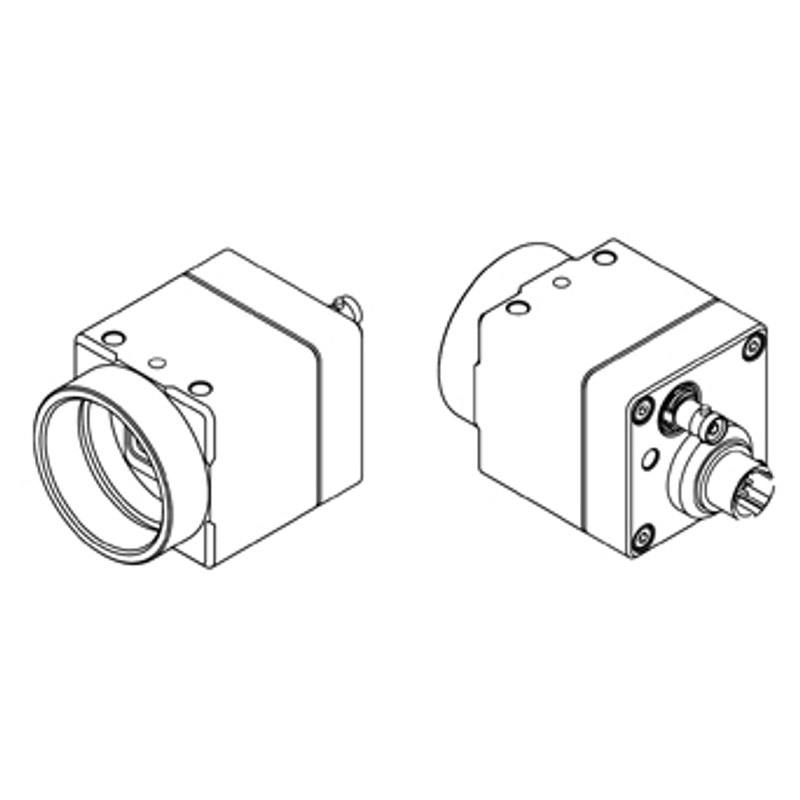
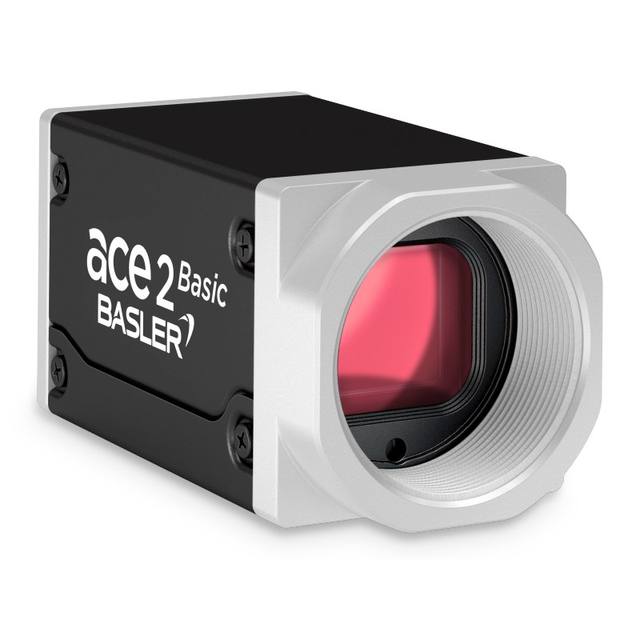
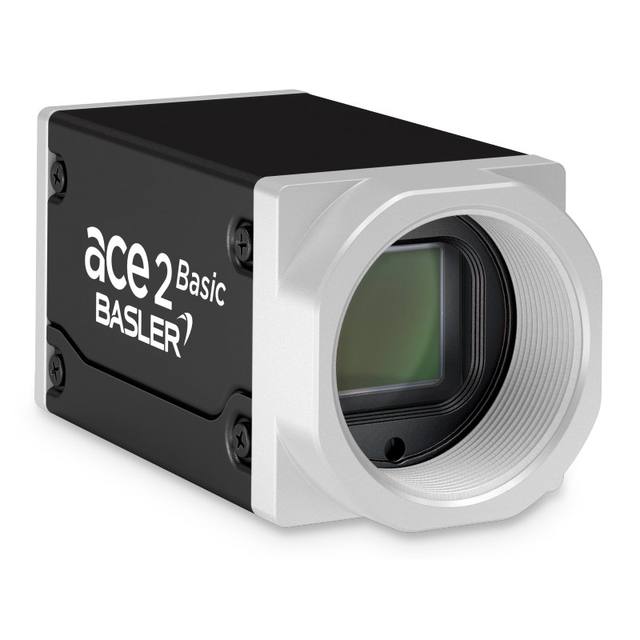
The STC-MBS203BCXP121 (mono) and STC-MCS203BCXP121 (color) use a Sony IMX541 1.1-inch global-shutter CMOS sensor delivering 20MP (4,504 x 4,504 px) at 2.74 um pixel pitch and up to 42.7 fps over a single-lane CoaXPress CXP-12 interface (CoaXPress Standard 2.0). The camera connects via a Micro-BNC (75 ohm) data link plus a Hirose HR10A-7R-6PB power/IO connector and is powered by PoCXP or external 18.5 to 26 Vdc, consuming 3.6 W or less. It is a compact C-mount camera (29 x 29 x 40 mm, approx. 54 g) supporting ROI scanning, x2 decimation, defective-pixel correction, FFC, and (color) auto/manual white balance with BayerRG or Mono 8/10/12 pixel formats.
The Omron Sentech STC-MBS/MCS203BCXP121 is a 20-megapixel area-scan camera built around the Sony IMX541, a 1.1-inch back-illuminated Pregius S global-shutter CMOS sensor. The 4,504 x 4,504 px square array at a 2.74 um pixel pitch gives you genuinely high spatial resolution in both axes, and the global shutter means every pixel is exposed simultaneously, so fast-moving parts and indexed conveyors image without the slant or smear a rolling shutter would introduce. For an installer this is the combination that matters: enough pixels to resolve fine defects, tight geometry for sub-pixel dimensional metrology, and a freeze-frame exposure that survives motion. It ships in two flavors that share the same body and electronics: the monochrome MBS for maximum sensitivity, contrast and metrology accuracy, and the color MCS with a BayerRG mosaic for jobs that depend on color cues such as print verification or material sorting.
The interface is single-lane CoaXPress CXP-12 (CoaXPress Standard 2.0) over a 75-ohm Micro-BNC connector, which is what lets the camera sustain 42.7 fps at the full 20MP over a single coax cable to the frame grabber. That bandwidth headroom is the reason to reach for CoaXPress here rather than GigE or USB3: pushing 20MP frames at over 40 fps is well beyond what those interfaces deliver, and a single coax keeps cabling simple while supporting long cable runs to the grabber. The link also carries Power over CoaXPress (PoCXP), so the same cable delivers data, control and power; alternatively you can supply external 18.5 to 26 Vdc through the Hirose HR10A-7R-6PB connector, which also breaks out the trigger and GPIO. Total draw is a modest 3.6 W or less. Control is standard GenICam, so the camera drops into any compliant CoaXPress grabber and vision library without proprietary glue.
Optically and mechanically it is a compact C-mount camera at 29 x 29 x 40 mm and roughly 54 g, which makes it easy to fit on gantries, robot end-effectors and tight inspection cells. Note that the 1.1-inch sensor and 4,504-pixel square format demand a lens with an image circle and resolving power matched to that format and the 2.74 um pixels, so plan your optics accordingly. On-camera features include freely positioned ROI scanning to trade field of view for higher frame rate, x2 decimation, defective-pixel correction and flat-field correction (FFC); the color MCS adds auto and manual white balance. Pixel formats are Mono 8/10/12 on the MBS and BayerRG 8/10/12 (plus Mono) on the MCS. Because the global shutter pairs cleanly with strobed illumination, plan to drive the trigger input from a lighting controller so the exposure window and the light pulse coincide, the standard recipe for crisp, repeatable high-resolution captures on moving lines. The camera is rated for operation from 0 to +40 degC, so verify the ambient in hotter enclosures.
Best for
High-resolution surface and defect inspection in electronics and semiconductor production, where the 20MP global-shutter sensor resolves fine flaws across a large field in a single frame
Dimensional measurement and metrology that needs tight, square 4,504 x 4,504 px geometry and motion-free global-shutter exposure for sub-pixel edge accuracy
OCR/OCV and print inspection, with the color MCS variant reading color-coded marks and labels and the mono MBS maximizing character contrast
Packaging inspection on fast indexed or continuous lines, where 42.7 fps at full resolution over CoaXPress keeps up with throughput
Gantry and robot-mounted setups that benefit from a single 75-ohm coax carrying data, control and PoCXP power in a compact 54 g body
Selection notes
Plan the imaging chain around CoaXPress: you need a single-lane CXP-12 (CoaXPress 2.0) frame grabber and a 75-ohm Micro-BNC coax cable rated for the run length; this is not a plug-and-play GigE/USB camera, but it delivers bandwidth those interfaces cannot.
Choose the variant deliberately: the monochrome MBS gives best sensitivity, contrast and metrology accuracy, while the color MCS (BayerRG) is for tasks that genuinely need color, at some cost in low-light sensitivity and effective resolution.
Match the lens to the format: the 1.1-inch sensor with 2.74 um pixels and a 4,504-pixel square frame requires a high-resolution C-mount lens with an adequate image circle, otherwise corner sharpness and true resolving power will be the limiting factor, not the sensor.
Budget power and connectors: drive it via PoCXP over the coax for single-cable simplicity, or feed external 18.5 to 26 Vdc through the Hirose HR10A-7R-6PB connector, which also carries the trigger and GPIO; total draw is only 3.6 W or less.
For moving targets, pair the global shutter with a triggered strobe: route the lighting controller to the camera trigger input so exposure and light pulse coincide, and use ROI scanning or x2 decimation to raise frame rate when you do not need the full 20MP field. Note the 0 to +40 degC operating range when siting the camera in warm cells.
Specifications: General
Brand
Omron / Sentech
Camera type
Area scan
Specifications: Sensor
Resolution
20 MP
Horizontal resolution
4,504 x 4,504 px
Mono / color
Mono (MBS) and Color (MCS) variants
Sensor manufacturer
Sony (Pregius S, back-illuminated global shutter)
Sensor model
Sony IMX541
Shutter
Global shutter
Sensor size
1.1-inch optical format
Pixel size
2.74 x 2.74 um
Specifications: Performance
FPS
42.7 fps (full resolution)
Specifications: Interface
Interface
CoaXPress CXP-12 (1 lane, CoaXPress Standard 2.0)
Protocols
GenICam / CoaXPress Standard 2.0
Specifications: Optics
Mount
C-mount
Specifications: Electrical
Power
pocxp (PoCXP / Power over CoaXPress, or external +18.5 to +26 Vdc)
Power consumption
3.6 W
Specifications: Environment
Operating temperature
0 to +40 degC
Specifications: Mechanical
Dimensions
29 (W) x 29 (H) x 40 (D) mm
Weight
54 g
Applications this camera is commonly selected for. Open one to see the full recommended hardware and approach.
Matched automatically by: lens mount fits the camera mount · lens image circle covers the camera sensor — this camera: C-mount · 1.1-inch optical format sensor.
By category
All 67C-mount lenses 43Telecentric lenses 24
By brand
All 67Basler 34iRAYPLE 23Omron / Sentech 8Datalogic / Datasensing 2
These steps take an Omron Sentech (STC) camera from the box to a stable first image and on to your own application. They apply across the GigE Vision, USB3 Vision and CoaXPress STC families; the interface only changes how you cable and power the camera.
Download and install the Sentech SDK on the host PC. The package provides StViewer, the viewing and configuration software you use to bring the camera up, and StApi, the programming SDK you integrate later. Because the cameras are GenICam/GenTL-compliant, StApi also registers a GenTL producer, so any GenICam-compliant third-party vision software can discover and drive the camera as an alternative front end.
2. Cable, power and connect the camera
Connect according to the interface. GigE Vision: link to a Gigabit NIC (use PoE or the separate power input) and put the camera and host on the same subnet; for USB3 Vision use a USB 3.x port and a certified cable; for CoaXPress (STC) connect to a CoaXPress frame grabber, which also supplies Power-over-Coax. Then open StViewer and let it enumerate the camera. If a GigE camera does not appear, check the IP configuration and firewall, and on USB3 confirm the host bandwidth and driver.
3. Configure exposure, gain and white balance
Open the device in StViewer and start a live stream. Set exposure and gain for a well-exposed, low-noise image: raise exposure first and only add gain when more light or a faster shutter is not an option, keeping exposure short enough to freeze motion on global-shutter models. On colour cameras, run white balance under your actual production lighting. Adjust the lens aperture and focus on a representative target before tuning anything else.
4. Set the trigger and grab a first image
Start in free-run (continuous) acquisition to confirm a clean, stable image. For inline inspection switch to hardware or software triggering: select the trigger source, set the active edge and any delay, and wire the strobe or illumination to the camera's I/O so lighting fires with each exposure. Acquire and save a frame in StViewer; this saved image is your reference for the SDK stage and for downstream inspection.
5. Move to the StApi SDK (or any GenICam software)
Once the image is stable, reproduce the same settings in code. Use StApi to open the device, apply the GenICam features you validated in StViewer (exposure, gain, trigger, pixel format) and grab frames into your application via the bundled C++, C, C#/.NET or Python interfaces; the included samples are the fastest starting point. Prefer a different stack? The same GenICam/GenTL camera works with third-party vision libraries. With a reliable feed, you can route it into a deep-learning inspection such as Rosepetal for AI-based defect detection.
Frequently asked questions
The camera delivers 20 megapixels (4,504 x 4,504 px) on a Sony IMX541 1.1-inch global-shutter sensor and runs at up to 42.7 fps at full resolution over its single-lane CoaXPress CXP-12 link. Using ROI scanning or x2 decimation lets you trade field of view for a higher frame rate.
Both are available from the same model family. The STC-MBS203BCXP121 is monochrome (Mono 8/10/12) for maximum sensitivity, contrast and metrology accuracy, and the STC-MCS203BCXP121 is color with a BayerRG mosaic (BayerRG 8/10/12, plus Mono) and auto/manual white balance.
It uses CoaXPress CXP-12 (1 lane, CoaXPress Standard 2.0) over a 75-ohm Micro-BNC connector to a compatible CoaXPress frame grabber. This single coax carries high-bandwidth data and control over long cable runs, which is why it suits 20MP-at-42.7fps imaging better than GigE or USB3.
It supports Power over CoaXPress (PoCXP), so the data coax also delivers power, or you can supply external 18.5 to 26 Vdc through the Hirose HR10A-7R-6PB connector. Power consumption is 3.6 W or less.
It is a compact C-mount camera (29 x 29 x 40 mm, about 54 g). Trigger and GPIO are provided on the Hirose HR10A-7R-6PB connector, so you can synchronize exposure to an external trigger or a strobed lighting controller; the global shutter makes this strobe pairing the recommended approach for moving parts.