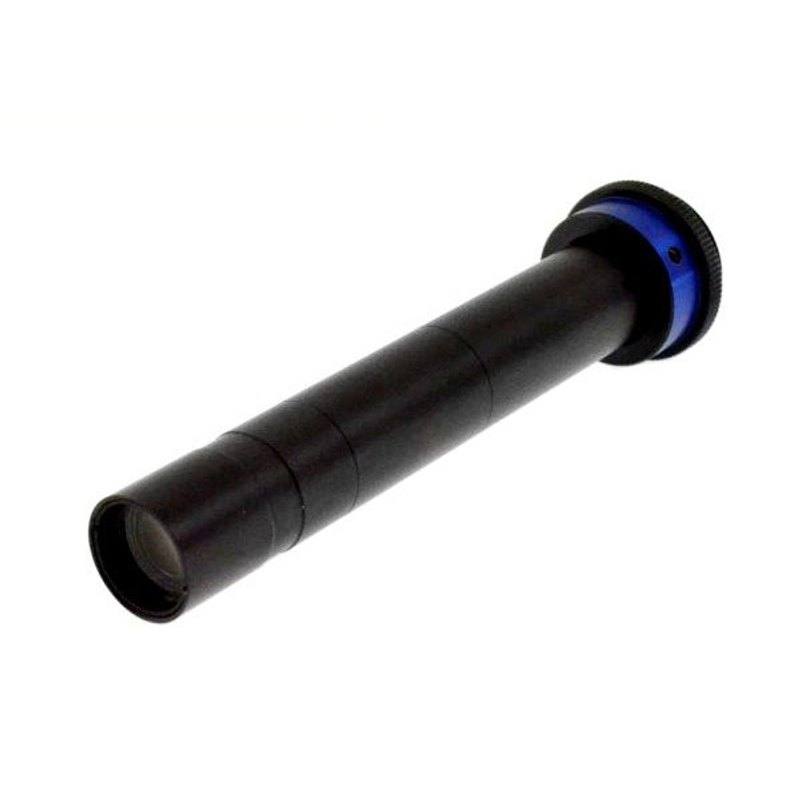
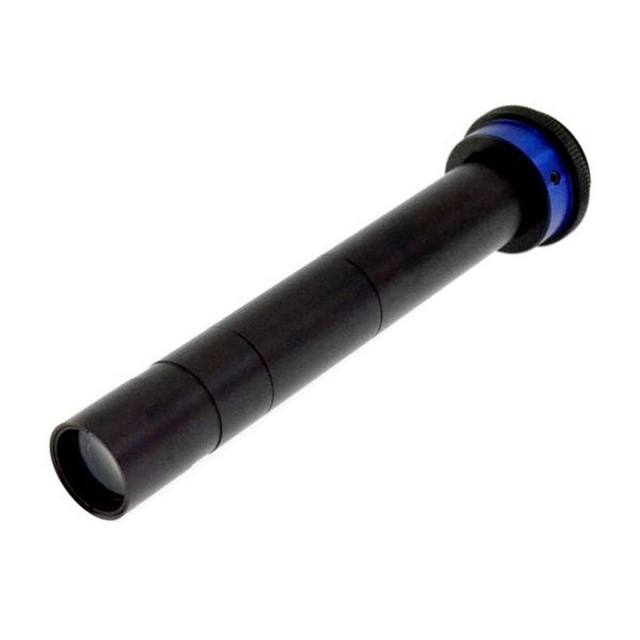
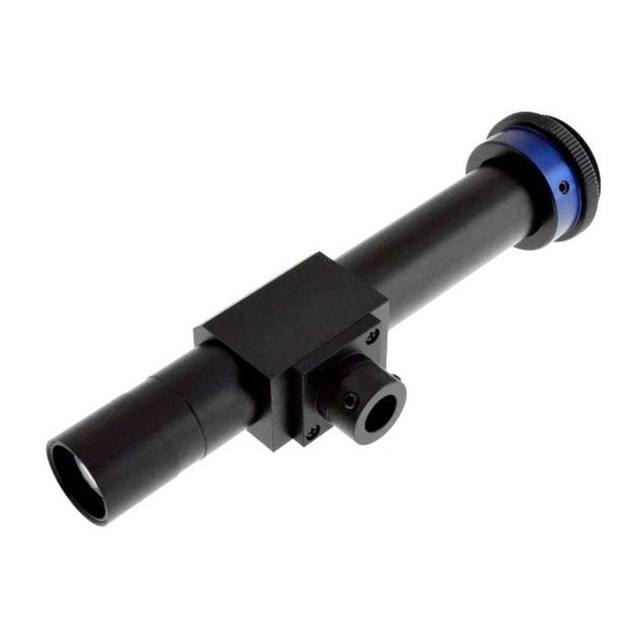
The Opto Engineering RT-HR-1M-71 is a 1.000× telecentric lens with a 71.0 mm working distance, a C-mount and a working f-number of wF/# 15.6. It is listed in the TCHM series of high magnification telecentric lenses for sensors up to 2/3″, with an Ø 11.0 mm image circle.
Telecentric imaging is the main reason to choose this lens for measurement. The chief rays are parallel to the optical axis, so magnification stays essentially constant when the object moves slightly toward or away from the lens, and a part that shifts in depth is not measured at a different size. At 1.000× the sensor views the object at actual size, so a feature that fits within the 2/3″ field can be checked one-to-one after calibration. The wF/# 15.6 governs the depth of field and the light reaching the sensor, which should be balanced against the exposure.
The 71.0 mm working distance suits compact cells where the lens sits close to the part and space remains for a separate light. Lighting is a separate design decision for this lens: a backlight suits silhouette measurement, while a directional light suits surface and edge features. The C-mount flange connects to a camera whose sensor is 2/3″ or smaller.
Best for
Dimensional gauging of small parts at 1.000× within a 2/3″ field
Compact inspection cells where the lens sits close to the part at 71.0 mm
Silhouette and edge gauging with a separate backlight
Feature location and alignment checks where constant magnification matters
Measurement of components that shift slightly in depth during handling
Selection notes
Pair with a C-mount camera whose sensor is 2/3″ or smaller to stay within the Ø 11.0 mm image circle.
Place the part at the 71.0 mm working distance so the telecentric measurement is referenced to the designed distance and stays in focus.
Choose the light for the feature being measured, since lighting is a separate choice for this lens.
Balance exposure and lighting with wF/# 15.6 in mind, because depth of field and light throughput are linked at this working f-number.
Specifications: General
Brand
Opto Engineering
Specifications: Optical
Lens mount
C-mount
Image circle / max sensor
Ø 11.0 mm (max sensor 2/3″)
Magnification
1.000×
Working distance
71.0 mm
Telecentric
Yes
Applications this product is commonly selected for. Open one to see the full recommended hardware and approach.
Matched automatically by: camera mount fits the lens mount · camera sensor is covered by the lens image circle — this lens: C-mount · Ø 11.0 mm (max sensor 2/3″) image circle.