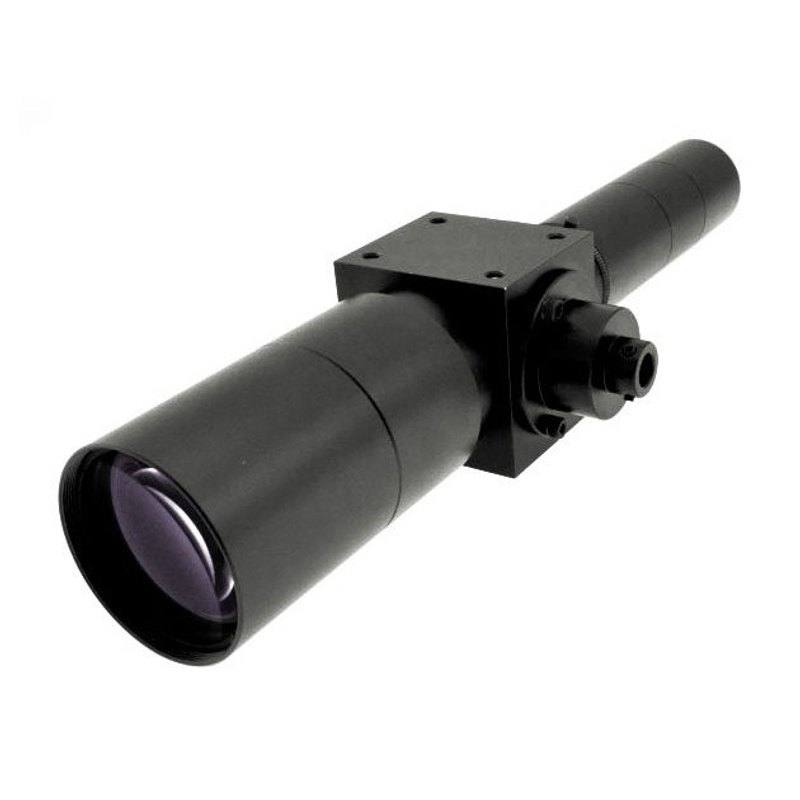
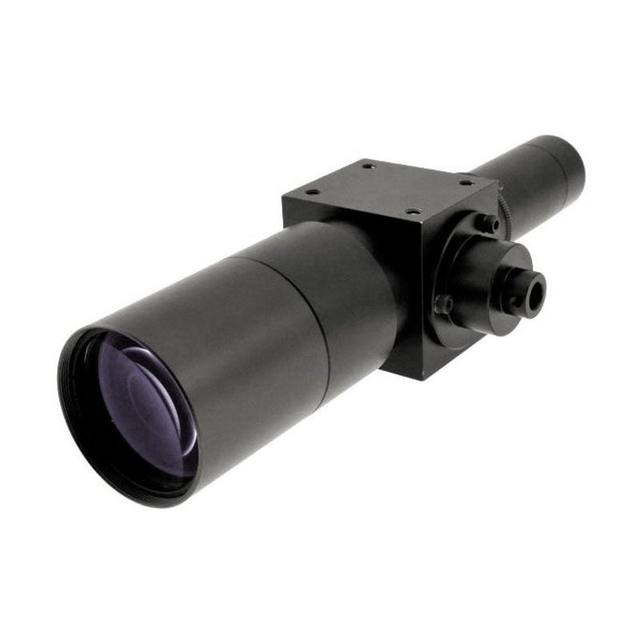
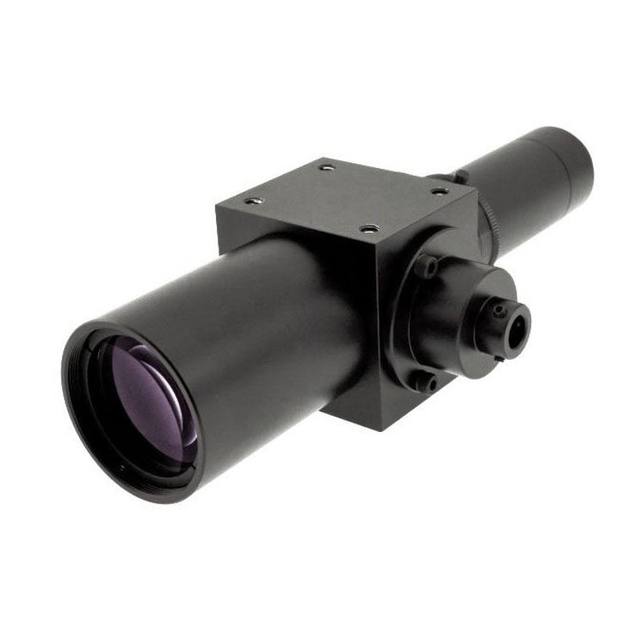
The RT-TCL0300-FU is a telecentric lens with 0.300× magnification, so the sensor records objects at 0.300 times their true size. Its Ø 16.0 mm image circle is rated for a maximum sensor of 1″, and it mounts by C-mount. It belongs to the TCCX2M series, described as coaxial telecentric lenses for sensors up to 1″, so design the camera around 1″.
The 167.0 mm working distance provides room for fixtures, part handling and mechanical clearance in front of the lens. Telecentric imaging keeps magnification nearly constant across a small change in object distance, so measurements stay close to the same scale when parts vary slightly in height. The working f-number range of wF/# 12-60 gives a broad span for setting depth of field: lower values admit more light for a shallower focus, while higher values deepen focus at the cost of brightness.
The built-in coaxial port is the feature to plan around for lighting. It gives coaxial illumination a path along the optical axis, which suits flat, reflective surfaces where light must return into the lens. Choose a camera whose sensor fits the Ø 16.0 mm image circle; a sensor larger than 1″ would not be fully covered by the image circle. The coaxial light arrangement shapes the inspection head, so settle it early in the design.
Best for
Measurement of parts on flat planes with a 1″ sensor and telecentric imaging at 0.300×.
Inspection of flat, reflective surfaces using coaxial lighting routed through the built-in coaxial port.
Applications that need a 167.0 mm working distance for fixtures or part handling.
Inspections that call for deeper focus, using the higher end of the wF/# 12-60 range.
Selection notes
Use a sensor of 1″ or smaller so it stays within the Ø 16.0 mm image circle.
Set the working f-number within wF/# 12-60 to balance light intensity against depth of field.
Plan the 167.0 mm working distance into the mechanical layout from the outset.
Validate the coaxial lighting arrangement on representative parts before ordering.
Specifications: General
Brand
Opto Engineering
Specifications: Optical
Lens mount
C-mount
Image circle / max sensor
Ø 16.0 mm (max sensor 1″)
Magnification
0.300×
Working distance
167.0 mm
Telecentric
Yes
Applications this product is commonly selected for. Open one to see the full recommended hardware and approach.
Matched automatically by: camera mount fits the lens mount · camera sensor is covered by the lens image circle — this lens: C-mount · Ø 16.0 mm (max sensor 1″) image circle.