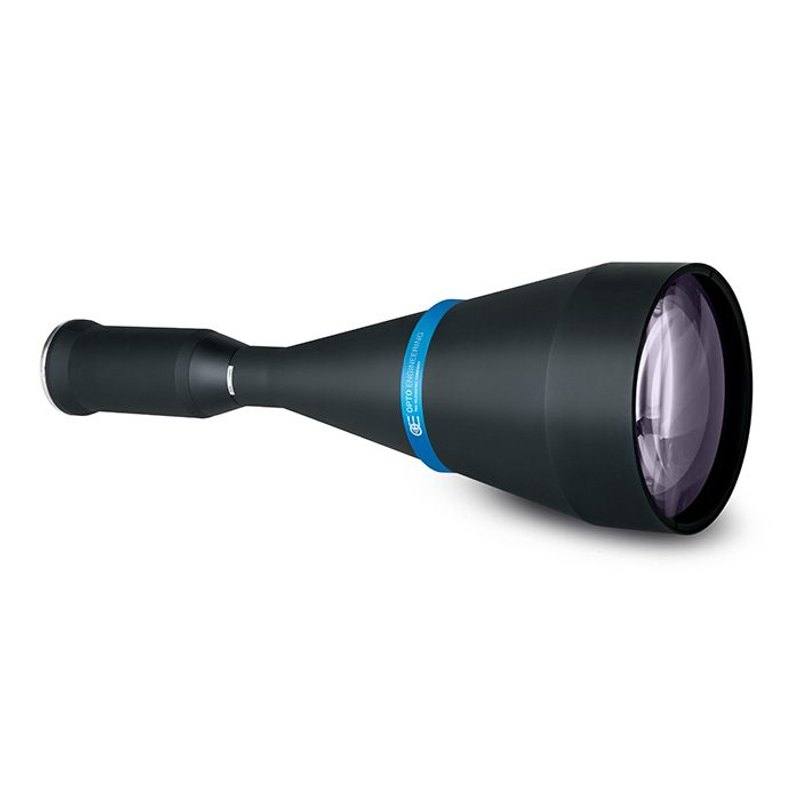
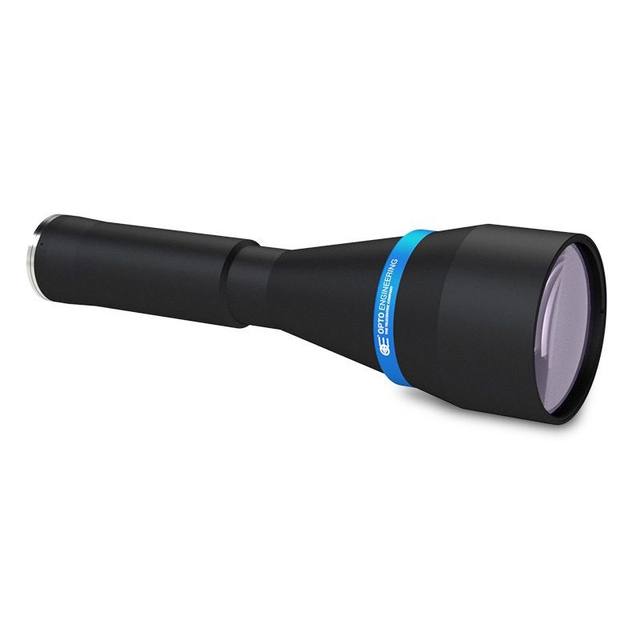
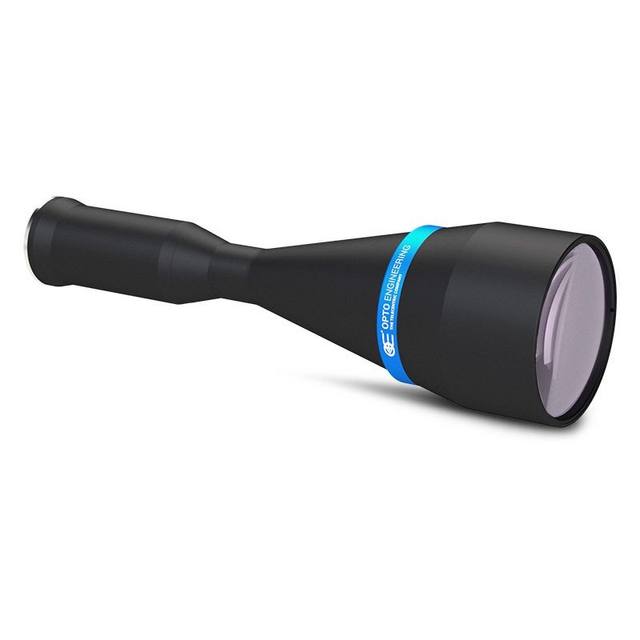
The Opto Engineering TC16M096 is a telecentric lens with 0.380× magnification and a 262.3 mm working distance, which places the object well away from the front of the lens. It has a Ø 43.3 mm image circle, listed for 35 mm Full Frame sensors (max sensor 35 mm Full Frame), and uses an F-mount. At 0.380× the object is imaged at a reduced scale, so each sensor covers a wide area of the part and the field of view is large for a given sensor size.
Telecentricity is listed below 0.06 deg typical and 0.08 deg maximum, so the chief rays run close to parallel to the optical axis and the image scale changes only slightly across the depth of focus. Distortion is listed below 0.07% typical and 0.15% maximum. The wF/# 16 working f-number supports a larger depth of field, but less light reaches the sensor, so the illumination should be sufficient for the exposure.
The TC16M series is described for sensors up to 43.3 mm and 8k line scan cameras. Check that your camera has the F-mount and that the sensor stays inside the image circle, and set out the 262.3 mm working distance in the mechanical layout.
Best for
Wide-area inspection where 0.380× magnification gives a large field of view
Inspection layouts with a 262.3 mm working distance between lens and object
Gauging tasks where telecentric imaging limits perspective error
Camera systems with sensors up to 35 mm Full Frame and an F-mount
Line scan imaging with 8k line scan cameras, the camera type the TC16M series is described for
Selection notes
Confirm the F-mount on the camera side before ordering.
Keep the sensor within the Ø 43.3 mm image circle, which is listed for sensors up to 35 mm Full Frame.
Lay out the fixture around the 262.3 mm working distance.
Calculate the field of view from the 0.380× magnification and your sensor size, and plan illumination for the wF/# 16 aperture.
Specifications: General
Brand
Opto Engineering
Specifications: Optical
Lens mount
F-mount
Image circle / max sensor
Ø 43.3 mm (max sensor 35 mm Full Frame)
Magnification
0.380×
Working distance
262.3 mm
Telecentric
Yes
Applications this product is commonly selected for. Open one to see the full recommended hardware and approach.
Matched automatically by: camera mount fits the lens mount · camera sensor is covered by the lens image circle — this lens: F-mount · Ø 43.3 mm (max sensor 35 mm Full Frame) image circle.