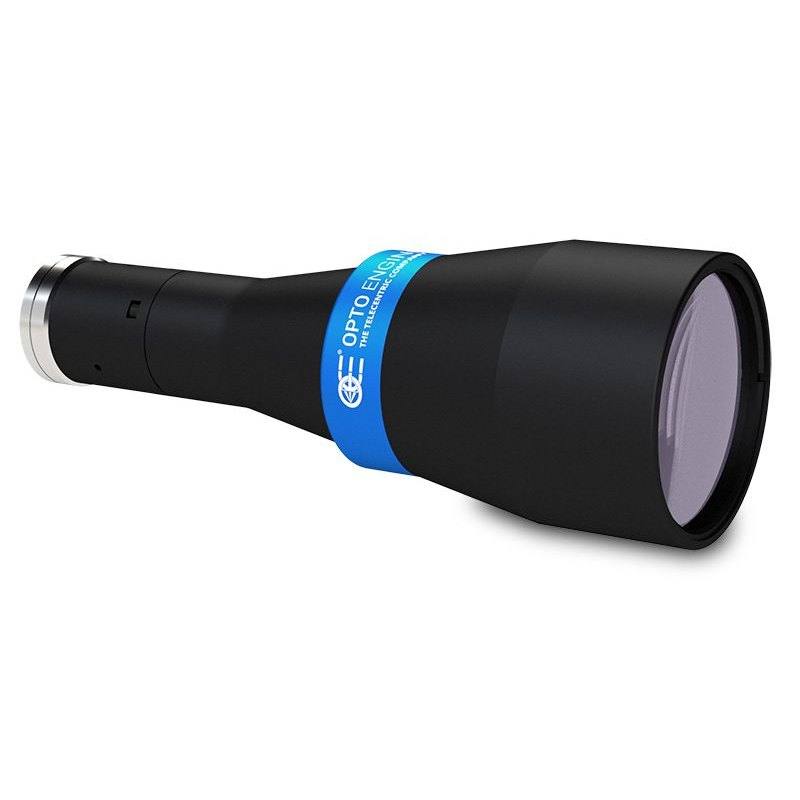
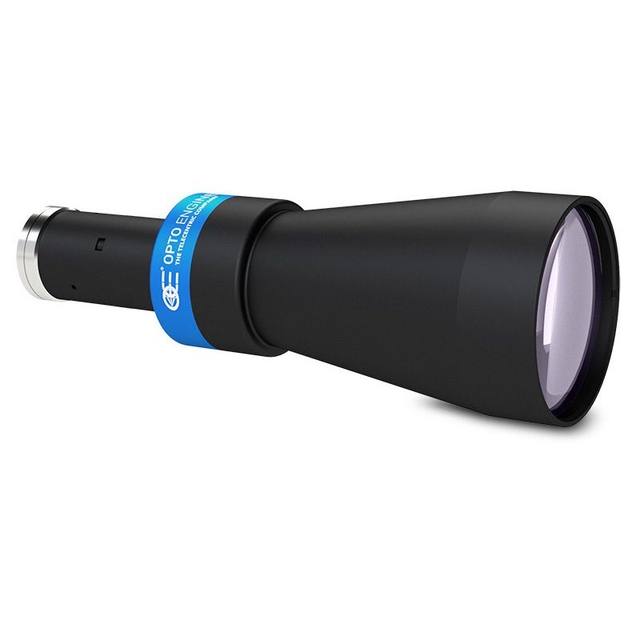
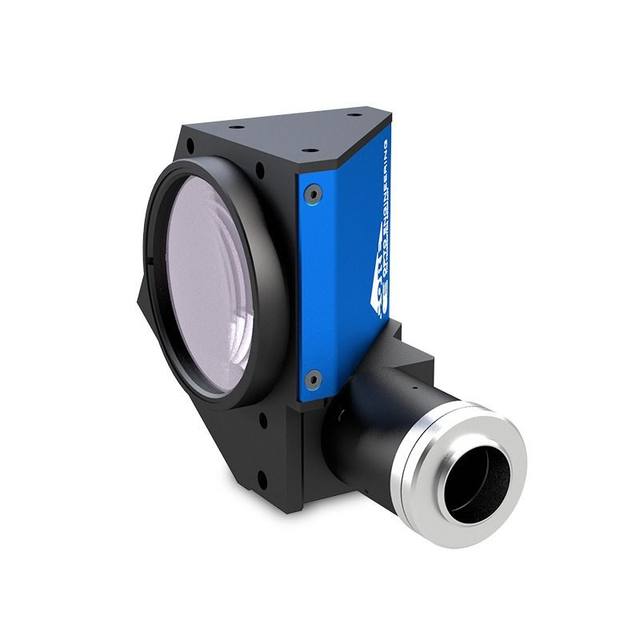
The Opto Engineering TC1MHR048-C is a high resolution telecentric lens for 1/1.2″ sensors. It delivers 0.222× magnification over an image circle of Ø 13.3 mm (max sensor 1/1.2″). This magnification gives a broad view of the object on a 1/1.2″ sensor, which suits wider areas of a part.
The lens is rated at telecentricity <0.08° typical with a 0.10° maximum, and distortion <0.08% typical with a 0.10% maximum. Telecentric design holds the chief rays close to parallel with the optical axis, so an object that moves within the depth of field keeps nearly the same apparent size. That supports measurement of overall dimensions, positions and outlines, where the sensor must map the part geometry accurately across the image.
At a 132.9 mm working distance the lens sits well back from the object, leaving room for lighting, guards and fixtures. The working f-number (wF/#) of 8 admits more light than higher f-numbers, which can shorten exposure, but the depth of field is shallower, so the object should be kept within a tight height band. The C-mount attaches to C-mount camera bodies.
Best for
Dimensional measurement of overall part outlines and positions on 1/1.2″ sensors.
Inspection stations that need 132.9 mm of clearance between the lens and the part.
Moving-part inspection where the light gathered at wF/# 8 helps keep exposures short.
C-mount camera builds where telecentric geometry must hold across the field.
Selection notes
Keep the sensor within 1/1.2″ so it fits the Ø 13.3 mm image circle.
Hold the object at the 132.9 mm working distance for the stated 0.222× magnification.
Keep part height variation within the depth of field set by wF/# 8, which is shallower than at higher f-numbers.
Budget tolerances against the maximum telecentricity (0.10°) and distortion (0.10%).
Align the lens square to the object plane and confirm the mechanical layout for the 132.9 mm working distance.
Specifications: General
Brand
Opto Engineering
Specifications: Optical
Lens mount
C-mount
Image circle / max sensor
Ø 13.3 mm (max sensor 1/1.2″)
Magnification
0.222×
Working distance
132.9 mm
Telecentric
Yes
Applications this product is commonly selected for. Open one to see the full recommended hardware and approach.
Matched automatically by: camera mount fits the lens mount · camera sensor is covered by the lens image circle — this lens: C-mount · Ø 13.3 mm (max sensor 1/1.2″) image circle.