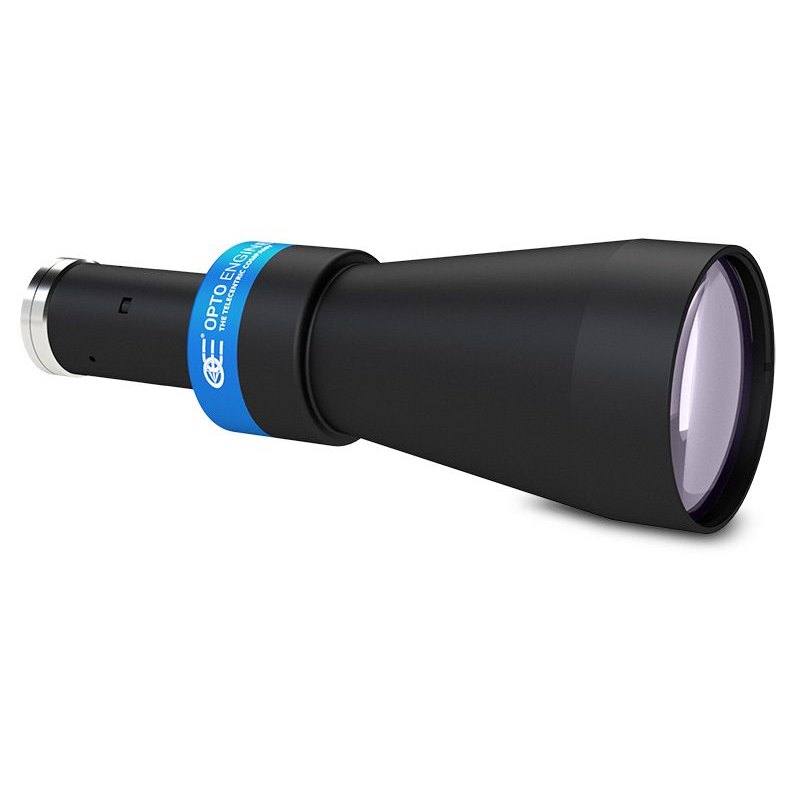
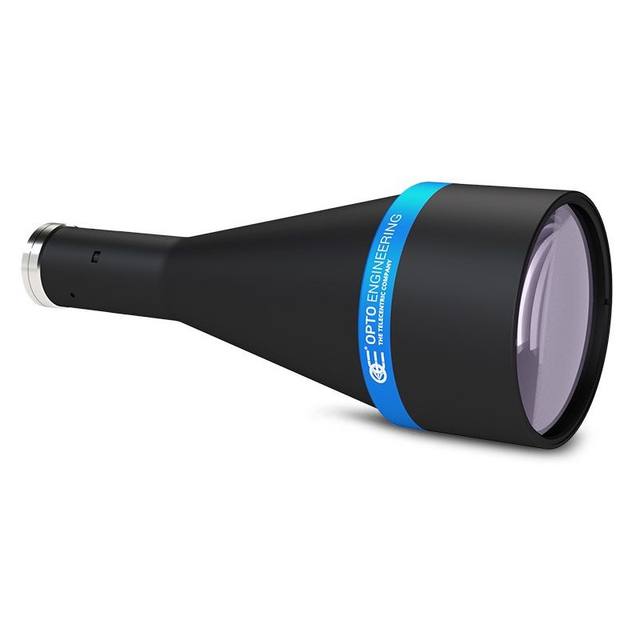
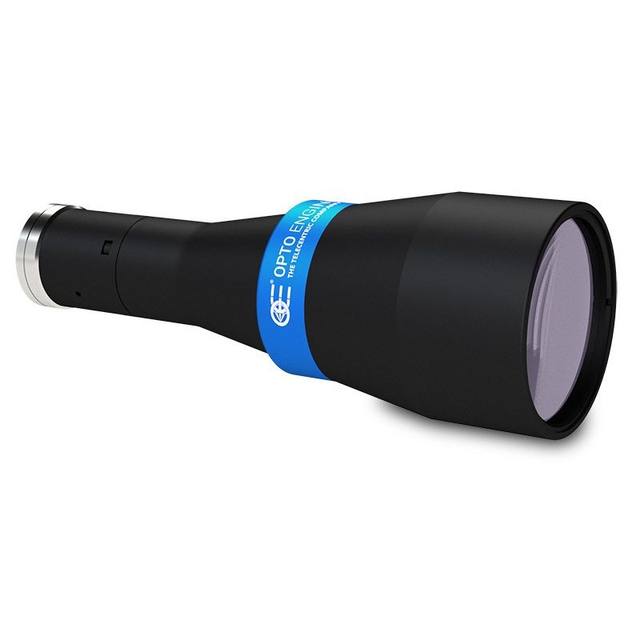
The Opto Engineering TC1MHR056-C is a high resolution telecentric lens for 1/1.2″ sensors, with 0.190× magnification and an image circle of Ø 13.3 mm (max sensor 1/1.2″). At 0.190× the field is wide relative to the sensor, so the lens captures a large area of the part in each frame. The trade-off is that each feature is imaged at a smaller scale, so the sensor's pixel size and count should be checked against the smallest detail that must be resolved.
Telecentricity is <0.08° typical with a 0.10° maximum, and distortion is <0.08% typical with a 0.10% maximum. The telecentric geometry keeps magnification steady as the object moves within the depth of field, so overall length, width and hole-position measurements stay consistent across the field. The lens is specified for a 157.8 mm working distance.
At 157.8 mm the lens sits well back from the object, leaving space for lighting, guards and any part-handling hardware. The working f-number (wF/#) of 8 admits relatively more light, which helps short exposures, but the depth of field is shallower and focus must hold across the part's height range. The C-mount connects to C-mount camera bodies.
Best for
Wide-area gauging of parts on a 1/1.2″ sensor, such as overall length and width checks.
Inspection stations with 157.8 mm clearance between the lens and the object for lighting and fixtures.
Hole-position and feature-presence checks where telecentric imaging limits perspective error.
C-mount camera systems that use 1/1.2″ sensor formats.
Selection notes
Keep the sensor no larger than 1/1.2″, since the image circle is Ø 13.3 mm.
Confirm that the pixel size and count of the chosen sensor can resolve the smallest feature, because 0.190× images each feature at a small scale.
Set the object plane at 157.8 mm, the working distance at which the stated magnification applies.
Plan lighting and exposure for wF/# 8 and keep part height within the shallow depth of field.
Use the maximum figures (0.10° telecentricity and 0.10% distortion) in tolerance budgets.
Specifications: General
Brand
Opto Engineering
Specifications: Optical
Lens mount
C-mount
Image circle / max sensor
Ø 13.3 mm (max sensor 1/1.2″)
Magnification
0.190×
Working distance
157.8 mm
Telecentric
Yes
Applications this product is commonly selected for. Open one to see the full recommended hardware and approach.
Matched automatically by: camera mount fits the lens mount · camera sensor is covered by the lens image circle — this lens: C-mount · Ø 13.3 mm (max sensor 1/1.2″) image circle.