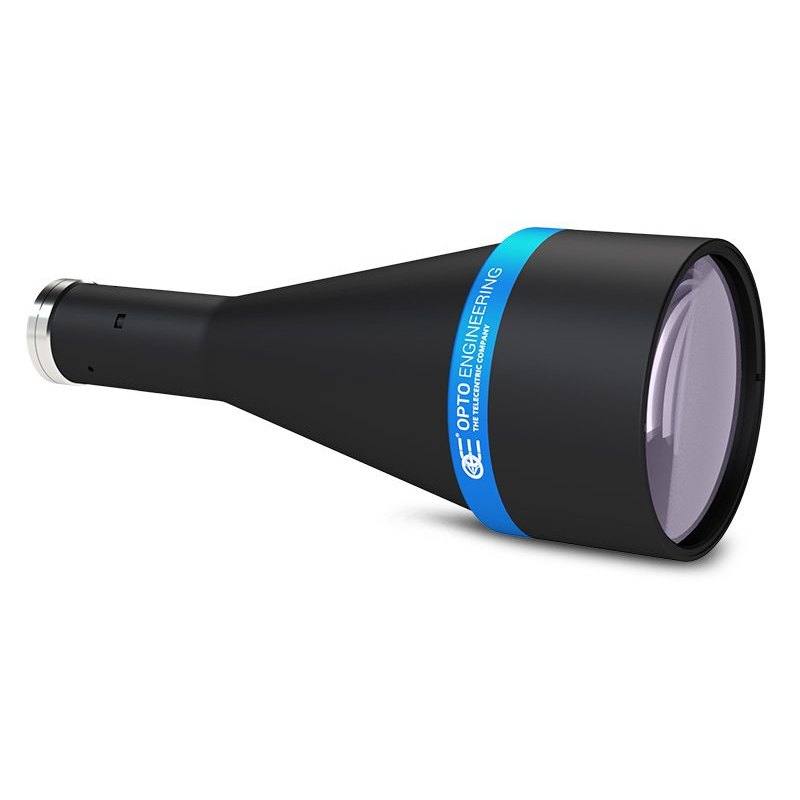
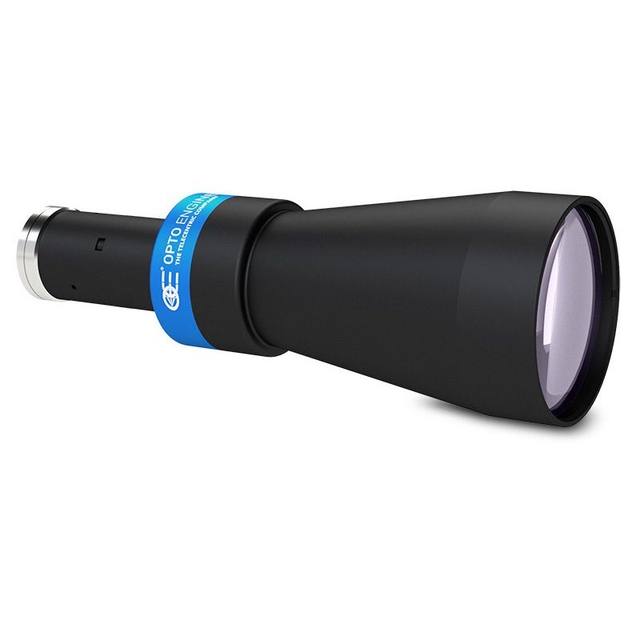
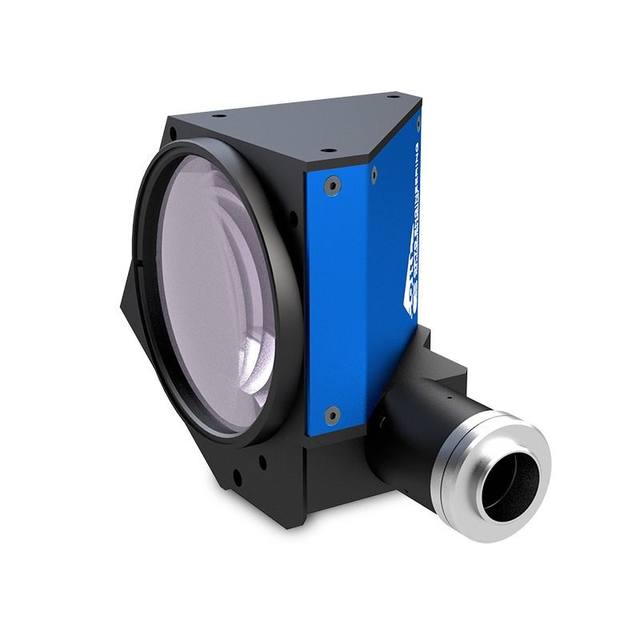
The Opto Engineering TC1MHR064-C is a high resolution telecentric lens with a C-mount and a magnification of 0.166×. Its Ø 13.3 mm image circle is the maximum the manufacturer gives for a 1/1.2″ sensor, so that is the format to design around. At 0.166× the lens images a field considerably larger than the sensor, which suits measuring whole parts or assemblies rather than small details on them.
The 181.9 mm working distance sets the object plane in front of the lens. Because the lens is telecentric, its chief rays run close to parallel to the optical axis, so the imaged size of a feature changes very little when the part sits slightly closer to or further from the lens. The manufacturer lists telecentricity below 0.08° typical and 0.10° maximum, and distortion below 0.08% typical and 0.10% maximum. Together these set the optical share of the measurement error budget, which is the first place to look when accuracy targets are tight.
The working f-number of 8 favours depth of field over light throughput, so the illumination has to deliver enough light at the sensor for the chosen exposure time. Pair the lens with a C-mount camera whose sensor is 1/1.2″ or smaller. A backlight or diffuse setup suits silhouette-based gauging, where the measurement depends on a clean edge contrast.
Best for
Dimensional gauging of whole parts presented at a 181.9 mm working distance
Measuring edge and hole positions where telecentric imaging limits size change as part height varies
Silhouette-based inspection under backlight that relies on a low-distortion image
Vision systems built around C-mount cameras with 1/1.2″ sensors
Selection notes
Choose a camera with a 1/1.2″ sensor or smaller, because the Ø 13.3 mm image circle is the stated maximum for that format.
Set the object plane at 181.9 mm and use a fixture that holds that distance repeatably.
Size the illumination for a working f-number of 8, which gives more depth of field at the cost of light reaching the sensor.
Use the telecentricity (below 0.08°, maximum 0.10°) and distortion (below 0.08%, maximum 0.10%) figures when setting the optical share of the tolerance budget.
Specifications: General
Brand
Opto Engineering
Specifications: Optical
Lens mount
C-mount
Image circle / max sensor
Ø 13.3 mm (max sensor 1/1.2″)
Magnification
0.166×
Working distance
181.9 mm
Telecentric
Yes
Applications this product is commonly selected for. Open one to see the full recommended hardware and approach.
Matched automatically by: camera mount fits the lens mount · camera sensor is covered by the lens image circle — this lens: C-mount · Ø 13.3 mm (max sensor 1/1.2″) image circle.