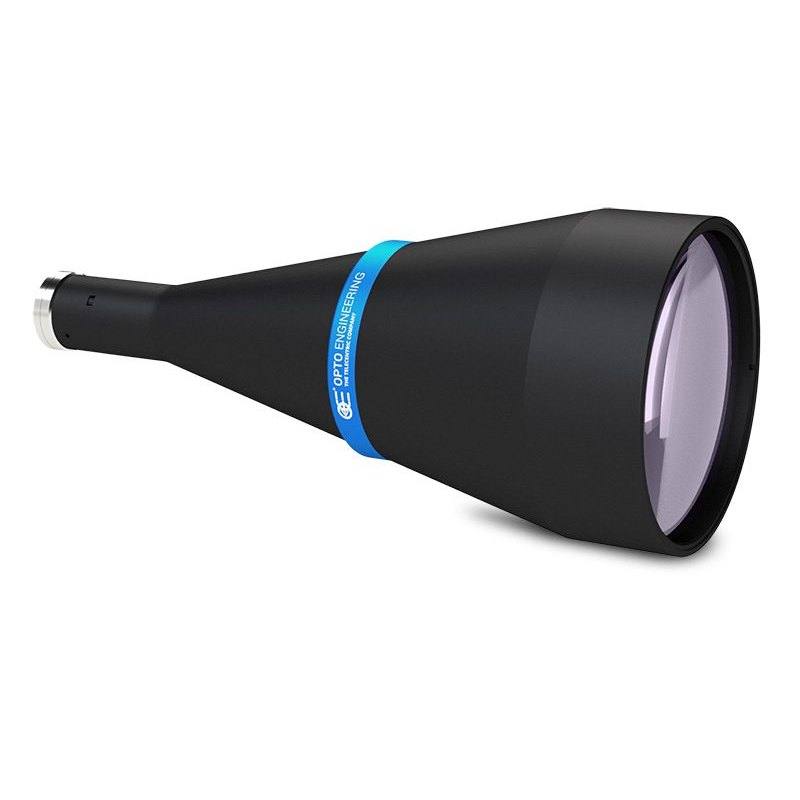
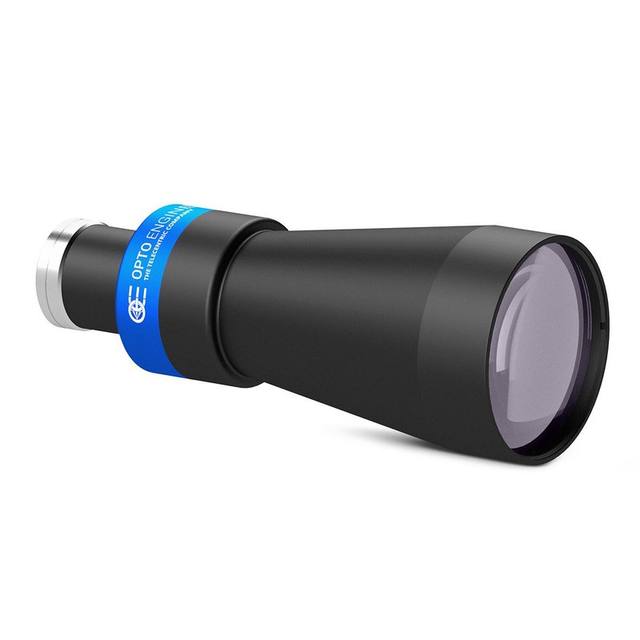
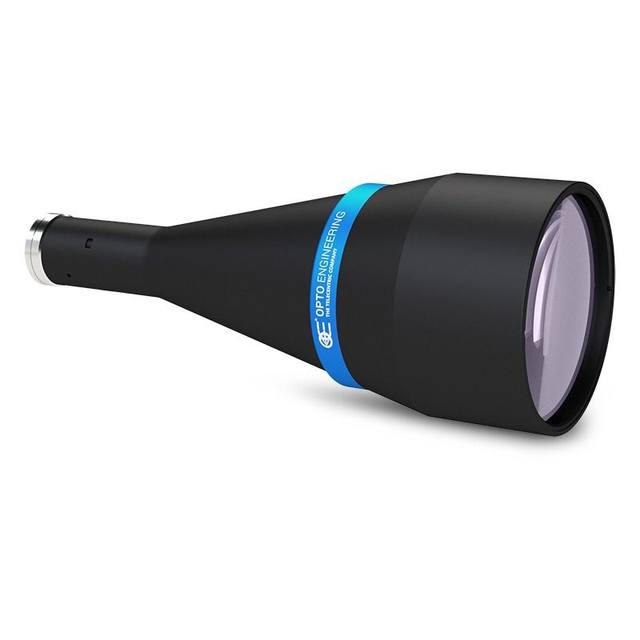
The Opto Engineering TC1MHR096-C is a high resolution telecentric lens with a C-mount and a magnification of 0.114×. Its Ø 13.3 mm image circle is the maximum the manufacturer gives for a 1/1.2″ sensor, which fixes the sensor format for the vision design. At 0.114× the field of view is wide relative to the sensor, so the lens is suited to measurements across a broad part area in one image.
The 278.6 mm working distance places the object well in front of the lens. Telecentric optics keep the chief rays close to parallel with the optical axis, so the imaged size of a feature changes little as its distance to the lens varies within the depth of field. The manufacturer gives telecentricity below 0.08° typical and 0.10° maximum, and distortion below 0.08% typical and 0.10% maximum. These optical figures belong in the measurement uncertainty calculation alongside camera resolution and part positioning tolerance.
A working f-number of 8 favours depth of field over light throughput. Plan the illumination to give the sensor enough signal at the chosen exposure time, and arrange the light so it reaches the object at the 278.6 mm working distance without shadowing the camera's view of the part.
Best for
Dimensional inspection of broad parts that must fit in one image at 0.114× magnification
Gauging setups where the object is held at a 278.6 mm working distance, clear of the lens
Edge position measurement where telecentric imaging limits size change with part height
Backlit silhouette checks of larger components using C-mount cameras with 1/1.2″ sensors
Selection notes
Select a 1/1.2″ sensor or smaller, because the Ø 13.3 mm image circle does not extend to larger formats.
Set the object plane at 278.6 mm and keep the fixture repeatable, since the measurement depends on that distance.
Allow for a working f-number of 8 when sizing illumination, because the aperture trades light for depth of field.
Use telecentricity (below 0.08°, maximum 0.10°) and distortion (below 0.08%, maximum 0.10%) as the optical inputs to the tolerance budget.
Specifications: General
Brand
Opto Engineering
Specifications: Optical
Lens mount
C-mount
Image circle / max sensor
Ø 13.3 mm (max sensor 1/1.2″)
Magnification
0.114×
Working distance
278.6 mm
Telecentric
Yes
Applications this product is commonly selected for. Open one to see the full recommended hardware and approach.
Matched automatically by: camera mount fits the lens mount · camera sensor is covered by the lens image circle — this lens: C-mount · Ø 13.3 mm (max sensor 1/1.2″) image circle.