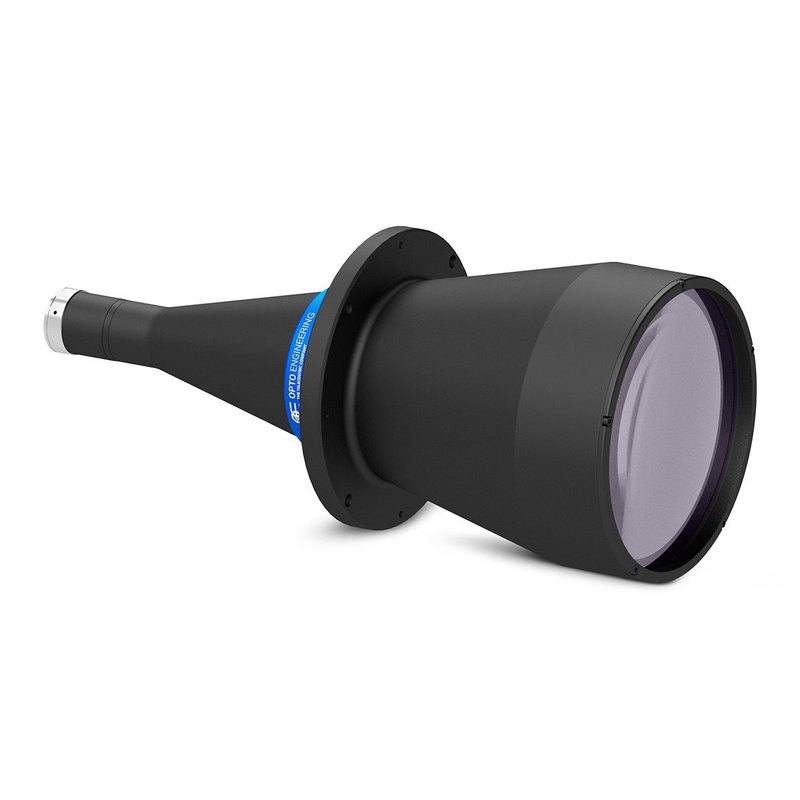
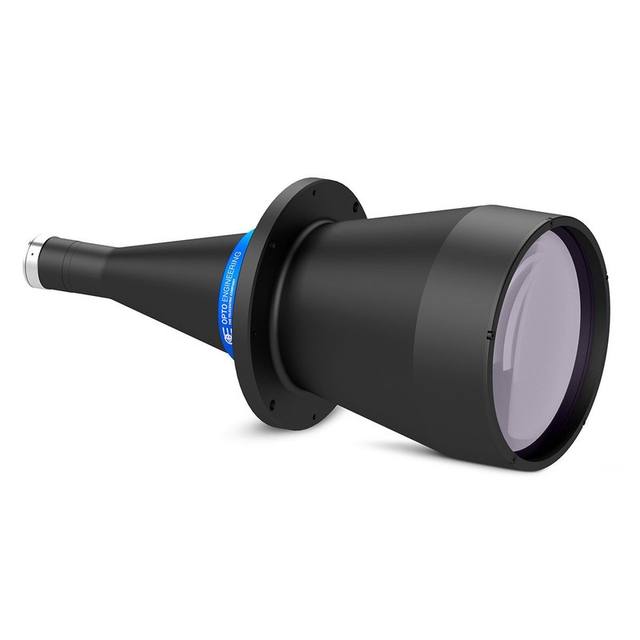
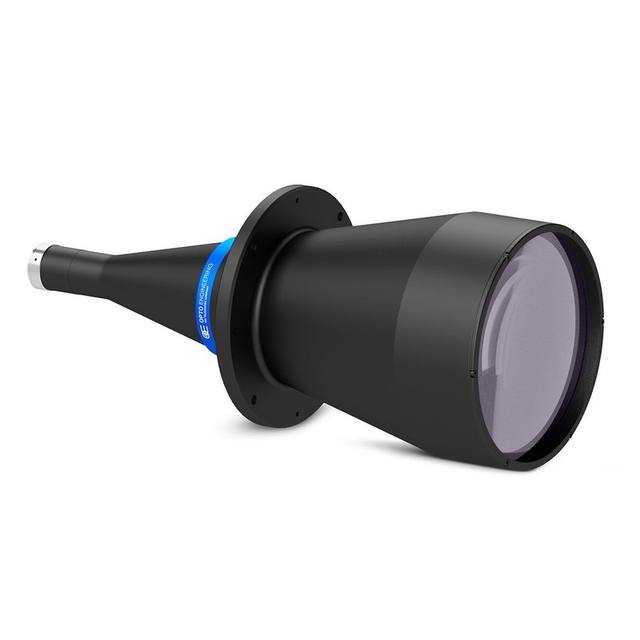
The Opto Engineering TC23110 is a bi-telecentric C-mount lens for 2/3″ sensors, specified at 0.079× magnification with a 334.6 mm working distance. Its image circle is Ø 11.0 mm (max sensor 2/3″). At 0.079×, the image on the sensor is 0.079 times the size of the object. The 334.6 mm working distance provides clearance for part handling, fixtures and lighting positioned in front of the lens.
For measurement, the telecentric and distortion figures matter most. Telecentricity is < 0.06° typical and 0.08° maximum, which keeps feature size nearly constant when the part shifts along the optical axis. Distortion is < 0.03 % typical and 0.07 % maximum, so calibration of the pixel-to-millimeter scale stays consistent across the frame. These values suit dimensional checks where repeatability over the whole field is the key requirement.
The wF/# 8 working f-number sets the depth of field and the light the sensor collects. The lens favors depth of field over brightness, so plan a stable, sufficiently bright light source and an exposure time that freezes motion at line speed. Illumination intensity and exposure time are the main levers for tuning brightness on this setup.
Best for
Gauging diameters, slot widths and hole positions at a fixed 334.6 mm working distance
Silhouette and edge measurement with a telecentric backlight
Dimensional checks with 2/3″ C-mount cameras where the 334.6 mm working distance leaves room for fixtures
Inspection cells where scale stability across the field matters more than compact packaging
Measurement of parts with slight height variation
Selection notes
Confirm sensor compatibility: the image circle is Ø 11.0 mm with a maximum sensor size of 2/3″.
Design the 334.6 mm working distance into the mechanical layout, including the camera housing, backlight and any protective glass.
Use telecentricity of < 0.06° typ. (0.08° max.) and distortion of < 0.03 % typ. (0.07 % max.) as inputs to the tolerance budget for your measurement.
At wF/# 8 the sensor receives less light, so size the illumination and exposure to match.
Specifications: General
Brand
Opto Engineering
Specifications: Optical
Lens mount
C-mount
Image circle / max sensor
Ø 11.0 mm (max sensor 2/3″)
Magnification
0.079×
Working distance
334.6 mm
Telecentric
Yes
Applications this product is commonly selected for. Open one to see the full recommended hardware and approach.
Matched automatically by: camera mount fits the lens mount · camera sensor is covered by the lens image circle — this lens: C-mount · Ø 11.0 mm (max sensor 2/3″) image circle.