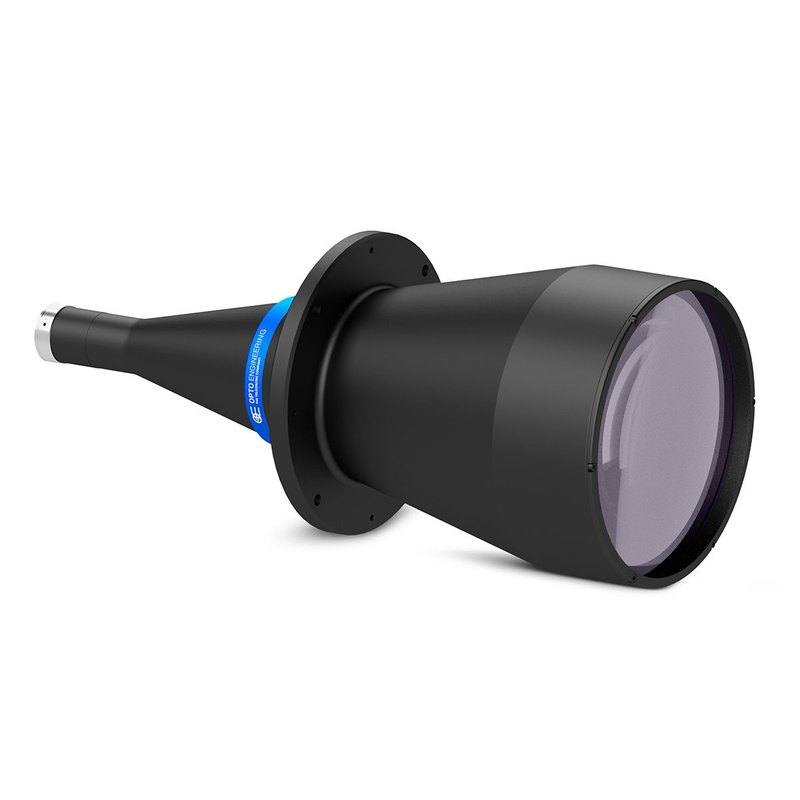
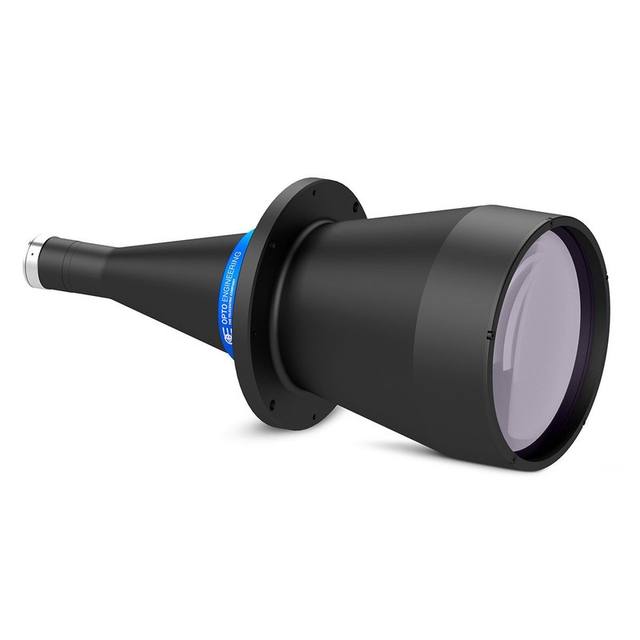
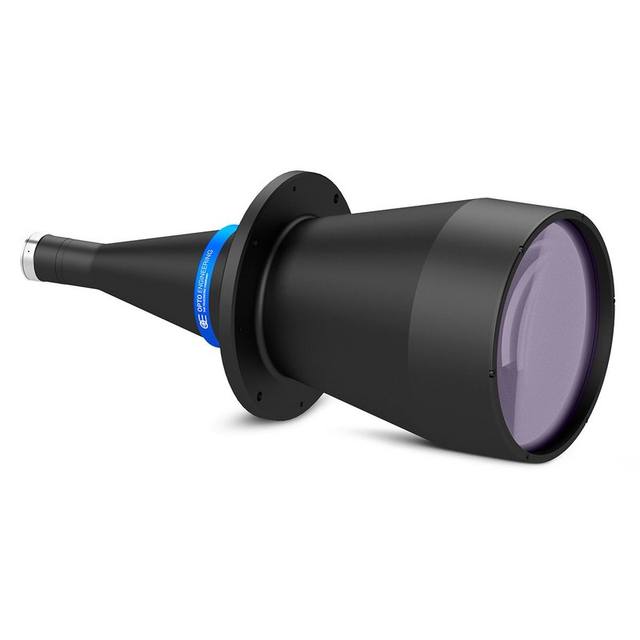
The Opto Engineering TC23130 is a bi-telecentric lens for 2/3″ sensors, specified at 0.068× magnification with a 396.0 mm working distance and a C-mount. Its image circle is Ø 11.0 mm (max sensor 2/3″). At 0.068×, the image on the sensor is 0.068 times the size of the object. The 396.0 mm working distance gives room for a protective window, lighting and handling equipment between the lens and the part.
Telecentricity is < 0.05° typical and 0.08° maximum, which keeps the imaged size of features stable as the part moves along the optical axis. Distortion is < 0.04 % typical and 0.10 % maximum. Use the typical figure as the expectation for a well-calibrated system and the maximum as the boundary for tolerance analysis. Together these specifications position the TC23130 for gauging, where scale predictability is the main requirement.
The wF/# 8 working f-number provides depth of field for parts with some height variation, but the sensor receives limited light, so the illumination needs to be strong and stable. Backlighting is the usual pairing for gauging with a telecentric lens, while front lighting is better suited to surface detail. Size the exposure and the light together so that moving parts are imaged without motion blur at your throughput.
Best for
Gauging of parts whose silhouette is measured under telecentric backlighting
Dimensional inspection at a 396.0 mm working distance
Hole, slot and edge position checks on 2/3″ C-mount camera systems
Parts with some height variation, where telecentricity limits the change in scale
Machine layouts that need a long standoff for guarding or fixtures
Selection notes
Specify 2/3″ sensors or smaller: the image circle is Ø 11.0 mm with a maximum sensor size of 2/3″.
Account for the 396.0 mm working distance in cell design, including housings, windows and light placement.
Use telecentricity of < 0.05° typ. (0.08° max.) to set the tolerance on part height variation.
Plan the illumination for wF/# 8: backlight intensity and camera exposure need to be sized together.
Specifications: General
Brand
Opto Engineering
Specifications: Optical
Lens mount
C-mount
Image circle / max sensor
Ø 11.0 mm (max sensor 2/3″)
Magnification
0.068×
Working distance
396.0 mm
Telecentric
Yes
Applications this product is commonly selected for. Open one to see the full recommended hardware and approach.
Matched automatically by: camera mount fits the lens mount · camera sensor is covered by the lens image circle — this lens: C-mount · Ø 11.0 mm (max sensor 2/3″) image circle.