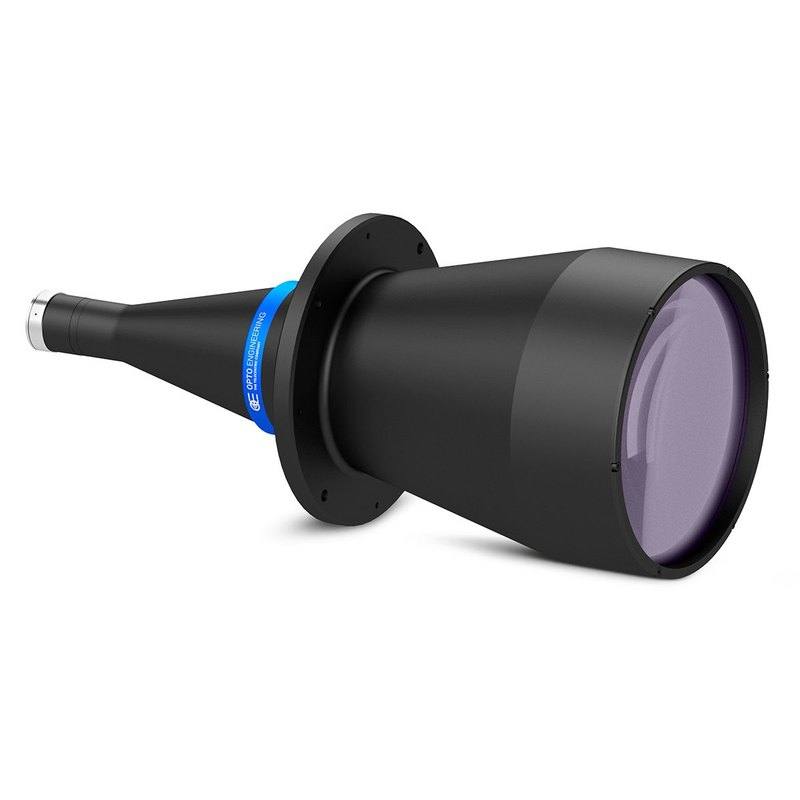
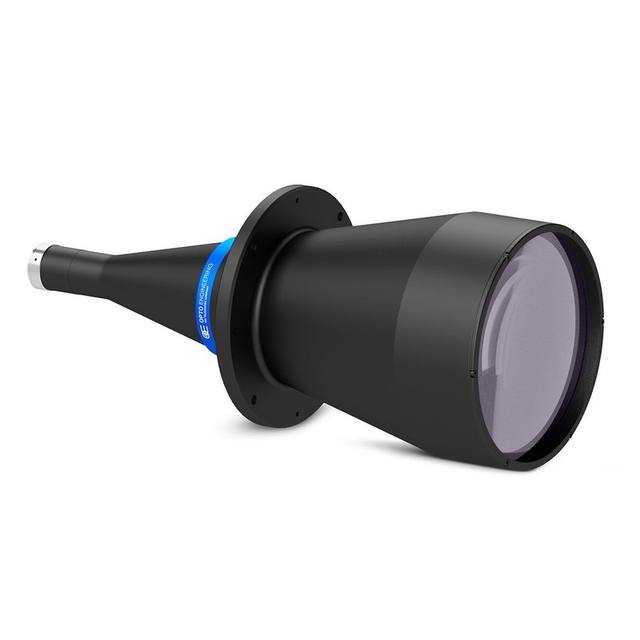
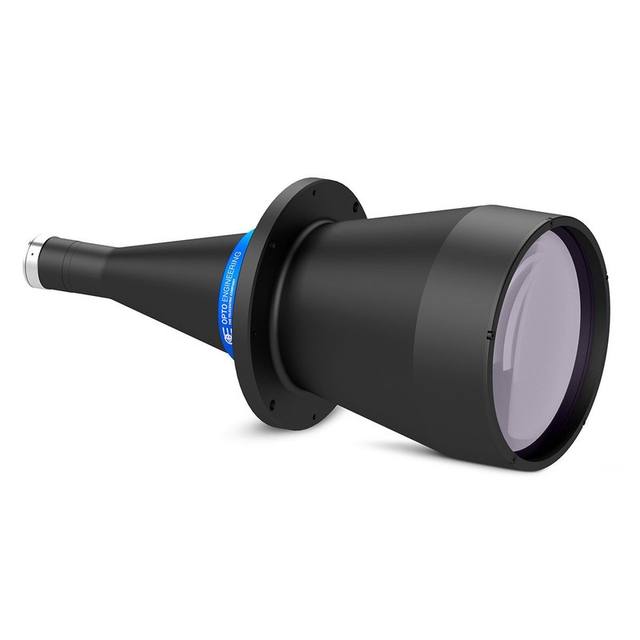
The Opto Engineering TC23144 is a bi-telecentric C-mount lens for 2/3″ sensors, specified at 0.061× magnification with a 396.0 mm working distance. Its image circle is Ø 11.0 mm (max sensor 2/3″). At 0.061×, the image on the sensor is 0.061 times the size of the object, so the lens suits measuring larger parts at a long standoff, with the camera covering a broad area of the part in one frame.
The metrology figures are telecentricity of < 0.05° typical and 0.08° maximum, and distortion of < 0.04 % typical and 0.08 % maximum. Telecentric imaging means the image scale changes little when the part sits slightly off the focal plane within the depth of field, so the lens fits gauging of parts with some height variation. Distortion at these levels keeps the pixel-to-millimeter calibration consistent across the field, which is what dimensional measurement depends on.
The wF/# 8 working f-number sets the working depth and the light level at the sensor. Use strong, stable illumination, preferably a telecentric backlight for silhouette-based gauging, and choose exposure times that keep the image free of motion blur at your part speed. The 396.0 mm working distance leaves clearance for lighting, fixtures and any protective glass between the lens and the part.
Best for
Silhouette gauging of larger parts with telecentric backlighting
Dimensional measurement at a 396.0 mm working distance
Checking part profiles, holes and slots with 2/3″ C-mount cameras
Measurement tasks where scale must remain constant across the field
Inspection setups that need standoff clearance around the part
Selection notes
Verify sensor size: the image circle is Ø 11.0 mm with a maximum sensor size of 2/3″.
Design the 396.0 mm working distance into the mechanical layout, covering the camera, lens and lighting.
Telecentricity of < 0.05° typ. (0.08° max.) defines the scale stability you can expect as part height changes.
The wF/# 8 setting trades light for depth of field, so size the illumination to the exposure your line speed requires.
Specifications: General
Brand
Opto Engineering
Specifications: Optical
Lens mount
C-mount
Image circle / max sensor
Ø 11.0 mm (max sensor 2/3″)
Magnification
0.061×
Working distance
396.0 mm
Telecentric
Yes
Applications this product is commonly selected for. Open one to see the full recommended hardware and approach.
Matched automatically by: camera mount fits the lens mount · camera sensor is covered by the lens image circle — this lens: C-mount · Ø 11.0 mm (max sensor 2/3″) image circle.