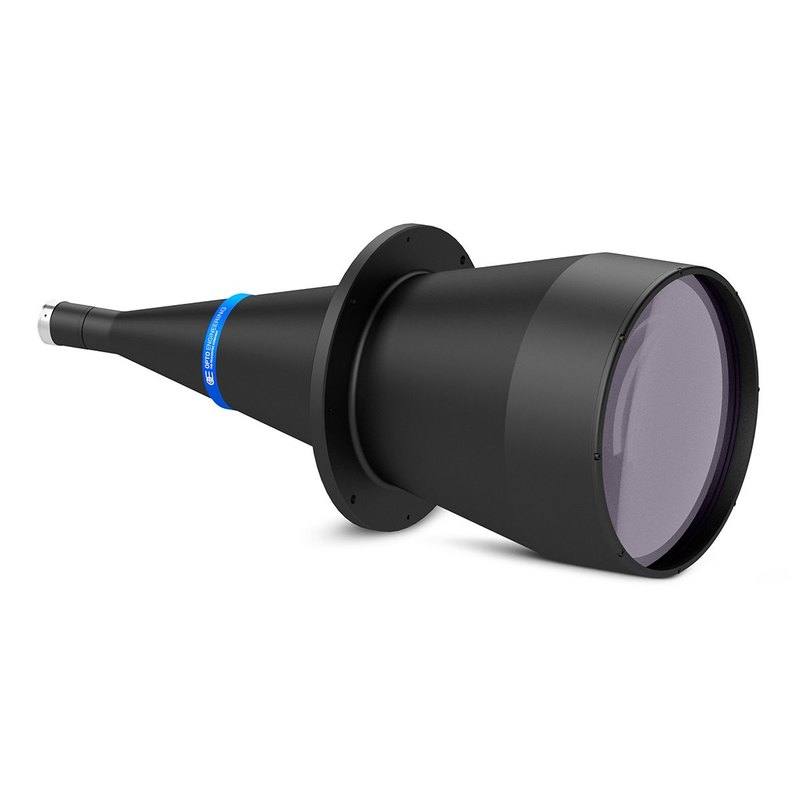
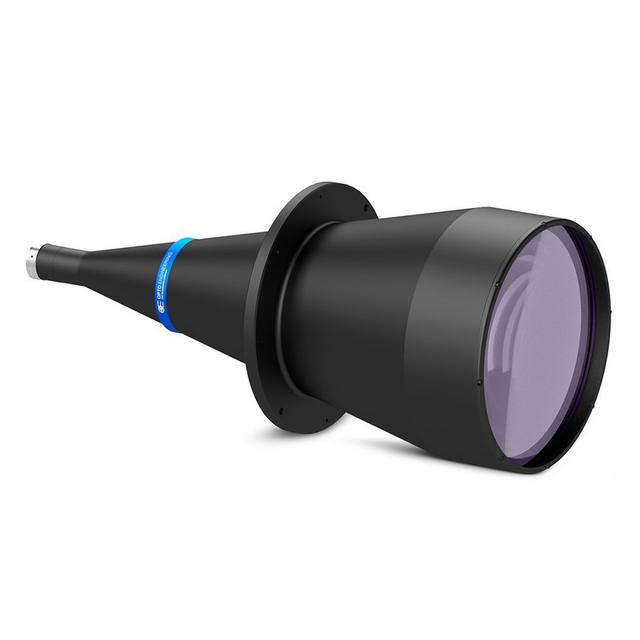
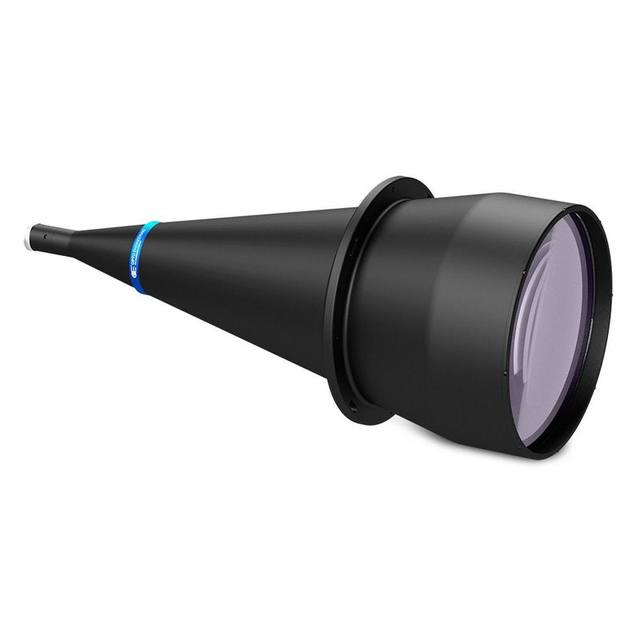
The Opto Engineering TC23172 is a bi-telecentric lens for 2/3″ sensors with 0.051× magnification, a 527.6 mm working distance and a C-mount. The image circle is Ø 11.0 mm (max sensor 2/3″). At 0.051×, the image on the sensor is 0.051 times the size of the object, so the lens suits large parts or large areas that have to fit within a single 2/3″ frame. The 527.6 mm standoff allows enclosures, protective glass and large backlights between the lens and the part.
Telecentricity is < 0.05° typical and 0.08° maximum, and distortion is < 0.04 % typical with a 0.10 % maximum. At a long working distance, telecentric imaging is especially useful for gauging: a conventional lens lets the image scale shift as the object moves relative to the focal plane, while a telecentric lens holds the scale nearly constant within its working depth. Use the 0.10 % maximum distortion as the tolerance boundary for edge-to-edge measurements.
The wF/# 8 working f-number provides depth of field, and light is the practical constraint at this aperture. Pair the lens with a strong, stable backlight sized to cover the whole field, and set the exposure so parts are imaged without motion blur at your throughput. Use the 527.6 mm working distance to create clearance for handling and for any protective window you add to the cell.
Best for
Gauging large parts or assemblies at a 527.6 mm working distance
Silhouette and profile measurement under large telecentric backlights
Dimension and presence checks across a broad area with 2/3″ C-mount cameras
Inspection where clearance is needed in front of the lens for handling or fixtures
Measurement of parts with some height variation
Selection notes
Confirm sensor compatibility: the image circle is Ø 11.0 mm with a maximum sensor size of 2/3″.
The 527.6 mm working distance needs enough cell space in front of the lens, so check the layout early.
Size the backlight for the full field at wF/# 8, since light is the limiting factor at this aperture.
Treat the 0.10 % maximum distortion as the worst-case value when budgeting edge measurement accuracy.
Specifications: General
Brand
Opto Engineering
Specifications: Optical
Lens mount
C-mount
Image circle / max sensor
Ø 11.0 mm (max sensor 2/3″)
Magnification
0.051×
Working distance
527.6 mm
Telecentric
Yes
Applications this product is commonly selected for. Open one to see the full recommended hardware and approach.
Matched automatically by: camera mount fits the lens mount · camera sensor is covered by the lens image circle — this lens: C-mount · Ø 11.0 mm (max sensor 2/3″) image circle.