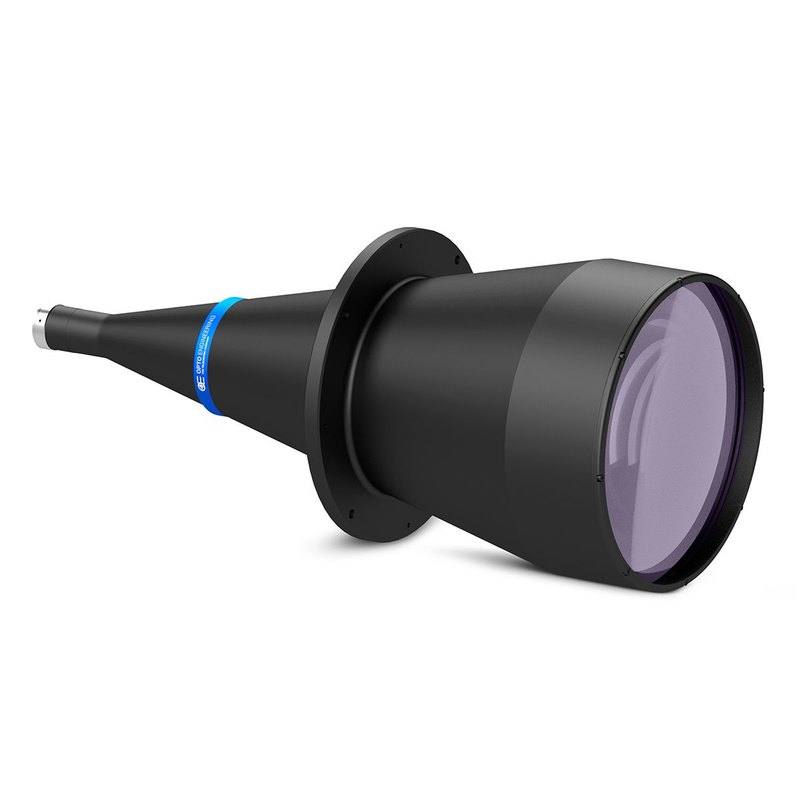
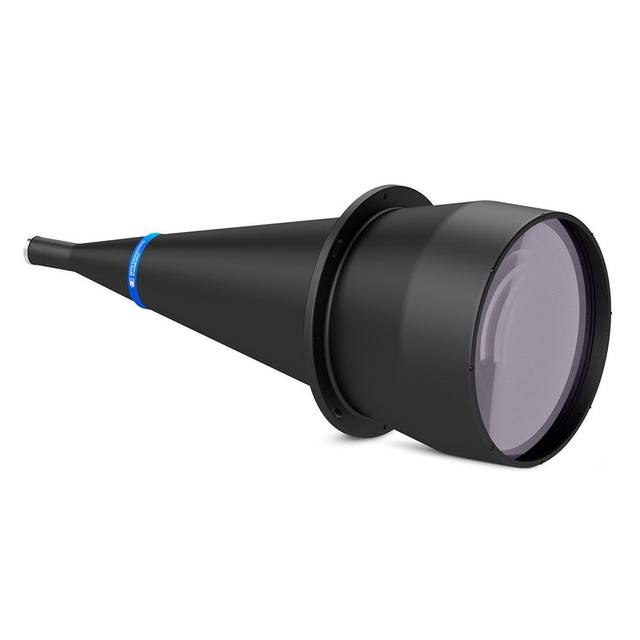
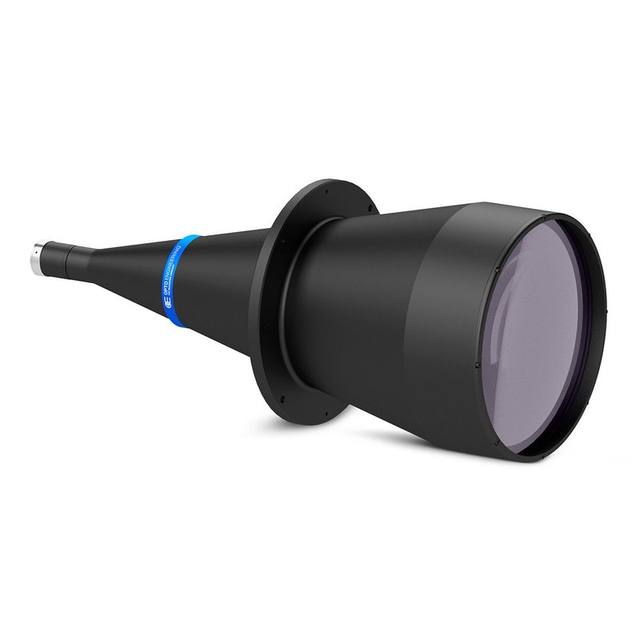
The Opto Engineering TC23192 is a bi-telecentric C-mount lens for 2/3″ sensors, specified at 0.046× magnification with a 527.6 mm working distance. Its image circle is Ø 11.0 mm (max sensor 2/3″). At 0.046×, the image on the sensor is 0.046 times the size of the object, so the lens is suited to large parts and wide areas at a long standoff. The working distance leaves room for fixtures and handling equipment in front of the lens.
Telecentricity is < 0.06° typical and 0.08° maximum, and distortion is < 0.05 % typical with a maximum of 0.08 %. Telecentric imaging keeps the imaged size of a feature close to constant when the object moves along the optical axis, which is the key requirement for dimensional gauging. The distortion figures describe how consistent the pixel-to-millimeter scale will be from the center of the field to the corners.
The wF/# 8 working f-number provides depth of field, but the light reaching the sensor depends on your illumination. Use a bright, uniform backlight for silhouette measurement and set the exposure to avoid blur at line speed. Mount the lens so it can be returned to the 527.6 mm working distance repeatably, since focus depends on that distance.
Best for
Dimensional gauging of large parts at a 527.6 mm working distance
Silhouette and contour measurement under telecentric backlighting
Imaging wide areas with 2/3″ C-mount cameras
Assembly verification where parts are measured without close access to the lens
Measurement cells that need standoff clearance for handling
Selection notes
Match the sensor: the image circle is Ø 11.0 mm with a maximum sensor size of 2/3″.
Carry the 0.08 % maximum distortion into the accuracy budget for your measurement.
Telecentricity of < 0.06° typ. (0.08° max.) helps keep scale stable across part height variation.
Size the backlight to the field you need to illuminate at the 527.6 mm working distance.
Specifications: General
Brand
Opto Engineering
Specifications: Optical
Lens mount
C-mount
Image circle / max sensor
Ø 11.0 mm (max sensor 2/3″)
Magnification
0.046×
Working distance
527.6 mm
Telecentric
Yes
Applications this product is commonly selected for. Open one to see the full recommended hardware and approach.
Matched automatically by: camera mount fits the lens mount · camera sensor is covered by the lens image circle — this lens: C-mount · Ø 11.0 mm (max sensor 2/3″) image circle.