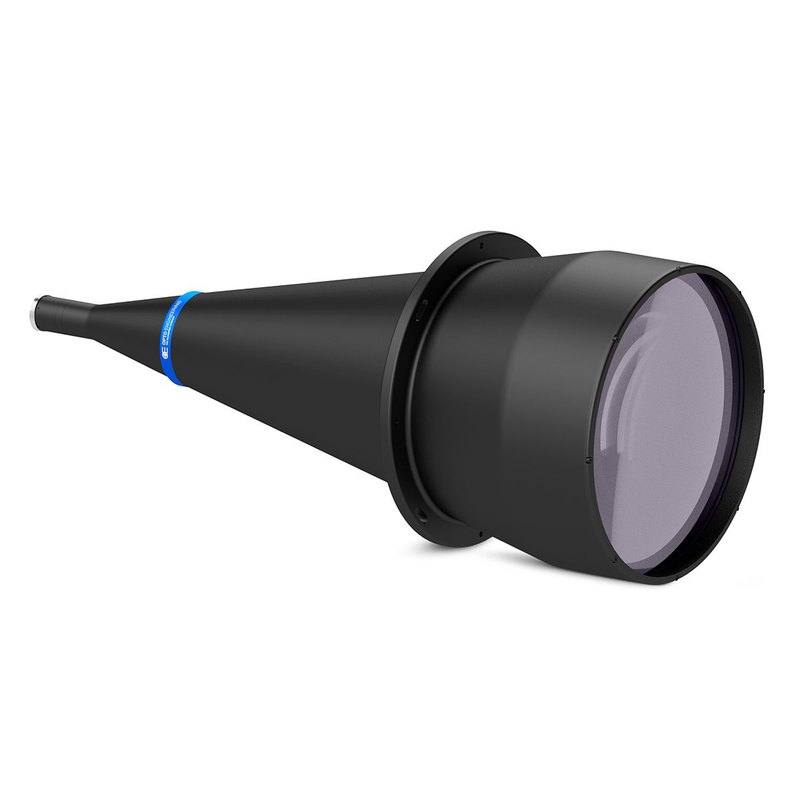
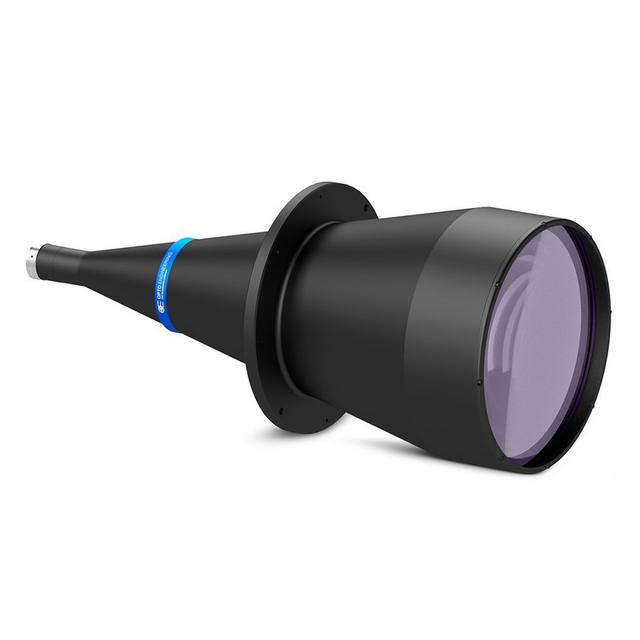
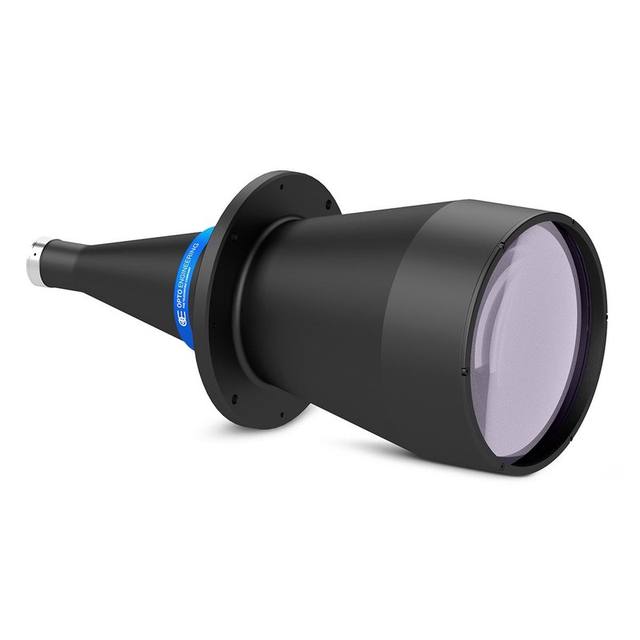
The Opto Engineering TC23200 is a bi-telecentric lens for 2/3″ sensors, specified at 0.044× magnification with a 492.8 mm working distance and a C-mount. Its image circle is Ø 11.0 mm (max sensor 2/3″). At 0.044×, the image on the sensor is 0.044 times the size of the object, so the lens is suited to measuring large parts within the field of a 2/3″ camera. The 492.8 mm standoff provides room for lighting and handling equipment between the lens and the part.
Telecentricity is < 0.06° typical and 0.08° maximum. Distortion is < 0.05 % typical and up to 0.10 % maximum. Telecentric optics keep feature size stable as the part moves along the optical axis, and the distortion specification sets how far the pixel-to-millimeter scale can vary across the field. Use the typical values for estimates and the maximum for worst-case tolerance analysis.
The wF/# 8 working f-number favors depth of field, with the trade-off that less light reaches the sensor. Choose a stable backlight or a high-output front light, and set the exposure so that moving parts are imaged without motion blur. Validate the setup with a calibration target placed at the 492.8 mm working distance before the cell goes into production.
Best for
Dimensional gauging of large parts at a 492.8 mm working distance
Silhouette-based measurement with telecentric backlighting
Measuring features across a large field with a 2/3″ C-mount camera
Inspection cells that need clearance between the lens and the part
Calibration-based metrology where distortion must be quantified
Selection notes
Verify the camera sensor is 2/3″ or smaller to fit the Ø 11.0 mm image circle.
Allow 492.8 mm of working distance in the mechanical design.
Use the 0.10 % maximum distortion as the worst-case figure when specifying measurement accuracy.
Plan the illumination around wF/# 8, sizing the light and the exposure together.
Specifications: General
Brand
Opto Engineering
Specifications: Optical
Lens mount
C-mount
Image circle / max sensor
Ø 11.0 mm (max sensor 2/3″)
Magnification
0.044×
Working distance
492.8 mm
Telecentric
Yes
Applications this product is commonly selected for. Open one to see the full recommended hardware and approach.
Matched automatically by: camera mount fits the lens mount · camera sensor is covered by the lens image circle — this lens: C-mount · Ø 11.0 mm (max sensor 2/3″) image circle.