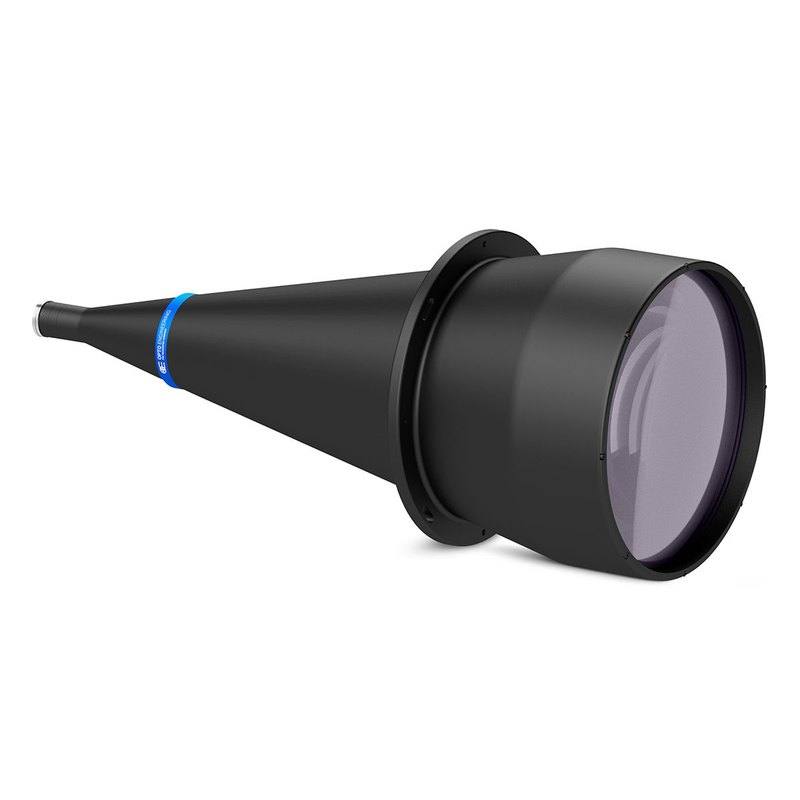
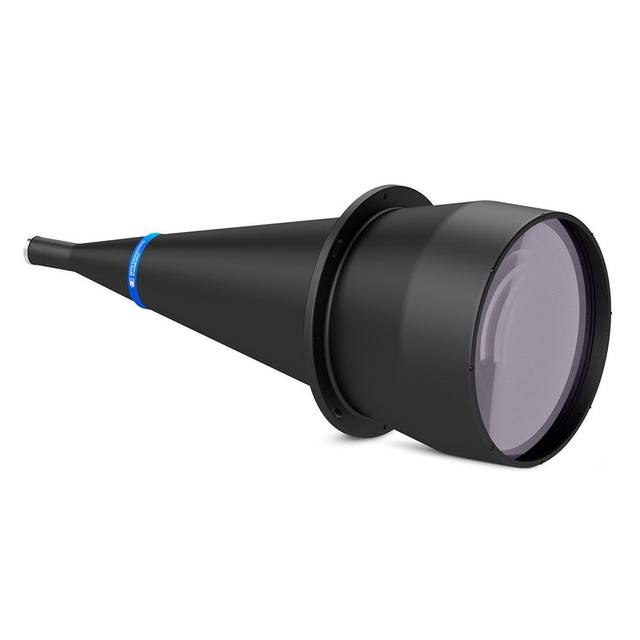
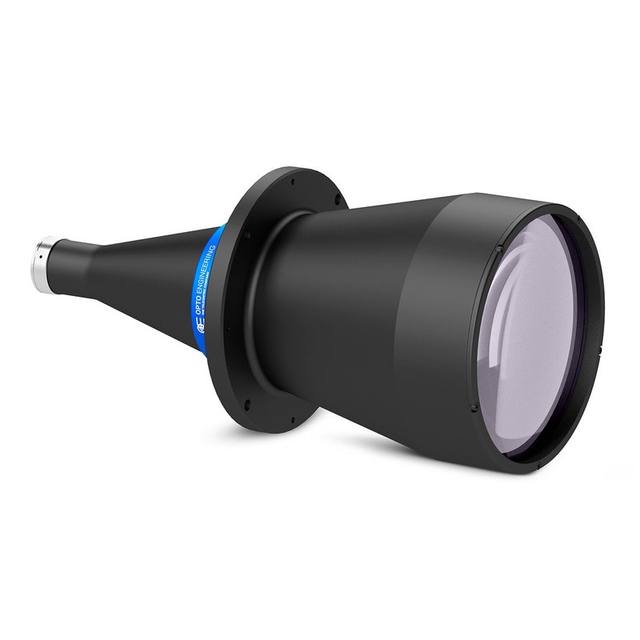
The Opto Engineering TC23240 is a bi-telecentric C-mount lens for 2/3″ sensors, specified at 0.037× magnification with a 492.8 mm working distance. Its image circle is Ø 11.0 mm (max sensor 2/3″). At 0.037×, the image on the sensor is 0.037 times the size of the object, so this lens is suited to capturing large objects or large areas in one frame from a long standoff.
Telecentricity is < 0.03° typical and 0.08° maximum, with distortion of < 0.04 % typical and 0.08 % maximum. Telecentric optics make the imaged size of a feature nearly independent of small changes in object distance, and a typical telecentricity of < 0.03° means the chief rays are very close to parallel. For gauging, a scale calibrated at one part height should hold within the telecentricity tolerance for parts that sit slightly higher or lower.
The wF/# 8 working f-number provides depth of field, and the trade-off is that the sensor receives less light. Use a high-output, uniform backlight for silhouette measurement and set the exposure to freeze motion at line speed. The 492.8 mm working distance leaves space for lighting, fixtures and protective glass between the lens and the part.
Best for
Large-area dimensional gauging at a 492.8 mm working distance
Silhouette and profile measurement with telecentric backlighting
Parts with variable height where measurement scale must stay consistent
Inspection of large objects in a single frame with a 2/3″ C-mount camera
Metrology setups that need standoff for fixtures and lighting
Selection notes
Confirm 2/3″ sensor compatibility with the Ø 11.0 mm image circle.
Design the 492.8 mm working distance into the cell layout early.
Telecentricity of < 0.03° typ. (0.08° max.) supports scale stability as part height changes; use the maximum for tolerance budgets.
Plan the light budget for wF/# 8 so the exposure stays short enough for your part speed.
Specifications: General
Brand
Opto Engineering
Specifications: Optical
Lens mount
C-mount
Image circle / max sensor
Ø 11.0 mm (max sensor 2/3″)
Magnification
0.037×
Working distance
492.8 mm
Telecentric
Yes
Applications this product is commonly selected for. Open one to see the full recommended hardware and approach.
Matched automatically by: camera mount fits the lens mount · camera sensor is covered by the lens image circle — this lens: C-mount · Ø 11.0 mm (max sensor 2/3″) image circle.