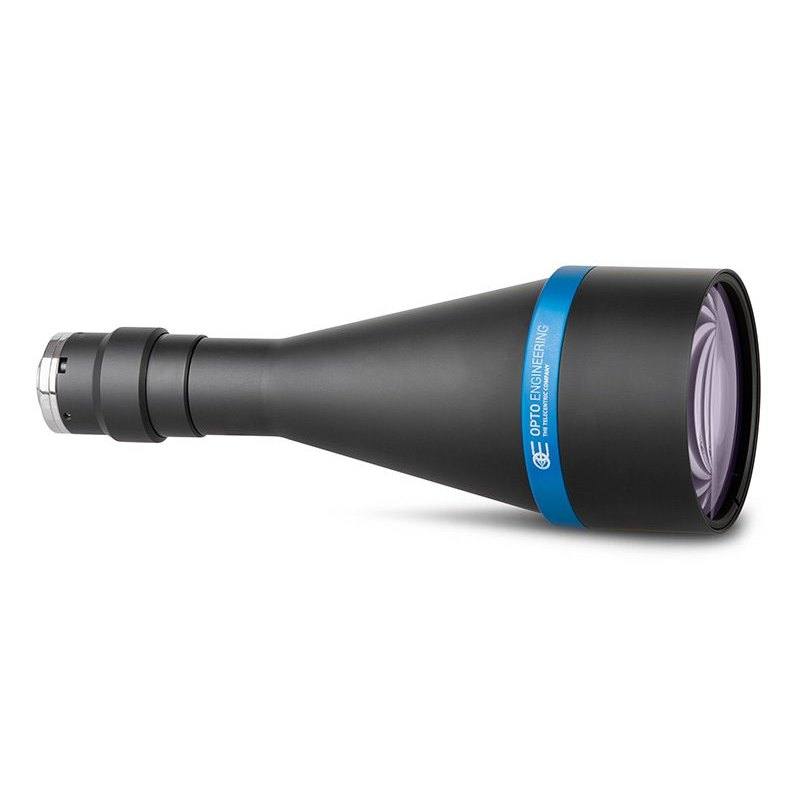
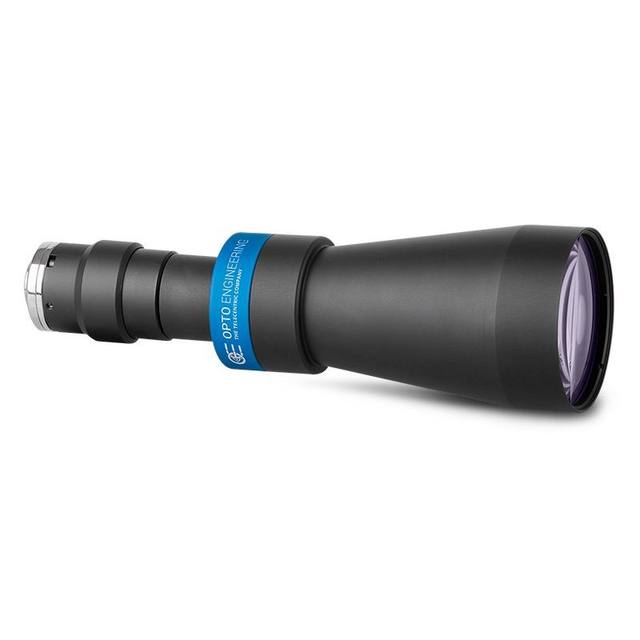
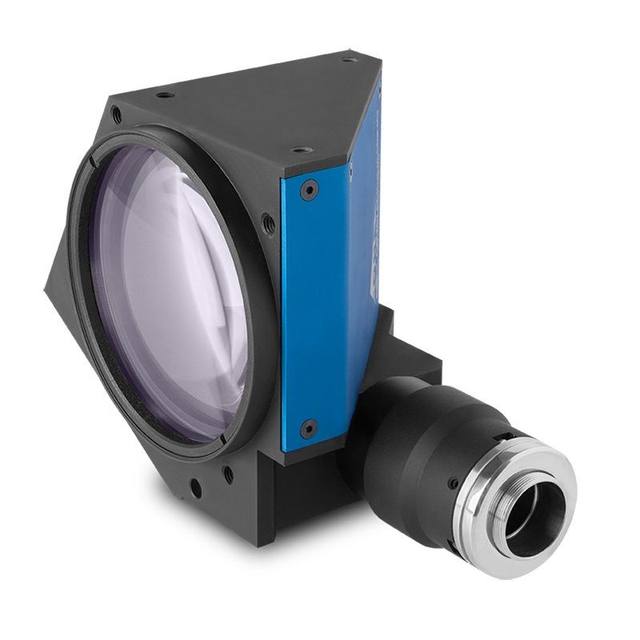
The TC2MHRP064-C is a high resolution telecentric lens for 1″ sensors, with a C-mount and an image circle of Ø 16 mm (max sensor 1″). At 0.200× magnification the sensor covers a wide area of the object, and the 181.9 mm working distance keeps the camera well clear of the part. That stand-off suits larger parts or setups that need significant distance between the camera and the work.
Telecentricity is <0.04 (0.10) deg typ. (max), so the rays passing through the lens are almost parallel. In practice, moving the object closer to or farther from the lens changes its apparent size very little, which matters for accuracy in dimensional gauging. Distortion is <0.05 (0.10) % typ. (max), so straight edges and feature positions stay faithful to the object with only a small error in the image.
The working f-number is wF/# 8, a moderate value that balances light intake and depth of field for parts whose height varies somewhat. Pair the lens with a C-mount camera whose sensor is 1″ or smaller, and match the illumination to the feature: backlight for edges and profiles, or diffuse front light for surface detail.
Best for
Dimensional gauging of larger parts where the 0.200× field must cover the whole component.
Measurement setups that need 181.9 mm of stand-off for clearance around the camera and the part.
Hole and edge position checks with minimal perspective error.
Backlit profile inspection of part outlines.
Presence verification of features across one frame.
Selection notes
Verify that the C-mount camera and its 1″ or smaller sensor match the Ø 16 mm image circle.
Include the 181.9 mm working distance in the machine design, with room for lens length and mounting clearance.
Plan illumination around wF/# 8 so that exposure times stay short for the required throughput.
Keep part height variation within the depth of field so feature edges remain sharp.
Specifications: General
Brand
Opto Engineering
Specifications: Optical
Lens mount
C-mount
Image circle / max sensor
Ø 16 mm (max sensor 1″)
Magnification
0.200×
Working distance
181.9 mm
Telecentric
Yes
Applications this product is commonly selected for. Open one to see the full recommended hardware and approach.
Matched automatically by: camera mount fits the lens mount · camera sensor is covered by the lens image circle — this lens: C-mount · Ø 16 mm (max sensor 1″) image circle.