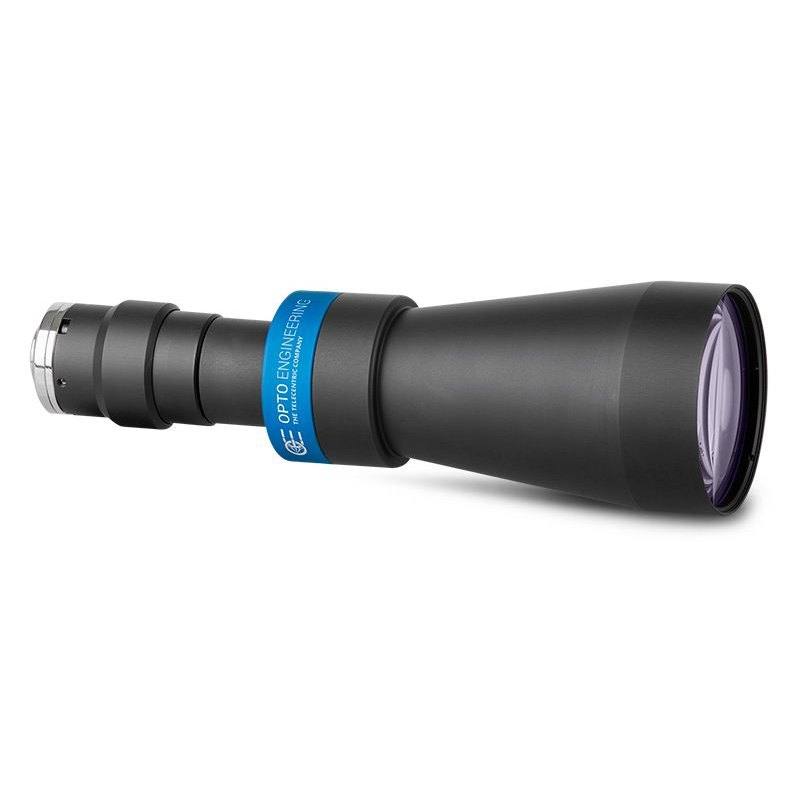
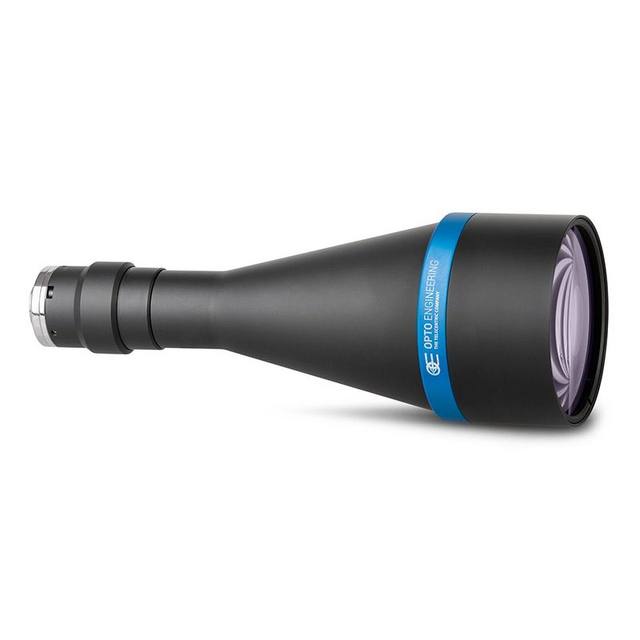
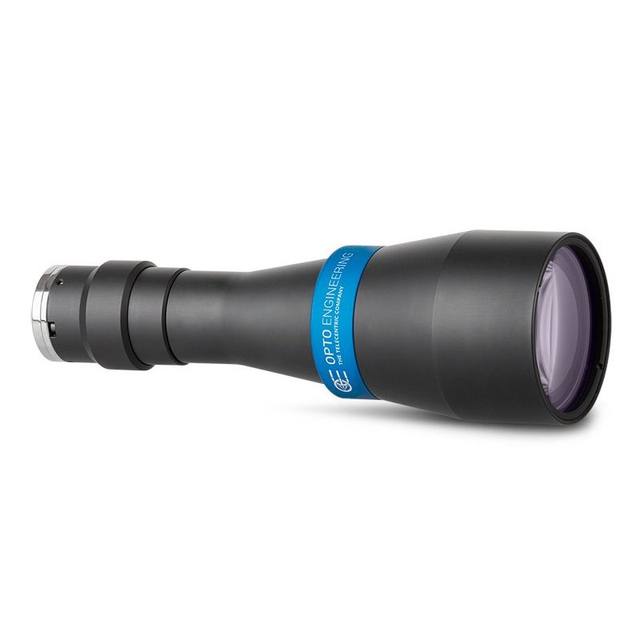
The TC2MHRP056-C is a high resolution telecentric lens for 1″ sensors, with a C-mount and an image circle of Ø 16 mm (max sensor 1″). At 0.228× magnification the sensor covers a wide area of the object, and the 157.8 mm working distance places the front of the lens well back from the work, giving the camera room to sit at a considerable distance from the part.
The telecentricity specification of <0.04 (0.10) deg typ. (max) means the imaging rays are very close to parallel, so changes in the distance between part and lens barely change the apparent size of features. Distortion is <0.05 (0.10) % typ. (max), keeping geometric error low across the image. These are the figures that matter for dimensional work, where perspective error would otherwise bias the readings.
The working f-number is wF/# 8, giving a moderate light intake and a usable depth of field for parts with some height variation. Use bright, stable illumination, and choose a camera with a C-mount and a sensor of 1″ or smaller so it matches the image circle. For edge gauging, backlighting is often chosen because it gives strong edge contrast.
Best for
Dimensional gauging, where the <0.04 (0.10) deg typ. (max) telecentricity keeps measurements repeatable.
Hole and edge measurement at a 157.8 mm working distance, with clearance around the camera and the part.
Position checks on parts that vary slightly in height.
Backlit profile measurement of part outlines.
Dimensional verification where the camera and part positions are fixed and repeatable.
Selection notes
Confirm the camera uses a C-mount and a sensor of 1″ or smaller to suit the Ø 16 mm image circle.
Design the mechanical layout around the 157.8 mm working distance, including lens length and mounting clearance.
Keep part height variation within the depth of field of wF/# 8 so features stay sharp.
Mount the lens and camera rigidly so the calibrated 0.228× scale stays stable over time.
Specifications: General
Brand
Opto Engineering
Specifications: Optical
Lens mount
C-mount
Image circle / max sensor
Ø 16 mm (max sensor 1″)
Magnification
0.228×
Working distance
157.8 mm
Telecentric
Yes
Applications this product is commonly selected for. Open one to see the full recommended hardware and approach.
Matched automatically by: camera mount fits the lens mount · camera sensor is covered by the lens image circle — this lens: C-mount · Ø 16 mm (max sensor 1″) image circle.