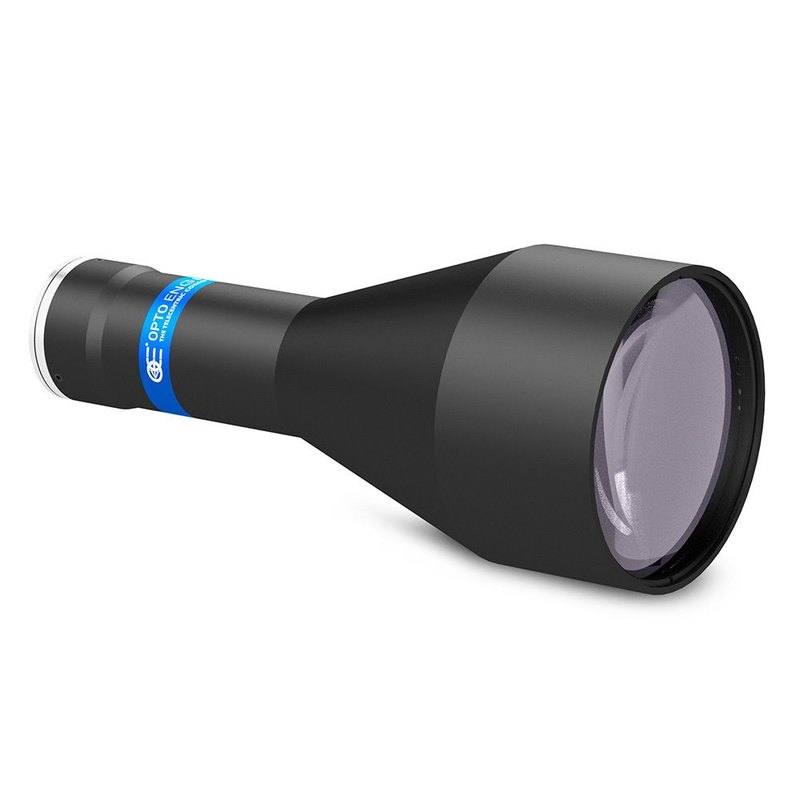
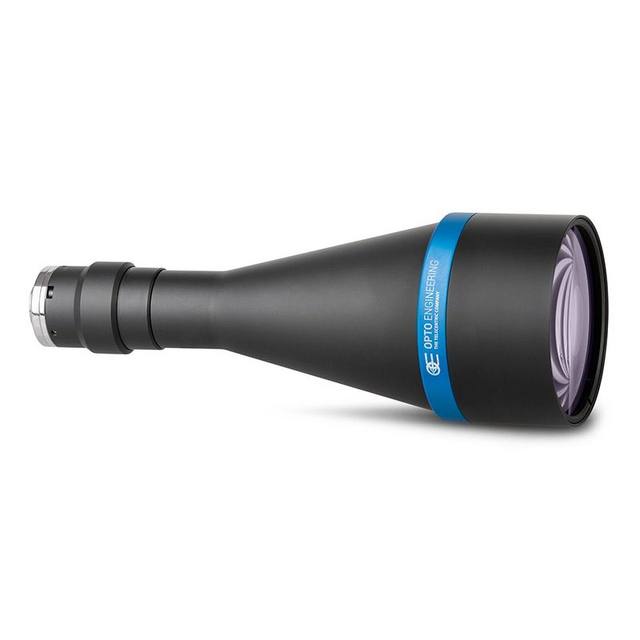
The Opto Engineering TCLWD020-275-23 is a telecentric lens for 2/3″ sensors with 0.200× magnification, a Ø 11.0 mm image circle, and a 276 mm working distance. It belongs to the TCLWD3M series of fixed working distance telecentric lenses and uses a C-mount. Its working f-number is wF/# 8.
Telecentric optics keep magnification nearly constant over small changes in object distance, so the 0.200× scale holds across slight variations in part position. That is the basis for dimensional work, where perspective would otherwise change apparent feature sizes. At 0.200× the object field is large for a 2/3″ sensor, which suits whole-part inspection rather than fine detail.
The 276 mm working distance provides a long standoff between the lens and the part, useful when a fixture, handling device or lighting has to sit between the optic and the object. Because the working distance is fixed, the part must be placed at 276 mm on every cycle. Pair the lens with a C-mount camera whose sensor is 2/3″ or smaller, and plan the lighting geometry around the standoff so the object plane is evenly illuminated.
Best for
Inspection stations that need a 276 mm standoff between the lens and the part
Fixed-setup dimensional gauging on 2/3″ sensors at 0.200×
Applications with fixtures, handling or lighting placed in front of the lens
Telecentric imaging of parts that are repeatably placed at one object distance
C-mount camera systems using 2/3″ sensors
Selection notes
Position the part at 276 mm consistently; a fixed working distance depends on repeatable placement.
Verify the sensor is 2/3″ or smaller so it fits within the Ø 11.0 mm image circle.
Check the lighting layout against the 276 mm standoff so the object plane is evenly illuminated.
Use the wF/# 8 aperture as a design input for depth of field and exposure.
Derive the pixel-to-millimeter scale from the 0.200× magnification and the camera's pixel size before setting tolerances.
Specifications: General
Brand
Opto Engineering
Specifications: Optical
Lens mount
C-mount
Image circle / max sensor
Ø 11.0 mm (max sensor 2/3″)
Magnification
0.200×
Working distance
276 mm
Telecentric
Yes
Applications this product is commonly selected for. Open one to see the full recommended hardware and approach.
Matched automatically by: camera mount fits the lens mount · camera sensor is covered by the lens image circle — this lens: C-mount · Ø 11.0 mm (max sensor 2/3″) image circle.