

- Rosepetal compatible
- Recommended by AIS Vision
On request
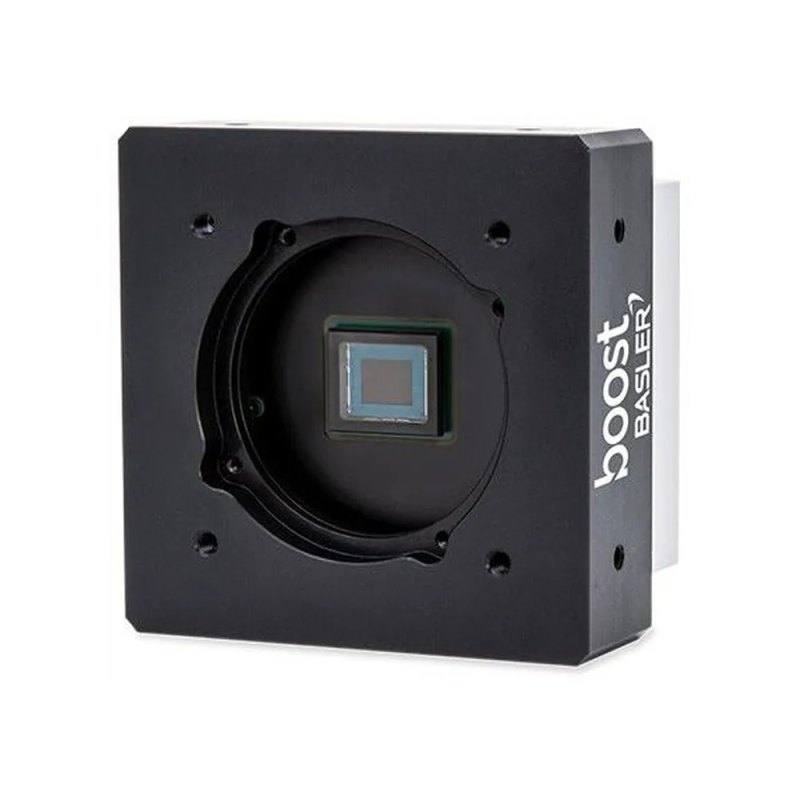
boA1936-400cm
The Basler boost boA1936-400cm is a high-speed industrial area scan camera built on the 2/3" Sony IMX421 mono CMOS global-shutter sensor with 1936 x 1472 px (2.8 MP) resolution and 4.5 µm pixels. It connects via a single CoaXPress 2.0 (CXP-12) channel through one Micro-BNC connector at up to 12.5 Gbps, reaching roughly 364 fps at full resolution and up to ~401 fps in 8-bit mode. The camera offers a universal lens front available in C-mount, F-mount, and M42 variants, and can be powered via Power over CoaXPress (PoCXP) or an external 24 VDC supply through the I/O connector. It conforms to GenICam and CoaXPress 2.0 standards, typically consuming about 7.9 W at 24 VDC.
The Basler boost boA1936-400cm is a high-speed area scan camera built around the 2/3" Sony Pregius IMX421 mono CMOS sensor, a 2.8 MP global-shutter device (1936 x 1472 px) with 4.5 µm pixels on an 8.7 x 6.5 mm imaging area. The global shutter is the defining trait here: every pixel is exposed simultaneously, so fast-moving objects on a conveyor or a rotating part image without the skew and smear a rolling shutter would introduce. That makes this camera suited to inline tasks where parts do not stop, and the monochrome sensor maximizes light sensitivity and per-pixel detail, which is exactly what surface-defect and edge-based dimensional work want. At 2.8 MP the resolution is modest by today's standards, so this is a speed-first sensor rather than a fine-detail one; the trade is throughput, not pixel count.
| Brand | Basler |
|---|---|
| Camera type | Area scan |
| Resolution | 2.8 MP |
|---|---|
| Horizontal resolution | 1936 x 1472 px (full) |
| Mono / color | Mono |
| Sensor manufacturer | Sony (Pregius IMX421) |
| Sensor model | Sony IMX421 (IMX421LLJ-C) |
| Shutter | Global shutter |
| Sensor size | 2/3" (11.0 mm diagonal, 8.7 x 6.5 mm) |
| Pixel size | 4.5 x 4.5 µm |
| FPS | ~364 fps full res (up to ~401 fps @ 8-bit) |
|---|
| Interface | CoaXPress 2.0 (CXP-12), single channel, 2.5-12.5 Gbps |
|---|---|
| Protocols | GenICam, CoaXPress 2.0 |
| Mount | Universal front: C-mount, F-mount, M42 |
|---|
| Power | PoCXP (Power over CoaXPress) or external 24 VDC via I/O |
|---|---|
| Power consumption | 7.9 W |
| Supply voltage | 18.6-26 VDC |
| Operating temperature | 0-50 °C |
|---|
| Housing material | Box |
|---|---|
| Dimensions | 45 x 80 x 80 mm |
| Weight | 436 g |
A practical decision guide to the three dominant machine-vision interfaces: bandwidth, cable length, multi-camera support, PoE, latency, frame grabber needs and cost.
How to build a high-speed machine-vision system: balance frame rate against resolution, freeze motion with short exposure and strobe lighting, and size the interface and frame grabber for sustained throughput.
How global and rolling shutters differ, why rolling shutter distorts moving objects, and when each is the right choice for industrial inspection.
Rosepetal · AI
Validate your visual inspection with AI: send us sample images and we evaluate the case on your hardware.
AIS Vision · Integration
AIS Vision defines and tests the optimal combination of camera, optics and lighting for your application before you buy.










