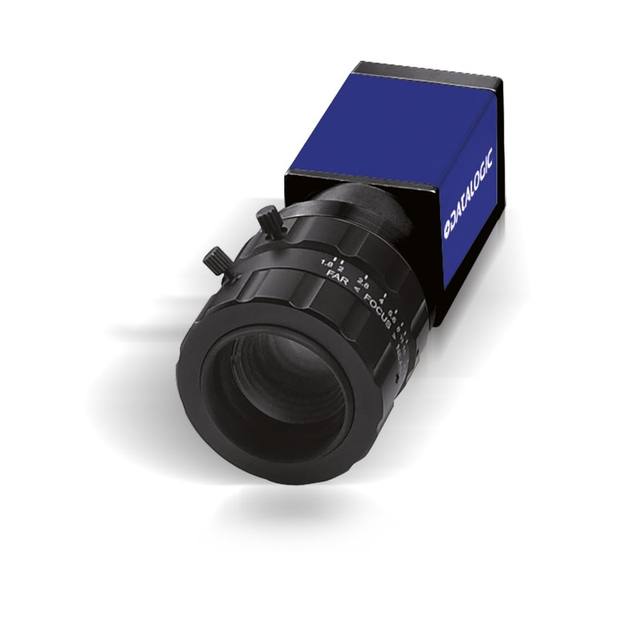
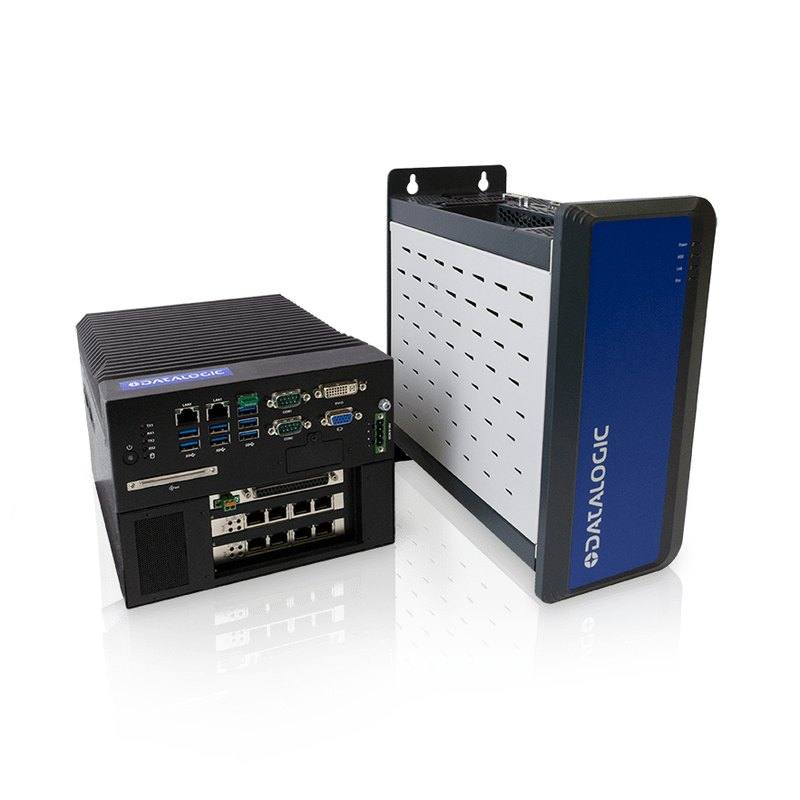
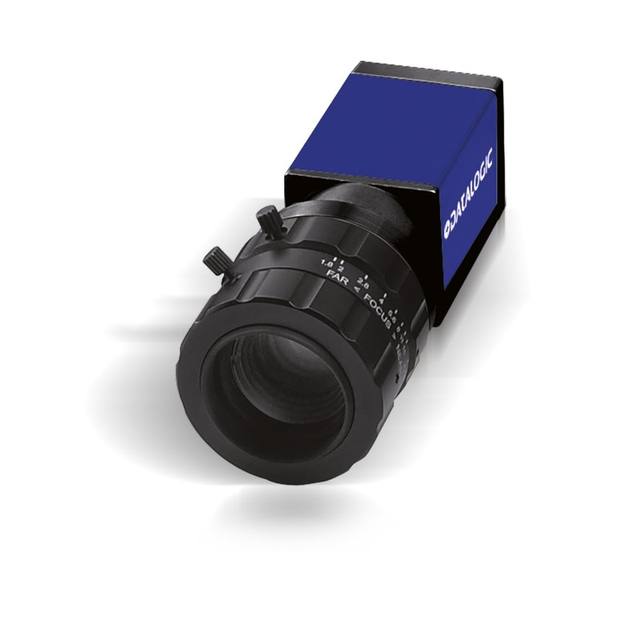
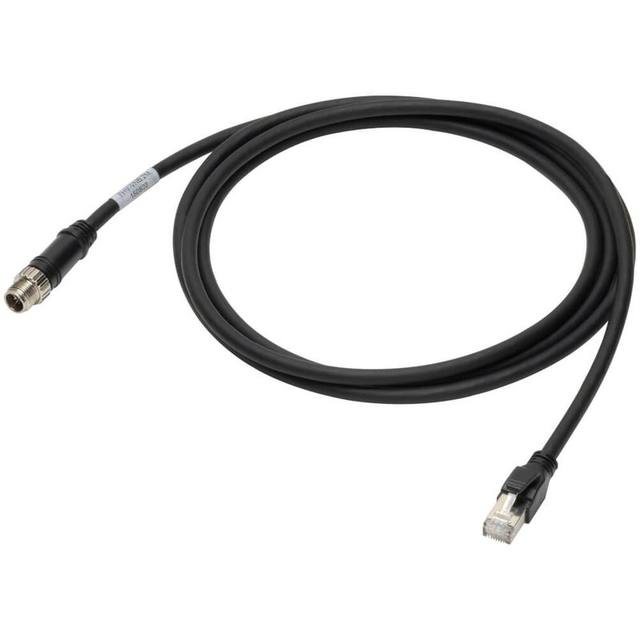
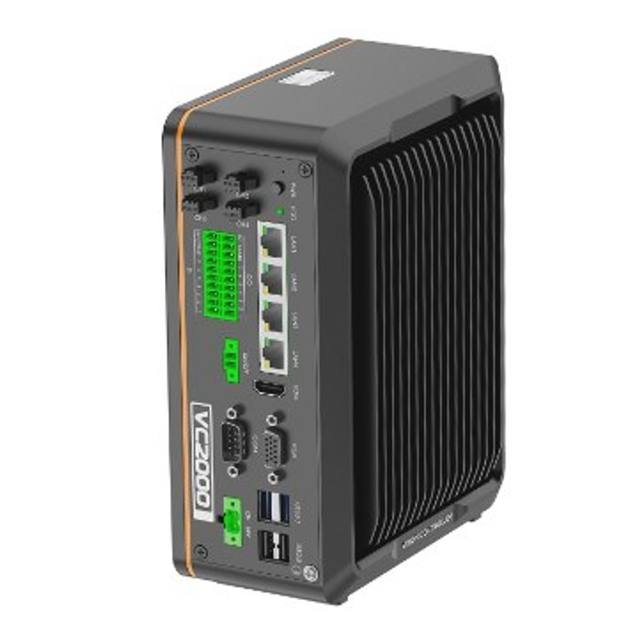
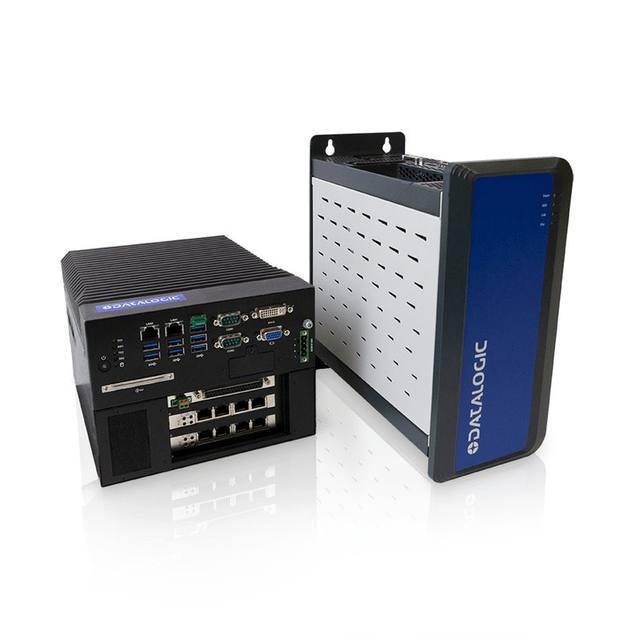
Datalogic MX-E25-2 — MX-E Series entry-level vision processor: Intel Celeron 1.7 GHz - dual core, 8 GB system memory, 128 GB storage; 2 × 1000 Mbps Base-T PoE camera ports (PoE camera ports, up to 7 W per channel); 16 IN / 16 OUT, PNP or NPN (per order code), 200 µs response time; 2x LAN ports - 10/100/1000 Mbps Base-T; EtherNet/IP, Profinet, Modbus TCP and OPC; 1x RS-232 serial port; 16 IN / 16 OUT digital I/O; Windows 10 IoT Enterprise LTSC 2021; 24 ± 25% VDC; IP20. 2 order codes.
Brand
Datalogic
On-board processing
Intel Celeron 1.7 GHz - dual core
On-board memory
8 GB system memory
Storage
128 GB
Camera ports
2 × 1000 Mbps Base-T PoE camera ports
Interface
GigE (1000 Mbps Base-T) camera ports with PoE
Trigger / GPIO
16 IN / 16 OUT, PNP or NPN (per order code), 200 µs response time
Communication
2x LAN ports - 10/100/1000 Mbps Base-T; EtherNet/IP, Profinet, Modbus TCP and OPC; 1x RS-232 serial port; 16 IN / 16 OUT digital I/O
Operating systems
Windows 10 IoT Enterprise LTSC 2021
Software / API
Configured with Datalogic IMPACT software (advanced algorithms); IMPACT Vision SDK
The camera-resolution limit is the number to design around: the MX-E25-2 is specified for cameras of 5 Mpix or lower. It pairs a dual-core Intel Celeron at 1.7 GHz with 8 GB of memory and 128 GB of storage, and runs Windows 10 IoT Enterprise LTSC 2021 with IMPACT software. Each of the two PoE camera ports is its own 1000 Mbps link. A GigE link typically carries about 110 MB/s of image payload, so a 5 Mpix 8-bit mono image (2448 × 2048 = 5.01 MB) tops out near 110 ÷ 5.01 ≈ 22 frames per second per camera (example).
On the control side there are 16 inputs and 16 outputs with a 200 µs response time, and the order code fixes the polarity as PNP or NPN. EtherNet/IP, Profinet, Modbus TCP and OPC run over the two gigabit LAN ports, and there is one RS-232 port.
Best for
One- or two-camera stations with sensors up to 5 Mpix, such as presence, position or alignment checks, where an entry-level processor is enough.
Machines that route many discrete signals through the vision controller: 16 inputs and 16 outputs cover triggers, strobes and reject outputs without extra I/O modules.
Cells with PoE cameras that draw less than 7 W, since each port powers its camera and no injector or PoE switch is needed.
Selection notes
Each port supplies up to 7 W, which corresponds to the IEEE 802.3af class 2 level (typical). A camera that identifies as a higher class may not be powered even when it draws less in use, so check the camera's PoE class as well as its consumption.
Order the polarity your wiring needs: the two order codes are PNP and NPN, so match them to the logic of your PLC and sensors.
Two ports is the limit: for four or eight cameras see MX-E45-4 or MX-E90-8, and for more processing per image MX-E45-2 raises the Celeron clock to 2.4 GHz.
IMPACT runs under a dongle licence in three levels, DNG-I, DNG-I-E (Enhanced) and DNG-I-E-P (Pro), so confirm which one your tool chain needs.
Specifications: General
Brand
Datalogic
Specifications: Performance
On-board processing
Intel Celeron 1.7 GHz - dual core
On-board memory
8 GB system memory
Storage
128 GB
Specifications: Interface
Camera ports
2 × 1000 Mbps Base-T PoE camera ports
Interface
GigE (1000 Mbps Base-T) camera ports with PoE
Trigger / GPIO
16 IN / 16 OUT, PNP or NPN (per order code), 200 µs response time
Communication
2x LAN ports - 10/100/1000 Mbps Base-T; EtherNet/IP, Profinet, Modbus TCP and OPC; 1x RS-232 serial port; 16 IN / 16 OUT digital I/O
Specifications: Electrical
Power over cable (PoE / PoCXP / PoCL)
PoE camera ports, up to 7 W per channel
Supply voltage
24 ± 25% VDC
Specifications: Environment
IP rating
IP20
Specifications: Software
Operating systems
Windows 10 IoT Enterprise LTSC 2021
Software / API
Configured with Datalogic IMPACT software (advanced algorithms); IMPACT Vision SDK
Specifications: Mechanical
Dimensions
270 (H) x 130 (W) x 255 (D) mm / 10.6 (H) x 5.1 (W) x 10 (D) in.
This product groups every purchasable order code that shares the same sensing method, range and output. Cable length, connector type and operation mode (Light-ON/Dark-ON, NO/NC) vary by order code below.
Family variants with highlighted differences
Model
Camera ports
Trigger / GPIO ●
Availability
Vision Processor, MX-E25, 2 ports, PNP, WIN10 Base
1. Install the IMPACT Software Suite and connect the camera
Install the IMPACT Software Suite on your PC, which provides both the configuration/viewer tools and the SDK. For a GigE Vision model (E100, M or U series), connect it to a dedicated NIC and, for USB3 models, use a certified USB3 cable and port. Power the camera and confirm it enumerates.
2. Bring the camera online and verify the link
For GigE Vision, put the camera and the host NIC on the same subnet (a static IP on the camera matching the NIC range is the most reliable starting point); for USB3, confirm the device is recognized. Open the IMPACT viewer/device tool, discover the camera, and verify a stable connection before streaming. Enabling jumbo frames on the NIC helps GigE throughput.
3. Set exposure, gain and trigger, then grab a first image
In the IMPACT tools, start a live stream and adjust exposure and gain until the image is well-lit without saturation; set white balance on color models. Begin in free-run (continuous) mode to confirm imaging, then switch to hardware or software trigger as your application requires. Capture and save a reference image once the scene looks correct.
4. Build a vision tool or move to the SDK/API
Use the IMPACT point-and-click vision tools to assemble an inspection, or use the IMPACT SDK to access the camera and results programmatically and feed them into your HMI/PLC application. As these are GenICam/GenTL-compliant devices, you can alternatively drive them from any GenICam-compliant third-party vision library if your pipeline standardizes on one.
5. Route the stable feed to deep-learning inspection (optional)
Once you have a stable, repeatable image, the feed can be sent to a deep-learning inspection platform such as Rosepetal for defect detection or classification tasks that go beyond rule-based tooling. Keep lighting, optics and trigger timing fixed so the images reaching the model stay consistent.
Frequently asked questions
Yes, if the camera is within 7 W per port and the port can power its PoE class. Such a camera needs only its Ethernet cable.
GigE cameras of 5 Mpix or lower, on two independent 1000 Mbps ports. Cameras above 5 Mpix are outside this model's specification.