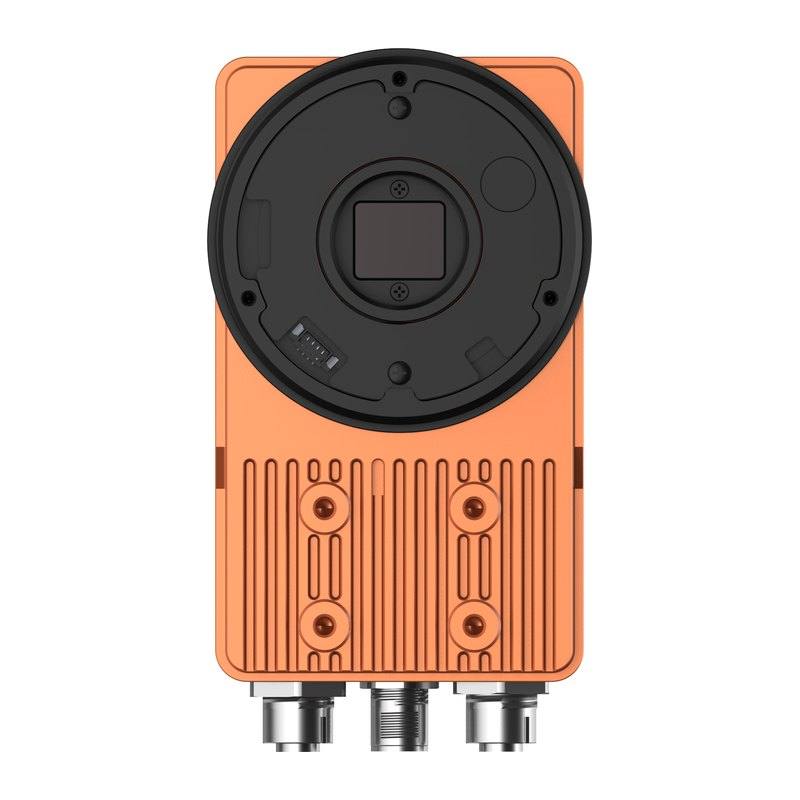
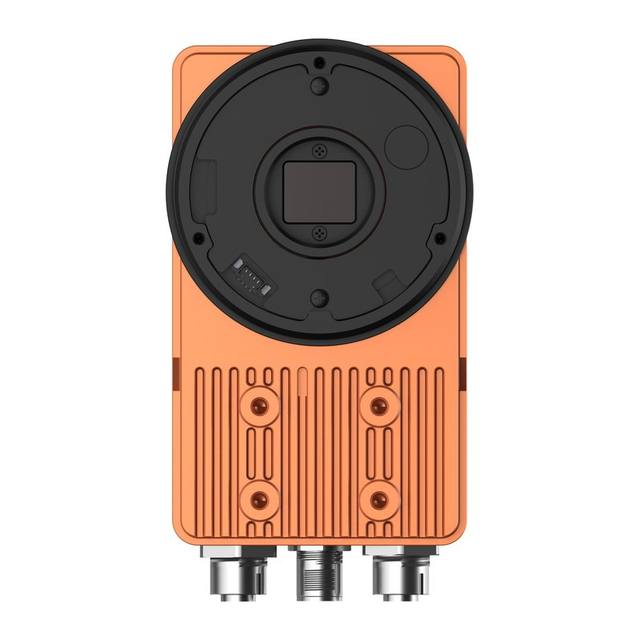
Twelve megapixels on a 1/1.7-inch sensor means very small pixels: 1.85 µm on a 4000 × 3000 px array, an active area of 7.4 mm × 5.6 mm (4000 × 1.85 µm by 3000 × 1.85 µm) and a diagonal of about 9.3 mm. The pitch moves the limit to the lens: Nyquist is 1 ÷ (2 × 1.85 µm) ≈ 270 lp/mm, and diffraction bites early. At 550 nm the Airy disk is about 2.44 × 0.55 µm × f-number, 5.4 µm (2.9 pixels) at f/4 and 10.7 µm (5.8 pixels) at f/8.
Over an example 100 mm field the sampling is 100 mm ÷ 4000 = 25 µm per pixel, so a 0.5 mm defect spans 20 px. The costs are a rolling shutter and 20 fps, and 12 MP × 20 fps = 240 MB/s at 8 bits per pixel is more than twice what a Gigabit port typically carries (about 115 MB/s). Like the rest of the X86 series this is a Windows 10 camera: MVP or your own SDK application analyses the images on board and only results leave.
Best for
Dimensional checks of small features in a field around 100 mm wide, where 25 µm per pixel (example) gives edges enough pixels for sub-pixel measurement.
Compact optics: the 9.3 mm image circle is covered by lenses made for 2/3-inch sensors (11 mm diagonal), which are typically smaller than 1-inch types, provided they resolve fine enough for 1.85 µm pixels.
Scratch and dent checks on stationary parts, where the extra pixels pay off and the rolling shutter does not skew the edges.
Selection notes
The lens decides the result. Choose one that covers at least 9.3 mm of image circle and is designed for pixels near 1.85 µm, and keep the aperture as open as depth of field allows, since at f/8 the Airy disk spans 5.8 pixels.
Small pixels collect less light (typical), so allow stronger lighting, and keep the exposure short enough that the part does not move during rolling readout.
For more pixels across the field, DH-MV-SI5B00MG002E gives 5472 px on a 1-inch sensor at 21 fps, at the cost of a larger lens.
Lighting is a separate item, and the three inputs and three outputs are not opto-isolated.
Follow these steps to bring up your iRAYPLE camera, capture a first image, and move from the viewer to your own application. The flow is the same across the A, AE, AX and L series; only the physical interface differs.
Download and install the iRAYPLE machine-vision SDK together with its viewer client for your operating system. The installer provides the camera drivers, the GenTL producer, and the viewer you will use for first light. For GigE Vision models, also install or enable the bundled filter/performance driver on the network adapter to maximize throughput.
2. Connect the camera to the correct interface
Wire the camera to its matching host interface: a dedicated Gigabit (or 10 GigE) NIC for GigE Vision models, a USB3 Vision port with a quality cable for USB3 models, or a frame grabber for CoaXPress models. Power the camera (PoE, USB bus power, or PoCXP / external supply as applicable). For GigE Vision, put the NIC and camera on the same subnet and, where supported, enable jumbo frames.
3. Detect and open the camera in the viewer
Launch the iRAYPLE viewer, run device enumeration, and select your camera from the discovered list. Open it to load the device feature tree (GenICam node map). If a GigE camera is found but cannot be opened, correct the IP configuration so the camera and NIC are in the same address range.
4. Set exposure, gain and trigger, then grab a first image
Start with continuous (free-run) acquisition under stable lighting. Adjust exposure time and gain for a well-exposed, low-noise image, set the pixel format (e.g. Mono8 or a Bayer/RGB format), and tune white balance on color models. Once the live image looks correct, switch trigger mode to hardware or software trigger to synchronize capture with your process, and verify a single triggered frame.
5. Move from the viewer to the SDK or a GenICam library
With imaging confirmed, reproduce the same settings in code using the SDK's C/C++ or Python API: enumerate, open, configure the relevant GenICam features, register a frame callback or grab loop, and convert frames to your pipeline's buffer format. Since the cameras are GenICam/GenTL-compliant, you can alternatively drive them from a third-party GenICam vision library. From here a stable image stream can feed a deep-learning inspection step such as Rosepetal for automated quality control.
Frequently asked questions
This one has a 1/1.7-inch sensor with 4000 × 3000 px at 1.85 µm and 20 fps; the 5B00 has a 1-inch sensor with 5472 × 3648 px at 2.4 µm and 21 fps. It needs a larger image circle but samples a given field about 1.4 times more finely (5472 ÷ 4000).
The rolling shutter at 20 fps suits indexed or slow parts. For moving parts, DH-MV-SI5500MG002E has a global shutter at 35 fps.
Camera Housing: Basler Camera housing ace 2 GigE, Basler Camera housing ace 2 USB / CXP / GMSL, Basler Camera housing ace USB, Basler Camera housing ace GigE