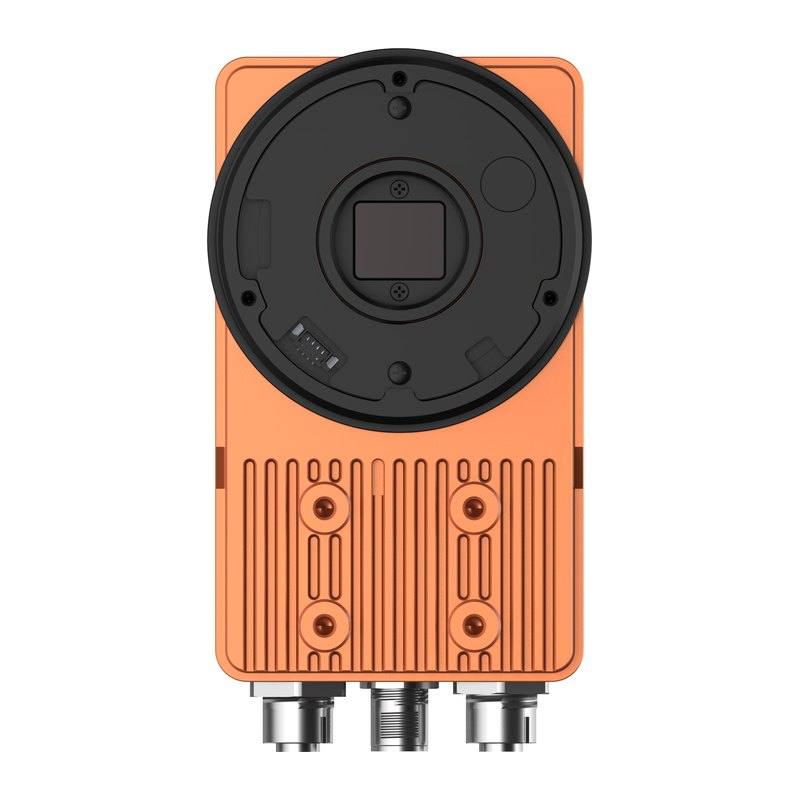
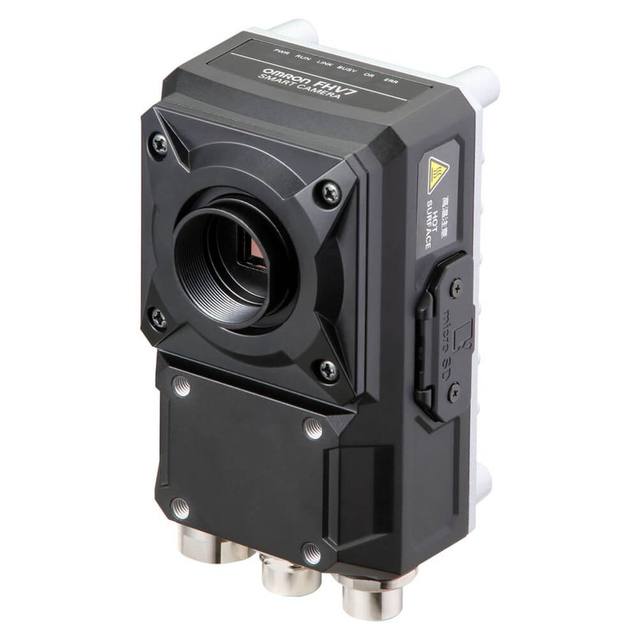
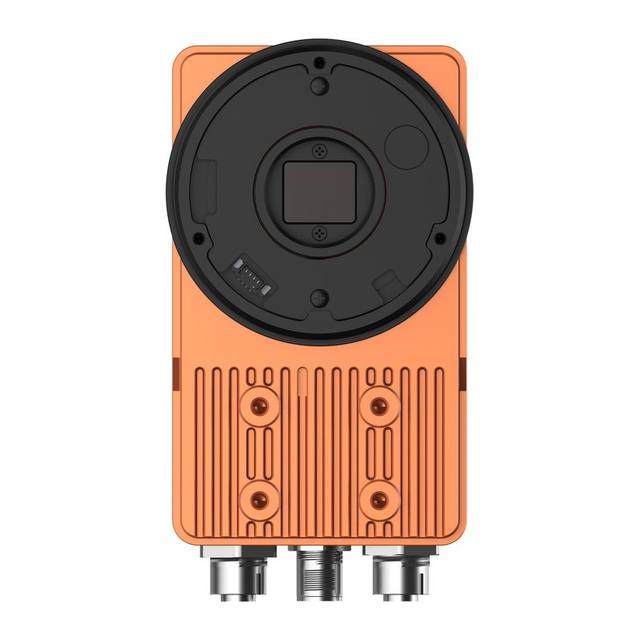
A 20 MP sensor on a 1-inch format: 5472 × 3648 px, 2.4 µm pixels, 21 fps and a rolling shutter. The active area is 13.1 mm × 8.8 mm (5472 × 2.4 µm by 3648 × 2.4 µm), a diagonal of about 15.8 mm, so the C-mount lens (not included) must be a 1-inch-format design. The pixel pitch matches DH-MV-SI5600MG002E, so the lens needs the same resolving power (Nyquist about 208 lp/mm); what changes is 1.8 times the width and 3.2 times the pixels (5472 ÷ 3072; 20.0 MP ÷ 6.3 MP).
Data volume decides how you use it. 20 MP × 21 fps ≈ 419 MB/s of 8-bit pixels is more than three times what a Gigabit port typically moves (about 115 MB/s, about 6 frames/s), so the analysis runs on the camera's x86 platform (Windows 10, MVP or your own SDK application) and images leave selectively. Over an example 100 mm field the sampling is 100 mm ÷ 5472 ≈ 18 µm per pixel, so a 0.1 mm feature spans about 5.5 px. Benchmark your algorithm at full resolution, since processing time typically grows with pixel count.
Best for
Large parts or panels inspected in one shot at fine sampling, kept stationary or indexed because of the rolling shutter.
Several small parts in one frame: the 5472 × 3648 px image holds four parts of 2736 × 1824 px each, so one trigger can check all four.
Defect inspection where an operator reviews rejects: over an example 100 mm field a 0.2 mm flaw spans about 11 px (0.2 mm ÷ 18.3 µm).
Selection notes
Lens: a 1-inch-format C-mount lens covering at least 15.8 mm and made for 2.4 µm pixels. Lenses for smaller sensors will vignette.
Rolling shutter at 21 fps suits stopped or slow parts. For moving parts under a strobe, DH-MV-SI5500MG002E has a global shutter.
If 6.3 MP is enough, DH-MV-SI5600MG002E has the same pixel pitch and 30 fps, and a lens covering only about 9 mm suffices.
Windows 10 reached end of support for most editions in October 2025. Check which Windows 10 edition is installed and how security updates are applied with your IT team before connecting the camera to a plant network.
Follow these steps to bring up your iRAYPLE camera, capture a first image, and move from the viewer to your own application. The flow is the same across the A, AE, AX and L series; only the physical interface differs.
Download and install the iRAYPLE machine-vision SDK together with its viewer client for your operating system. The installer provides the camera drivers, the GenTL producer, and the viewer you will use for first light. For GigE Vision models, also install or enable the bundled filter/performance driver on the network adapter to maximize throughput.
2. Connect the camera to the correct interface
Wire the camera to its matching host interface: a dedicated Gigabit (or 10 GigE) NIC for GigE Vision models, a USB3 Vision port with a quality cable for USB3 models, or a frame grabber for CoaXPress models. Power the camera (PoE, USB bus power, or PoCXP / external supply as applicable). For GigE Vision, put the NIC and camera on the same subnet and, where supported, enable jumbo frames.
3. Detect and open the camera in the viewer
Launch the iRAYPLE viewer, run device enumeration, and select your camera from the discovered list. Open it to load the device feature tree (GenICam node map). If a GigE camera is found but cannot be opened, correct the IP configuration so the camera and NIC are in the same address range.
4. Set exposure, gain and trigger, then grab a first image
Start with continuous (free-run) acquisition under stable lighting. Adjust exposure time and gain for a well-exposed, low-noise image, set the pixel format (e.g. Mono8 or a Bayer/RGB format), and tune white balance on color models. Once the live image looks correct, switch trigger mode to hardware or software trigger to synchronize capture with your process, and verify a single triggered frame.
5. Move from the viewer to the SDK or a GenICam library
With imaging confirmed, reproduce the same settings in code using the SDK's C/C++ or Python API: enumerate, open, configure the relevant GenICam features, register a frame callback or grab loop, and convert frames to your pipeline's buffer format. Since the cameras are GenICam/GenTL-compliant, you can alternatively drive them from a third-party GenICam vision library. From here a stable image stream can feed a deep-learning inspection step such as Rosepetal for automated quality control.
Frequently asked questions
It is if a 5 MP or 6.3 MP model already resolves your smallest feature with 3 to 5 px. More pixels cost processing time on the camera and demand a larger lens.
Not at full rate. One 20 MP frame is about 20 MB and Gigabit Ethernet typically carries about 115 MB/s, so about 6 frames per second.
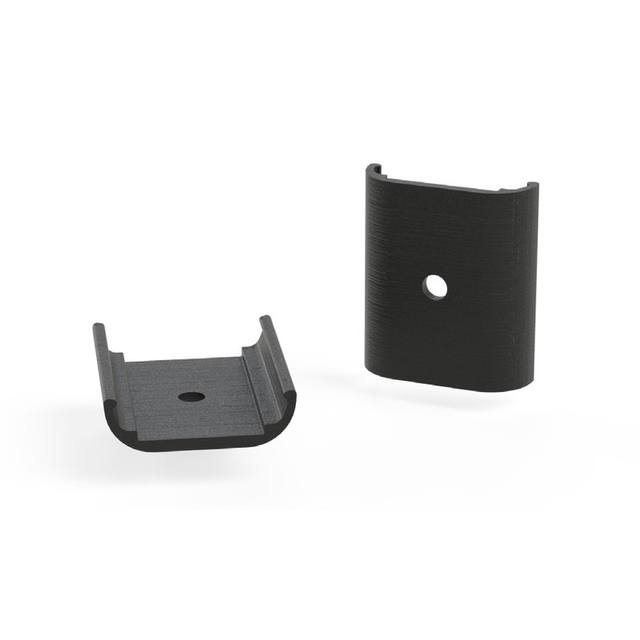
Camera Housing: Basler Camera housing ace 2 GigE, Basler Camera housing ace 2 USB / CXP / GMSL, Basler Camera housing ace USB, Basler Camera housing ace GigE