Skip to content
Omron / Sentech STC-MBS322U3V / STC-MCS322U3V machine vision camera
  • Rosepetal compatible
  • Recommended by AIS Vision

Omron / Sentech Sentech STC-MBS322U3V / STC-MCS322U3V (3.2MP USB3 Vision)

STC-MBS322U3V

The STC-MBS322U3V (mono) and STC-MCS322U3V (color) use a 1/1.8" Sony IMX252 Pregius global-shutter CMOS sensor with 2048 x 1536 (3.2 MP) effective resolution and 3.45 x 3.45 µm pixels, delivering up to 121 fps at 8-bit output. The camera connects over USB 3.0 SuperSpeed via a Micro-B connector and is USB3 Vision 1.0.1 and GenICam (SFNC 2.2 / PFNC 2.0) compliant, supporting 8/10/12-bit output with packed modes. It is bus-powered (+5 Vdc via USB, 4.2 W or less), uses a C-mount, and ships in a compact 28 x 28 x 40 mm aluminium housing weighing about 48 g. Features include ROI scanning, 2x binning/decimation, edge/pulse/start-stop triggering, auto exposure/gain, image flip, defective-pixel correction, and chunk/event functions; exposure ranges from 19 µs to 22 s with analog gain to ~19-24 dB.

Brand
Omron / Sentech
Camera type
Area scan
Interface
USB3 (USB 3.0 SuperSpeed, Micro-B)
Resolution
3.2 MP
Horizontal resolution
2048 x 1536 px
Mono / color
Mono (STC-MBS322U3V) / Color (STC-MCS322U3V)
Sensor manufacturer
Sony Pregius
Sensor model
Sony IMX252
Shutter
Global shutter
FPS
Up to 121.0 fps (8-bit); 60.5 fps (10/12-bit)
Mount
C-mount
Sensor size
1/1.8"

Technical overview

This is an area-scan camera built around the 1/1.8-inch Sony IMX252 Pregius global-shutter CMOS sensor, delivering 2048 x 1536 (3.2 MP) effective resolution from 3.45 x 3.45 um pixels. The global shutter is the headline characteristic for an installer: every pixel is exposed simultaneously, so parts moving on a conveyor, on a rotary table, or under a robot end-effector are captured without the skew or smear that a rolling-shutter sensor would introduce. Combined with up to 121 fps at 8-bit output (dropping to 60.5 fps at 10/12-bit), this makes it well suited to high-throughput inline inspection where you need geometric fidelity on moving targets rather than just a high frame count. The 1/1.8-inch optical format and 3.45 um pixel pitch are a balanced combination: they give enough resolution for fine defect and code-reading work while keeping pixels large enough to hold reasonable sensitivity and avoid forcing extremely bright lighting.

The interface is USB 3.0 SuperSpeed over a Micro-B connector, with full USB3 Vision 1.0.1 and GenICam (SFNC 2.2 / PFNC 2.0) compliance, so it drops into any USB3 Vision-aware software stack without proprietary drivers. The camera is bus-powered at +5 Vdc drawing 4.2 W or less, which means a single cable carries both power and data and no separate power supply or PoE injector is required. That is a practical advantage for compact cells and benchtop rigs, with the standard caveat that USB3 cabling is best kept short and routed away from drag chains; this is a single-camera-per-controller, short-run interface rather than a long-haul or heavily multiplexed one. Output supports 8/10/12-bit with packed modes, so you can trade frame rate for bit depth when an application needs finer gradation. The unit is offered in monochrome (STC-MBS322U3V) and color (STC-MCS322U3V) variants, letting you pick the mono version for maximum resolution and sensitivity on metrology, OCR/OCV and code reading, or the color version where part color or print verification matters.

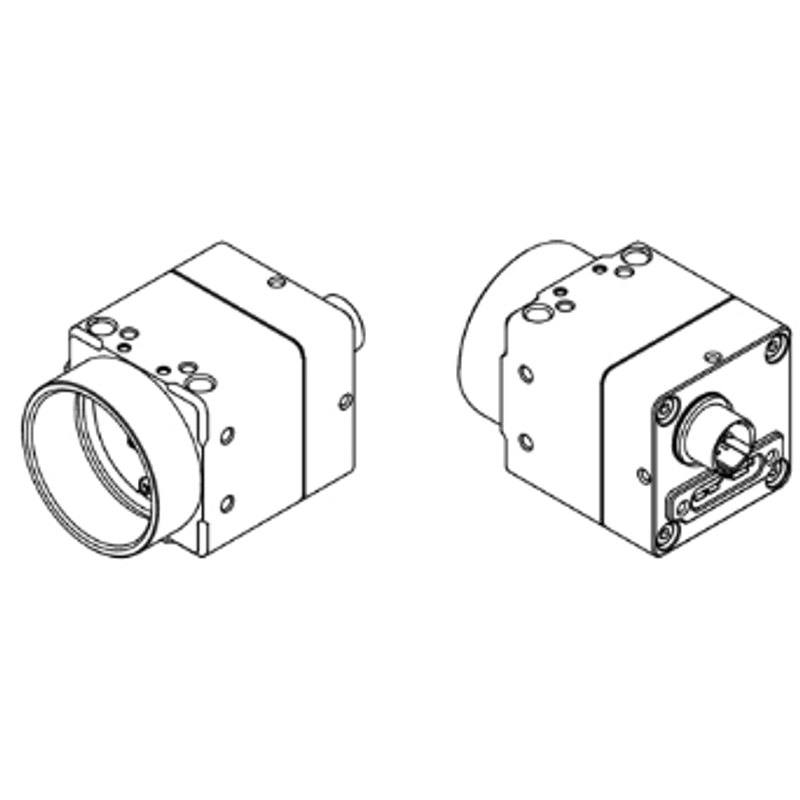
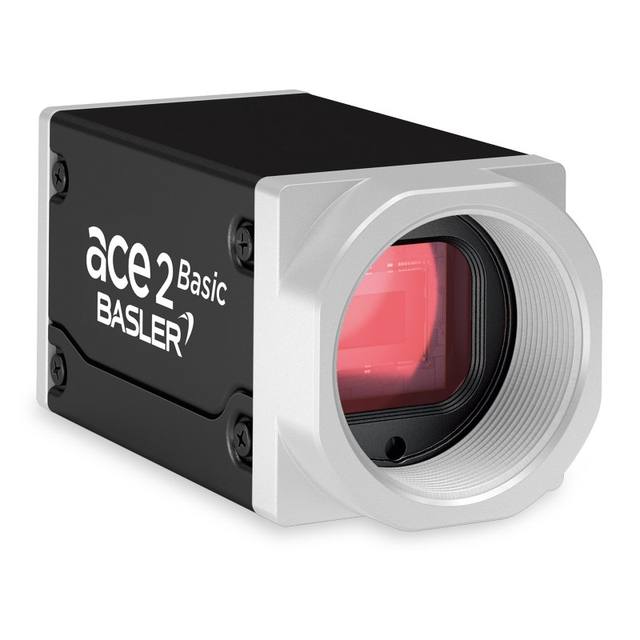
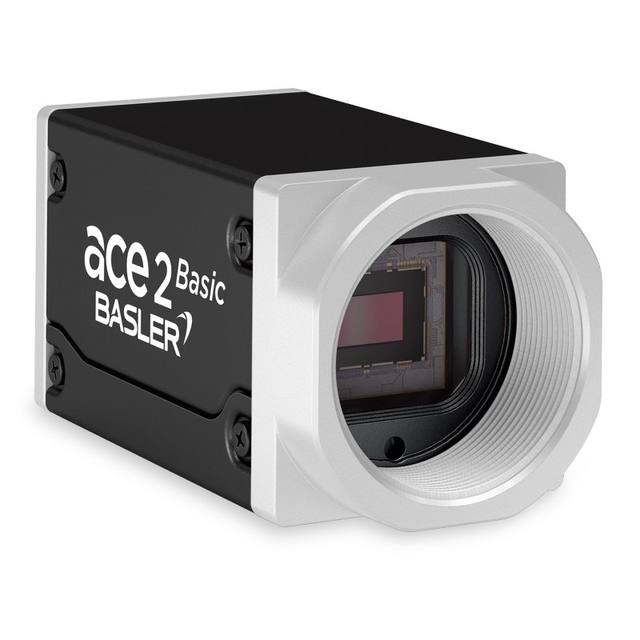
Mechanically the camera uses a C-mount and ships in a 28 x 28 x 40 mm aluminium housing weighing about 48 g, which is genuinely small and light enough to mount on a moving axis or fit into a tight multi-camera array. The C-mount and 1/1.8-inch format keep lens selection straightforward and economical, though the lens you choose must resolve the 3.45 um pixel pitch to extract the full 3.2 MP. On the integration side the feature set is broad: ROI scanning and 2x binning/decimation to trade resolution for speed, edge/pulse/start-stop triggering for synchronizing to an encoder or PLC, auto exposure and gain, image flip, defective-pixel correction, and chunk/event functions for metadata and event reporting. Exposure is adjustable from 19 us up to 22 s with analog gain to roughly 19-24 dB, so the same camera handles both strobed high-speed captures and long, low-light integrations. Because it has a global shutter and hardware triggering, it pairs naturally with strobed LED illumination: freeze motion with a short exposure synchronized to a trigger pulse, and the global shutter ensures the whole frame sees the same flash. Operating temperature is rated 0 to +65 C.

Best for

  • High-speed inline defect inspection of parts moving on a conveyor or rotary table, using the global shutter and up to 121 fps to capture distortion-free images at full throughput
  • Industrial OCR/OCV and 1D/2D code traceability reading, where the mono variant's 3.2 MP resolution and global shutter give sharp, motion-stable character and code images
  • Dimensional measurement and metrology on moving or indexed parts, where simultaneous-exposure global shutter preserves geometric accuracy
  • Robot-guidance and pick-and-place vision, where the 48 g, 28 x 28 x 40 mm body mounts on a moving arm and the single bus-powered USB3 cable simplifies routing
  • Compact electronics, semiconductor and packaging inspection cells where a small bus-powered camera and short USB3 run keep the footprint and wiring minimal

Selection notes

  • Choose the variant by task: STC-MBS322U3V (mono) for maximum resolution and sensitivity on measurement, OCR/OCV and code reading; STC-MCS322U3V (color) only where part or print color must be evaluated.
  • Plan for the USB3 interface limits: it is bus-powered over a Micro-B connector at 4.2 W or less with no separate supply needed, but keep cable runs short and away from drag chains, and budget one USB3 host port per camera rather than expecting long-distance or multi-camera trunking.
  • Match the lens to the sensor: the C-mount and 1/1.8-inch format are easy to source, but the lens must resolve the 3.45 um pixel pitch to realize the full 2048 x 1536 resolution; size the lens for your working distance and field of view.
  • Budget bit depth against speed: 121 fps is achieved at 8-bit, dropping to 60.5 fps at 10/12-bit, so reserve the higher bit depths only where gradation matters and confirm the resulting frame rate meets cycle time.
  • Use the hardware triggering and global shutter together with strobed lighting: edge/pulse/start-stop trigger inputs let you sync exposure to an encoder or PLC, and a short strobed exposure freezes motion across the whole frame; ROI and 2x binning are available to raise frame rate or sensitivity when needed.
  • Verify the thermal environment: the camera is rated for 0 to +65 C operation, and the aluminium housing aids heat dissipation, but ensure mounting allows that range in the installed location.

Specifications: General
BrandOmron / Sentech
Camera typeArea scan

Specifications: Sensor
Resolution3.2 MP
Horizontal resolution2048 x 1536 px
Mono / colorMono (STC-MBS322U3V) / Color (STC-MCS322U3V)
Sensor manufacturerSony Pregius
Sensor modelSony IMX252
ShutterGlobal shutter
Sensor size1/1.8"
Pixel size3.45 x 3.45 µm

Specifications: Performance
FPSUp to 121.0 fps (8-bit); 60.5 fps (10/12-bit)

Specifications: Interface
InterfaceUSB3 (USB 3.0 SuperSpeed, Micro-B)
ProtocolsUSB3 Vision 1.0.1, GenICam (SFNC 2.2 / PFNC 2.0)

Specifications: Optics
MountC-mount

Specifications: Electrical
PowerUSB bus power (+5 Vdc), 4.2 W or less

Specifications: Environment
Operating temperature0 to +65 °C

Specifications: Mechanical
Dimensions28 (W) x 28 (H) x 40 (D) mm
Weight48 g
Housing materialAluminium

Frequently asked questions

Related technical guides

Rosepetal · AI

Test this camera with Rosepetal

Validate your visual inspection with AI: send us sample images and we evaluate the case on your hardware.

AIS Vision · Integration

We validate camera + lens + lighting

AIS Vision defines and tests the optimal combination of camera, optics and lighting for your application before you buy.