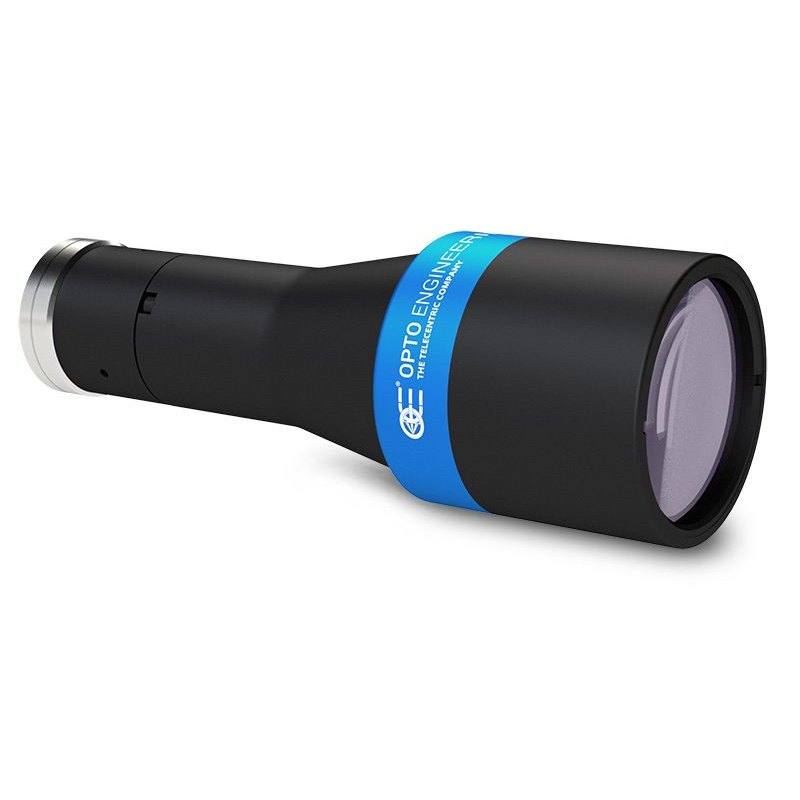
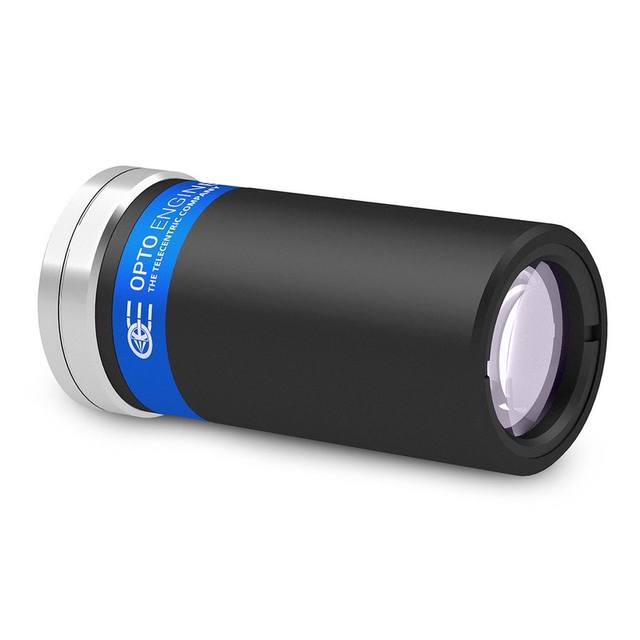
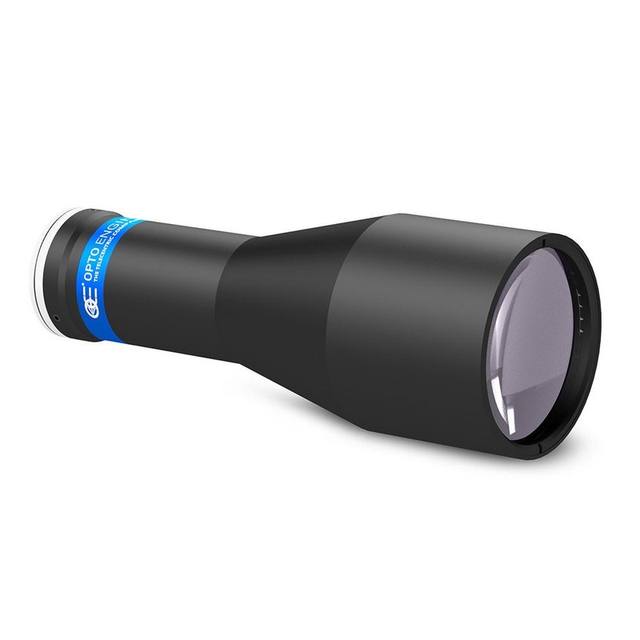
The Opto Engineering TC1MHR036-C is a high resolution telecentric lens for 1/1.2″ sensors. It provides 0.295× magnification over an image circle of Ø 13.3 mm (max sensor 1/1.2″), so a 1/1.2″ sensor is fully covered and smaller formats sit well inside the circle. At 0.295× the lens images a broad area of the object onto the sensor, so match the pixel count to the smallest detail you need to measure.
Telecentricity is <0.08° typical with a 0.10° maximum, while distortion is <0.08% typical with a 0.10% maximum. Telecentric imaging keeps the chief rays nearly parallel to the optical axis, so changes in object distance within the depth of field produce little change in apparent size. That property suits measurement of features such as slot widths, pin spacing and edge positions, where a size change from perspective would skew the result.
The 102.6 mm working distance gives room for lighting and fixturing between the lens and the object. The working f-number (wF/#) of 11 sets the depth of field and light throughput, so check illumination and exposure against the chosen camera and the part motion. The C-mount attaches directly to C-mount camera bodies.
Best for
Gauging of machined components where slot widths, pin spacing or edge positions must be measured with limited perspective error.
Inspection of parts at a 102.6 mm object distance, with room for lighting and fixturing.
Telecentric imaging of 1/1.2″ sensors in general inspection cells.
Measurement systems built around C-mount cameras.
Selection notes
Keep the sensor no larger than 1/1.2″, since the image circle is Ø 13.3 mm.
Set the object plane at 102.6 mm, the working distance at which the stated 0.295× magnification is specified.
Plan lighting for wF/# 11 and verify exposure time for any part motion.
Use the maximum figures (0.10° telecentricity and 0.10% distortion) when setting tolerance budgets.
Align the lens square to the part plane, because telecentric accuracy depends on alignment as much as on the lens figures.
Specifications: General
Brand
Opto Engineering
Specifications: Optical
Lens mount
C-mount
Image circle / max sensor
Ø 13.3 mm (max sensor 1/1.2″)
Magnification
0.295×
Working distance
102.6 mm
Telecentric
Yes
Applications this product is commonly selected for. Open one to see the full recommended hardware and approach.
Matched automatically by: camera mount fits the lens mount · camera sensor is covered by the lens image circle — this lens: C-mount · Ø 13.3 mm (max sensor 1/1.2″) image circle.