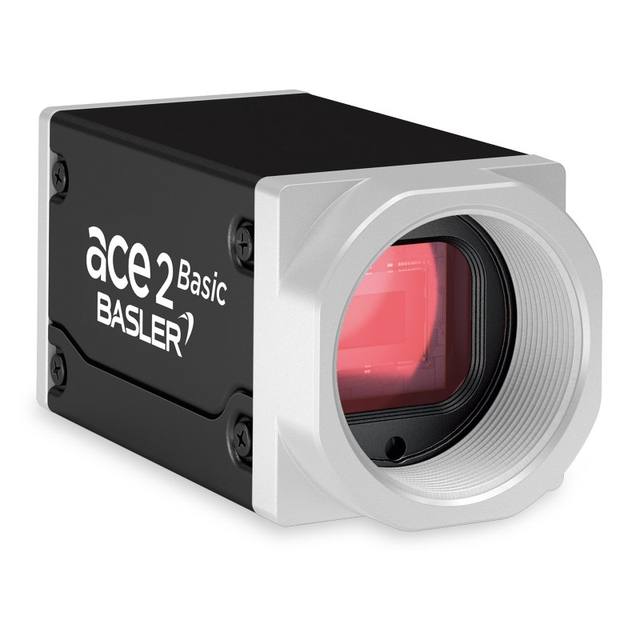
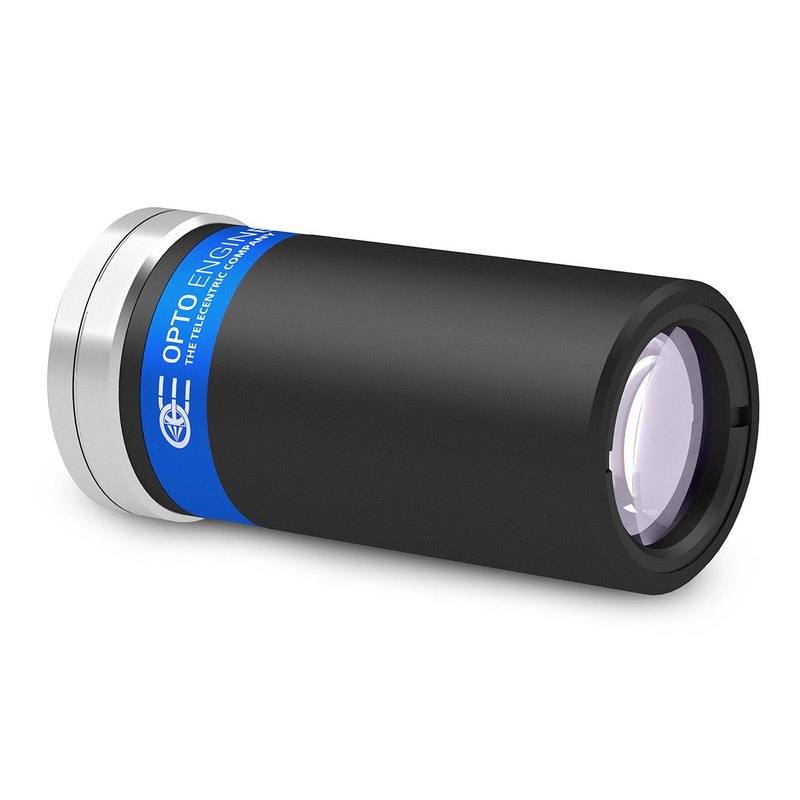
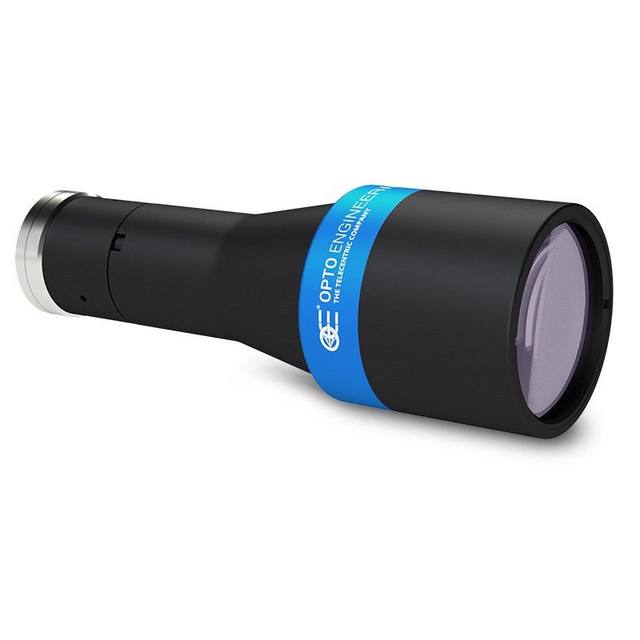
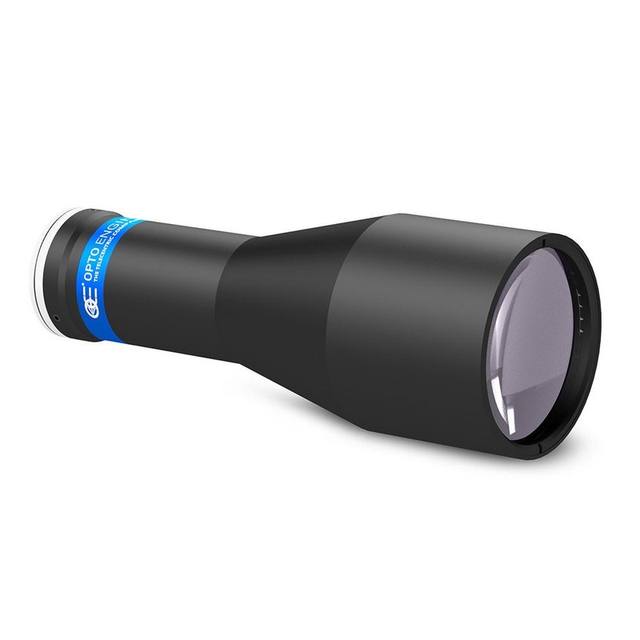
The Opto Engineering TC13016 is a bi-telecentric lens for 1/3″ sensors, with 0.290× magnification, a short working distance of 43.1 mm and a C-mount. Its image circle is listed as Ø 6.0 mm for a maximum 1/3″ sensor. The short working distance places the lens close to the object, which suits compact inspection cells where the part can sit near the optics.
Being bi-telecentric, the lens is telecentric on both the object and image sides. That helps keep image scale steady as the object moves within the depth of field and as the image plane shifts slightly. The published figures are distortion below 0.04% typical (0.08% maximum) and telecentricity below 0.08° typical (0.10° maximum), which keep optical error small when edge positions are measured.
The working f-number is wF/# 8. It provides depth of field, but the small image on a 1/3″ format needs sufficient light, so illumination and exposure should be set for this aperture. Keep the sensor within the Ø 6.0 mm image circle so that the full sensor area is covered.
Best for
Measurement of small parts with a 1/3″ C-mount camera at 0.290× magnification
Compact inspection cells where the lens sits close to the object at a 43.1 mm working distance
Gauging tasks that depend on image scale staying steady as parts vary in position
Edge-based dimensional checks where distortion below 0.04% typical is part of the requirement
Selection notes
Match the camera to the 1/3″ format and keep the sensor within the Ø 6.0 mm image circle.
Confirm the C-mount on the camera before ordering.
The 43.1 mm working distance is short, so plan the lighting, fixtures and any guarding so they do not interfere with the lens at that distance.
The wF/# 8 aperture needs enough light on the small image, so set illumination and exposure for it.
Include the listed distortion (below 0.04% typical, 0.08% maximum) and telecentricity (below 0.08° typical, 0.10° maximum) in the measurement uncertainty budget.
Specifications: General
Brand
Opto Engineering
Specifications: Optical
Lens mount
C-mount
Image circle / max sensor
Ø 6.0 mm (max sensor 1/3″)
Magnification
0.290×
Working distance
43.1 mm
Telecentric
Yes
Applications this product is commonly selected for. Open one to see the full recommended hardware and approach.
Matched automatically by: camera mount fits the lens mount · camera sensor is covered by the lens image circle — this lens: C-mount · Ø 6.0 mm (max sensor 1/3″) image circle.
The image circle is Ø 6.0 mm, given for a maximum 1/3″ sensor.
Yes. It is described as a bi-telecentric lens, with telecentricity below 0.08° typical (0.10° maximum) and distortion below 0.04% typical (0.08% maximum).