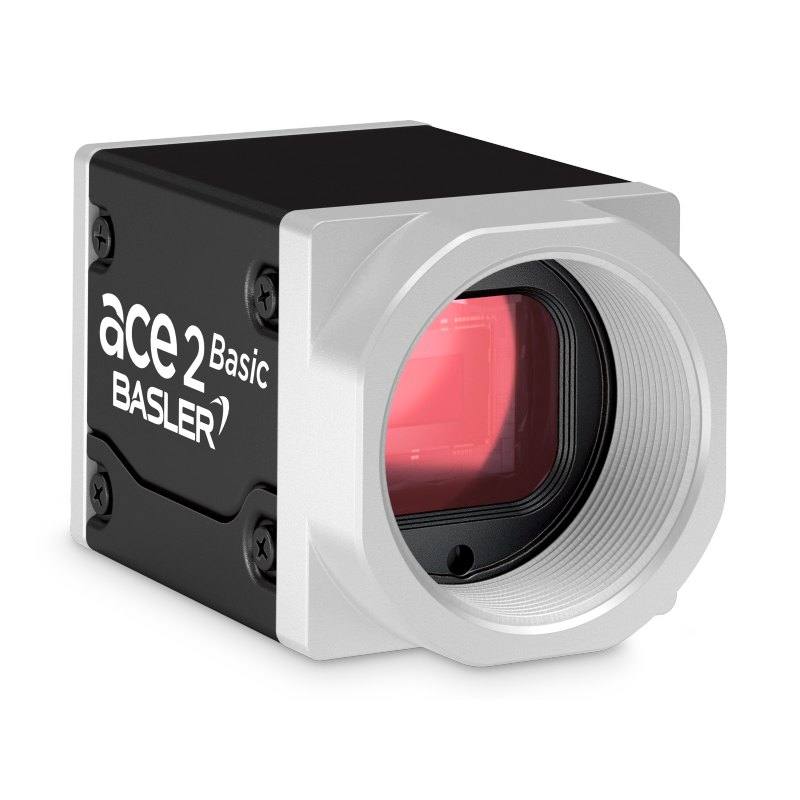
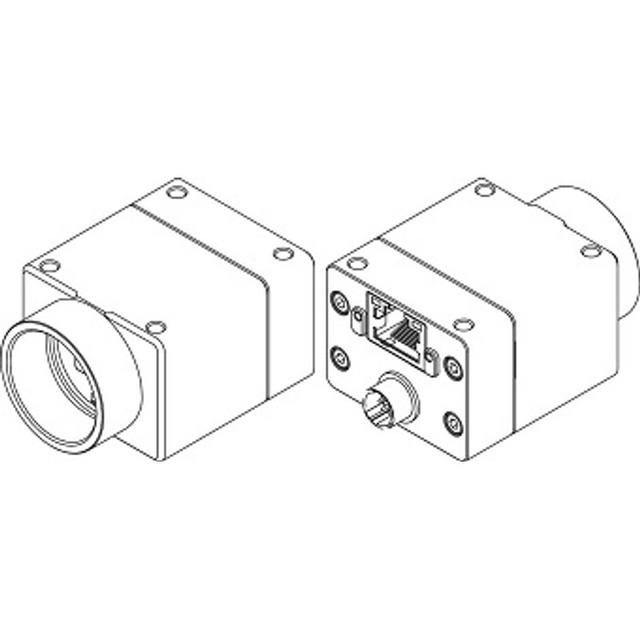
The Basler ace 2 a2A2600-64uc is part of Basler's ace 2 R (USB) series, equipped with the Gpixel GMAX2505 progressive scan CMOS sensor in a 1/2" format. It achieves 64 fps at full 2600 × 2160 resolution (5.6 MP) over a USB 3.0 SuperSpeed interface, with a 2.5 µm pixel pitch and global shutter for distortion-free imaging of moving objects. The camera supports 8, 10, and 12-bit pixel depth, hardware and software triggering, and conforms to USB3 Vision and GenICam standards. It features a C-mount lens interface, IP30 protection rating, and is available in BAS (Basic) and PRO variants sharing the same core sensor and optics.
The Basler ace 2 a2A2600-64uc pairs a Gpixel GMAX2505 global shutter CMOS sensor with a 2.5 µm pixel pitch on a compact 1/2" optical format (6.52 mm × 5.42 mm, 8.45 mm diagonal) to deliver 5.6 MP (2600 × 2160) images at up to 64 fps — or 70.4 fps when the USB 3.0 throughput limit is disabled. Global shutter readout means all pixels are exposed simultaneously, eliminating the rolling-shutter skew and wobble that would corrupt imagery of fast-moving parts on a conveyor or a robot-held component. The 2.5 µm pixel pitch is fine enough to capture high spatial detail across that 5.6 MP array, giving a good balance of field-of-view coverage and per-pixel resolution without demanding unusually fast lenses. The color sensor variant covered here separates component color, label hue, and surface finish differences that a monochrome sensor cannot distinguish, making it especially useful for packaging integrity checks, pharmaceutical tablet sorting, and label-print verification where chromatic defects are the primary reject criterion.
The USB 3.0 SuperSpeed interface (5 Gbit/s) buses the full 5.6 MP stream at 64 fps without the per-port bandwidth contention that can affect GigE multi-camera setups, and it also supplies camera power (approximately 3 W at 5 VDC) directly from the host port, cutting cable runs. The BAS variant additionally accepts 12–24 VDC via the I/O connector for installations where the USB power budget is reserved for other peripherals. Both hardware and software triggering are supported under the USB3 Vision / GenICam standard framework, so the camera integrates directly into any compliant vision runtime — pylon, Halcon, VisionPro, or open-source alternatives — without vendor-specific driver shims. Pixel depth is selectable at 8, 10, or 12 bits: 8-bit maximises throughput for OCR and barcode tasks; 10 or 12 bit retains the sensor's tonal headroom for dimensional measurement and surface-defect grading where subtle grey-level differences carry diagnostic information.
The C-mount lens interface keeps the installed base of high-resolution industrial lenses available, though integrators should verify image circle: the 8.45 mm diagonal of the 1/2" sensor is covered by standard C-mount lenses designed for 1/2" or larger formats, so lens selection is straightforward and cost-effective. The box housing measures only 42.8 × 29 × 29 mm and weighs 85 g, which eases mounting inside tight inspection enclosures or on robot end-effectors. The IP30 rating protects against solid-particle ingress, sufficient for enclosed machine-vision cabinets; harsher wash-down or outdoor environments require an external housing. Operating temperature spans −10 to 60 °C for the BAS variant (−10 to 50 °C for PRO), covering typical factory-floor ranges. Hardware trigger input enables precise synchronisation with a strobe light source to freeze motion cleanly at 64 fps — an important pairing decision, since the small 2.5 µm pixels benefit from well-controlled, high-intensity illumination to maintain dynamic range under short exposures.
Best for
High-throughput packaging line inspection where color label verification, print quality, and seal-integrity checks must run simultaneously at conveyor speeds approaching 64 frames per second
Electronics and semiconductor assembly defect detection — global shutter eliminates the component-vibration smear that would compromise solder-joint and component-placement inspection at 5.6 MP detail
Pharmaceutical tablet and blister-pack sorting requiring simultaneous color and dimensional data from the same image, leveraging 10- or 12-bit depth to resolve subtle coating or chipping defects
Robot guidance and pick-and-place applications where the small 85 g form factor and USB bus power simplify end-effector integration and the global shutter prevents pose-estimation errors from fast arm motion
Industrial OCR/OCV and 2D/DPM code reading on moving parts, where 5.6 MP resolution provides adequate field coverage to read both large date-lot codes and fine DataMatrix marks in a single shot without mechanical zoom changes
Selection notes
Lens image circle must cover the 1/2" sensor diagonal (8.45 mm): confirm the chosen C-mount lens is rated for 1/2" or larger format, and check that corner resolution meets the application's MTF requirement — not just the centre specification
The 2.5 µm pixel pitch imposes a relatively tight diffraction limit: apertures beyond roughly f/5–f/6 begin to diffraction-limit the pixel at visible wavelengths, so lens selection should target fast, low-distortion optics (f/2.8–f/4 working aperture) rather than stopping down for depth of field
USB 3.0 cable length is limited to approximately 5 m without an active extension; for distances beyond that, plan for an active USB extender or switch to a GigE variant if longer runs are unavoidable — this is a layout constraint, not a camera limitation
IP30 protection suits enclosed cabinets but is insufficient for direct exposure to coolant mist or wash-down: specify a sealed enclosure or housing if the camera will face liquid splash, and verify the operating-temperature ceiling (60 °C BAS, 50 °C PRO) against enclosure thermal modelling
Color Bayer interpolation reduces effective spatial resolution by roughly half a pixel compared with a monochrome sensor of the same pixel count; for applications where the finest edge detection or sub-pixel measurement accuracy is paramount, evaluate whether the monochrome variant of this camera better matches the requirement
Specifications: General
Brand
Basler
Camera type
Area Scan
Specifications: Sensor
Resolution
5.6 MP
Horizontal resolution
2600 × 2160 px
Mono / color
Color
Sensor manufacturer
Gpixel
Sensor model
Gpixel GMAX2505
Shutter
Global Shutter
Sensor size
1/2" (6.52 mm × 5.42 mm, 8.45 mm diagonal)
Pixel size
2.5 µm × 2.5 µm
Specifications: Performance
FPS
64 fps (70.4 fps max w/ throughput limit off)
Specifications: Interface
Interface
USB 3.0 (SuperSpeed, 5 Gbit/s)
Protocols
USB3 Vision, GenICam
Specifications: Optics
Mount
C-Mount
Specifications: Electrical
Power
USB 3.0 (≈3 W @ 5 VDC); BAS also supports 12–24 VDC via I/O connector
Specifications: Environment
IP rating
IP30
Operating temperature
-10 to 60 °C (BAS); -10 to 50 °C (PRO)
Specifications: Mechanical
Housing material
Box
Dimensions
42.8 × 29 × 29 mm
Weight
85 g
Applications this camera is commonly selected for. Open one to see the full recommended hardware and approach.
Matched automatically by: lens mount fits the camera mount · lens image circle covers the camera sensor — this camera: C-Mount · 1/2" (6.52 mm × 5.42 mm, 8.45 mm diagonal) sensor.
By category
All 229C-mount lenses 164Telecentric lenses 62F-mount / large-format lenses 3
By brand
All 229Omron / Sentech 74iRAYPLE 66Basler 59Datalogic / Datasensing 30
Get a first image quickly with the pylon Viewer, then move into the pylon SDK for your application. These cameras are GenICam/GenTL-compliant, so any compliant vision software can drive them as well.
Download and install the pylon Camera Software Suite for your OS from Basler. This provides the pylon Viewer, the GenTL transport-layer producers and the pylon SDK (C/C++/.NET/Python). On Windows the installer adds the needed drivers; on Linux follow the included setup notes for USB and network permissions.
2. Connect the camera and check the link
Cable the camera to its matching interface: GigE Vision to a GigE port (use a quality cable and, ideally, a dedicated NIC with jumbo frames enabled), USB3 Vision to a USB 3.x port with the supplied cable, or CoaXPress to the frame grabber. Provide power where required (PoE, USB bus power, or PoCXP). Open the pylon Viewer and confirm the camera appears in the device list; for GigE, make sure the camera and NIC are on the same subnet.
3. Grab a first image and set exposure, gain and pixel format
Select the camera in the pylon Viewer and start a continuous grab. Adjust exposure time and gain until the image is well exposed (avoid clipped highlights), set the pixel format (e.g. Mono8 or a Bayer/RGB format), and focus the lens. Use a test pattern if the lens or scene is not ready yet.
4. Configure triggering and acquisition
Decide between free-run and triggered acquisition. For synchronized capture, set the trigger source (software or a hardware line on the I/O connector), trigger mode and any debounce or exposure mode, then verify timing. Note the parameter names you change in the Viewer feature tree, as you will reuse them in code.
5. Move to the SDK or a GenICam-compliant library
Recreate your settings in code with the pylon SDK (C, C++, .NET or Python) to open the device, apply the same features and pull frames into your pipeline; pylon vTools and pylon AI can add processing blocks. Because the cameras are GenICam/GenTL standard, third-party vision libraries work too. Once the image stream is stable, you can route frames to a deep-learning inspection such as Rosepetal for automated defect detection.
Frequently asked questions
At full 2600 × 2160 resolution the camera delivers 64 fps within the USB 3.0 5 Gbit/s bandwidth envelope, rising to 70.4 fps when the throughput limit is disabled. Reducing ROI or switching from 12-bit to 8-bit pixel depth reduces per-frame data and allows higher frame rates, the exact figures for which are available in Basler's pylon Bandwidth Calculator.
Yes. The Gpixel GMAX2505 uses a global shutter, meaning every pixel on the 2600 × 2160 array is exposed at exactly the same instant. There is no rolling-shutter line-by-line scan, so fast-moving objects are captured without skew, wobble, or partial-exposure artefacts — provided exposure time is kept short enough to freeze the motion optically.
The camera draws approximately 3 W at 5 VDC from the USB 3.0 port, so a standard SuperSpeed host port or powered hub supplies all necessary power without a separate PSU. The BAS variant additionally accepts 12–24 VDC through the I/O connector, giving flexibility in installations where the USB power budget is constrained.
The camera uses a C-mount interface. The sensor measures 6.52 mm × 5.42 mm with an 8.45 mm diagonal (1/2" format). Any C-mount lens rated for a 1/2" or larger image circle will illuminate the full sensor; lenses designed for smaller formats (e.g. 1/3") will vignette the corners and should be avoided.
Yes. The camera conforms to the USB3 Vision and GenICam standards, which are supported natively by Basler pylon, Cognex VisionPro, MVTec HALCON, National Instruments Vision, and most open-source GenICam-compliant runtimes. No proprietary driver layer is required beyond a USB3 Vision-compliant transport layer.