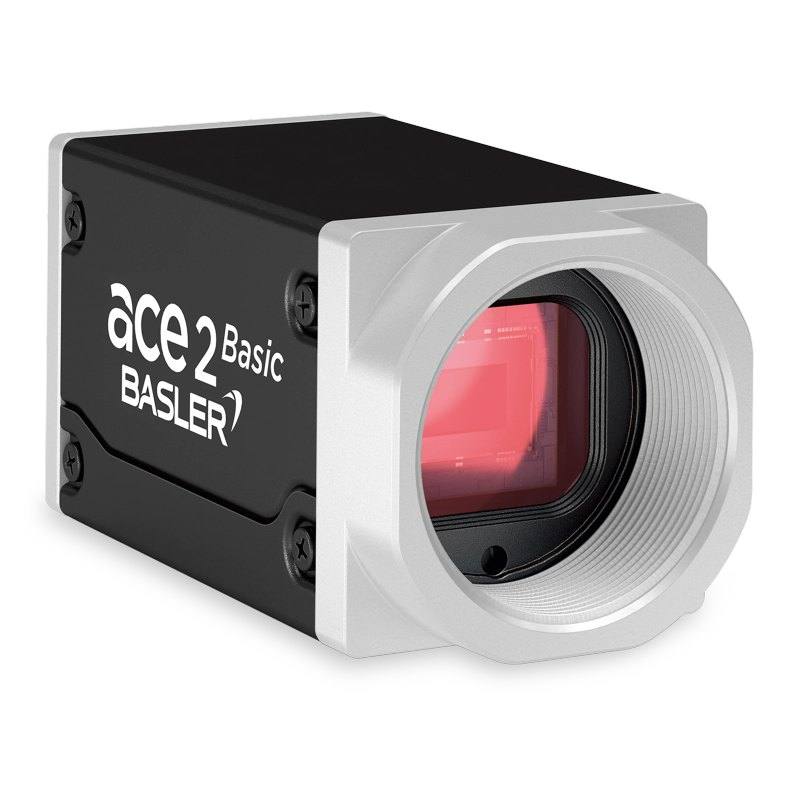
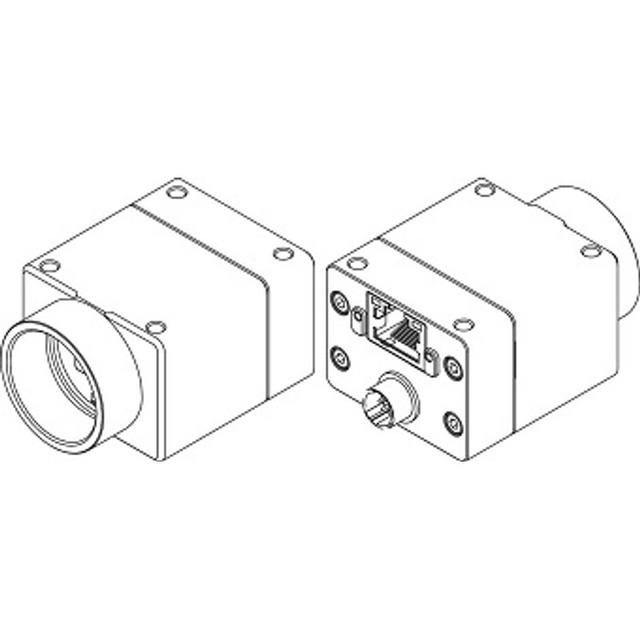
The Basler a2A3536-42g5cBAS is a 5GigE area scan camera from the ace 2 Basic (BAS) family, equipped with the Sony IMX676-AACR1-C CMOS rolling shutter sensor at 12.5 MP (3536 x 3552 pixels full resolution). It delivers up to 42.49 fps and features a 2.0 µm pixel pitch on a 1/1.6" optical format. The camera supports GigE Vision 2.0 and GenICam protocols, is powered via a 12–24 VDC M8 6-pin connector, and carries an IP30 protection rating in a compact 29 x 29 mm cross-section housing.
The Basler a2A3536-42g5cBAS is built around the Sony IMX676-AACR1-C CMOS sensor — a 1/1.6" (7.1 x 7.1 mm) chip running at 12.5 MP (3536 x 3552 pixels) with a 2.0 µm pixel pitch and a rolling shutter. At full resolution the camera sustains 42.49 fps over 5GigE, making it one of the faster double-digit-megapixel options in the ace 2 Basic range. The 2.0 µm pixel pitch extracts high spatial detail from a relatively compact optical format, but integrators should account for rolling-shutter behaviour when targets or the camera itself move: fast conveyor lines or vibrating fixtures will require either electronic synchronisation with a short strobe pulse or a mechanical approach that keeps exposure time well below the row-readout period to avoid skew artefacts. The IR cut filter is permanently fitted, so the sensor delivers accurate colour fidelity under broadband illumination without additional external filters in most setups.
The 5GigE interface (GigE Vision 2.0 / GenICam compliant) operates natively at 5 Gbit/s while auto-negotiating down to 2.5G, 1G, or 100M Ethernet, giving the system builder flexibility to match existing switch infrastructure or dedicate a 5GigE NIC for full throughput. At 12.5 MP and 42.49 fps the raw pixel stream is approximately 534 Mpx/s — a 5GigE link comfortably carries this with headroom for metadata and transport overhead. Power arrives via the M8 6-pin connector (12–24 VDC, 5.8 W); PoE power delivery is also supported via an optional external injector on the Ethernet cable, which simplifies cable routing in gantry or robotic installations. The compact 48.9 x 29 x 29 mm body at 100 g and the standard C-mount lens interface make it straightforward to integrate into tight brackets or multi-camera rigs. IP30 protection is adequate for clean indoor factory environments; installations with coolant mist or wash-down requirements will need an enclosure.
The C-mount on a 1/1.6" sensor imposes a clear lens-selection discipline: any lens specified must resolve across a 7.1 x 7.1 mm image circle at 2.0 µm pixel pitch (Nyquist ~250 lp/mm at the sensor). At 12.5 MP, lens quality rather than sensor resolution is usually the limiting factor, so pairing with high-performance C-mount lenses corrected for 1" or larger format is advisable. At practical working distances, the 3536 px horizontal dimension delivers sub-pixel measurement capability on relatively large fields of view — for example, a 200 mm wide field yields roughly 56 µm/px, while a 50 mm field reaches ~14 µm/px — making the camera well suited to dimensional gauging tasks where moderate accuracy is needed without moving to a line-scan platform. Illumination pairing should account for the rolling shutter: continuous LED illumination with a sufficiently short exposure, or a strobe flash timed to complete before row scanning reaches mid-frame, will minimise motion artefacts on faster lines.
Best for
High-resolution surface and defect inspection on slow-to-moderate-speed lines where colour differentiation aids classification (e.g. cosmetic defects, contamination, coating uniformity).
Packaging and label inspection requiring simultaneous OCR/OCV and barcode decoding across a wide field at 12.5 MP, avoiding the need for multiple lower-resolution cameras.
Dimensional measurement of parts up to ~200 mm where sub-pixel accuracy at a single station is sufficient and a rolling-shutter artefact budget can be managed through controlled illumination.
Robot guidance and bin-picking applications in structured lighting environments where 42 fps provides responsive pose updates and the compact 29 x 29 mm body fits within arm-mounted brackets.
Traceability and code-reading stations (1D/2D/DPM) where the 12.5 MP resolution resolves small or high-density codes printed on fast-moving cartons without requiring a dedicated high-speed camera.
Selection notes
Rolling shutter requires careful illumination design: use a strobe duration shorter than the frame readout period, or continuous illumination combined with an exposure time that keeps motion blur within one pixel at the target's maximum velocity. On lines faster than roughly 0.3 m/s at typical working distances, evaluate whether a global-shutter alternative is warranted.
The 5GigE interface demands a 5GigE-capable NIC or managed switch port on the host PC; standard GigE NICs will auto-negotiate to 1G, cutting sustainable throughput to approximately 119 MB/s and forcing a reduction in fps or resolution at full frame. Confirm NIC and cable quality (Cat 6A or better for cable runs beyond 10 m).
Lens selection is critical: the 2.0 µm pixel pitch at 1/1.6" format requires a C-mount lens rated for at least 1" image circle with MTF performance at or above 250 lp/mm to avoid the sensor outresolving the optic. Budget-grade C-mount lenses corrected for 1/2" or 2/3" formats will show visible corner softness.
IP30 protection covers only finger-touch intrusion; this camera is not splash-resistant. For food-and-beverage, pharma wash-down, or cutting-fluid environments, an IP65/IP67-rated enclosure with an optical window is required — factor window glass transmission and additional working distance into the optical design.
The -10 to +50 °C operating range covers most climate-controlled factory floors, but installations near heat sources (ovens, welding, autoclaves) or in refrigerated warehouses near the temperature extremes should include thermal margin analysis and ensure adequate airflow around the 5.8 W body.
Specifications: General
Brand
Basler
Camera type
Area Scan
Specifications: Sensor
Resolution
12.5 MP
Horizontal resolution
3536 px
Mono / color
Color (with IR cut filter)
Sensor manufacturer
sony_starvis2
Sensor model
Sony IMX676-AACR1-C
Shutter
Rolling Shutter
Sensor size
1/1.6" (7.1 x 7.1 mm)
Pixel size
2.0 µm
Specifications: Performance
FPS
42.49 fps
Specifications: Interface
Interface
5GigE (also supports 100M/1G/2.5G Ethernet)
Protocols
GigE Vision 2.0, GenICam
Specifications: Optics
Mount
C-mount
Specifications: Electrical
Power
12–24 VDC via M8 6-pin (PoE via optional injector)
Power consumption
5.8 W
Specifications: Environment
IP rating
IP30
Operating temperature
-10 to +50 °C
Specifications: Mechanical
Dimensions
48.9 x 29 x 29 mm
Weight
100 g
Applications this camera is commonly selected for. Open one to see the full recommended hardware and approach.
Matched automatically by: lens mount fits the camera mount · lens image circle covers the camera sensor — this camera: C-mount · 1/1.6" (7.1 x 7.1 mm) sensor.
By category
All 198C-mount lenses 135Telecentric lenses 60F-mount / large-format lenses 3
By brand
All 198Omron / Sentech 66Basler 59iRAYPLE 48Datalogic / Datasensing 25
Get a first image quickly with the pylon Viewer, then move into the pylon SDK for your application. These cameras are GenICam/GenTL-compliant, so any compliant vision software can drive them as well.
Download and install the pylon Camera Software Suite for your OS from Basler. This provides the pylon Viewer, the GenTL transport-layer producers and the pylon SDK (C/C++/.NET/Python). On Windows the installer adds the needed drivers; on Linux follow the included setup notes for USB and network permissions.
2. Connect the camera and check the link
Cable the camera to its matching interface: GigE Vision to a GigE port (use a quality cable and, ideally, a dedicated NIC with jumbo frames enabled), USB3 Vision to a USB 3.x port with the supplied cable, or CoaXPress to the frame grabber. Provide power where required (PoE, USB bus power, or PoCXP). Open the pylon Viewer and confirm the camera appears in the device list; for GigE, make sure the camera and NIC are on the same subnet.
3. Grab a first image and set exposure, gain and pixel format
Select the camera in the pylon Viewer and start a continuous grab. Adjust exposure time and gain until the image is well exposed (avoid clipped highlights), set the pixel format (e.g. Mono8 or a Bayer/RGB format), and focus the lens. Use a test pattern if the lens or scene is not ready yet.
4. Configure triggering and acquisition
Decide between free-run and triggered acquisition. For synchronized capture, set the trigger source (software or a hardware line on the I/O connector), trigger mode and any debounce or exposure mode, then verify timing. Note the parameter names you change in the Viewer feature tree, as you will reuse them in code.
5. Move to the SDK or a GenICam-compliant library
Recreate your settings in code with the pylon SDK (C, C++, .NET or Python) to open the device, apply the same features and pull frames into your pipeline; pylon vTools and pylon AI can add processing blocks. Because the cameras are GenICam/GenTL standard, third-party vision libraries work too. Once the image stream is stable, you can route frames to a deep-learning inspection such as Rosepetal for automated defect detection.
Frequently asked questions
Yes, PoE power delivery is supported via an optional external PoE injector connected to the camera's Ethernet port — power and data both travel over the Ethernet cable when PoE is used. The M8 6-pin connector is the alternative power input (12–24 VDC). You will need an 802.3at (PoE+) injector between the switch and the camera to supply the 5.8 W consumption, plus a 5GigE-capable switch port upstream of the injector.
At full 3536 x 3552 resolution the camera delivers 42.49 fps over a 5GigE link. Using GenICam region-of-interest (ROI) controls to reduce the active pixel area will increase the achievable frame rate beyond 42.49 fps, since fewer rows are read out per cycle — the exact rate depends on the ROI height selected.
Not categorically, but it requires mitigation. Rolling shutter causes geometric skew when either the camera or the target moves during frame readout. Short strobe illumination that freezes motion within a single row period, or limiting conveyor speed to keep pixel-level blur within tolerance, are the standard solutions. For targets moving faster than your strobe or exposure budget allows, a global-shutter camera should be evaluated.
The sensor is 1/1.6" with a 7.1 x 7.1 mm active area, and the mount is C-mount. Select a C-mount lens with an image circle rated for at least 1" and MTF specifications that resolve at or above 250 lp/mm at the sensor plane. Lenses designed for smaller formats (1/2" or 2/3") will vignette and soften corners at 12.5 MP.
This is a colour model (the 'c' suffix) with a permanently integrated IR cut filter. It is not convertible to monochrome or near-infrared operation. If your application requires NIR sensitivity or monochrome imaging for higher sensitivity under monochromatic illumination, Basler's ace 2 lineup includes monochrome variants of this sensor that should be selected instead.