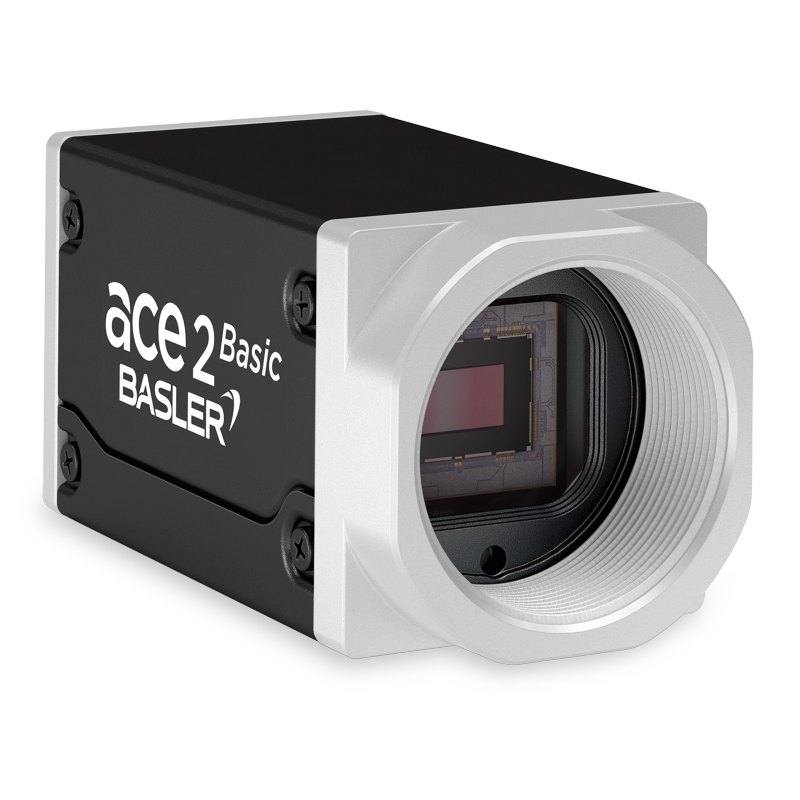
The Basler a2A3536-42g5mBAS is part of the ace 2 Basic (BAS) product line and uses the Sony IMX676 progressive scan CMOS sensor (1/1.6" format, 2.0 µm pixel pitch) to deliver 12.5 MP resolution at 42.49 fps over a 5GigE interface. The sensor covers the visible and near-infrared spectrum (0.4–1.1 µm) with a typical quantum efficiency of 91.7% at 541 nm and dynamic range of 68.4 dB. The camera features a rolling shutter, C-mount lens mount, IP30 protection, and is powered via a dedicated I/O connector at 12–24 VDC with no PoE support. It is compliant with GigE Vision 2.0 and GenICam standards.
The Basler a2A3536-42g5mBAS centers on Sony's IMX676 STARVIS 2 rolling-shutter CMOS, a 1/1.6" sensor that packs 3536 × 3536 pixels at a 2.0 µm pitch into a 7.1 × 7.1 mm die. At 12.5 megapixels in a square array, the camera delivers an unusually symmetric field of view that eliminates the asymmetric distortion trade-offs common in wide-format rectangular sensors — a practical advantage when inspecting substrates, wafers, or panels where all four edges carry equal importance. The 91.7% peak quantum efficiency at 541 nm and the 68.4 dB dynamic range let the camera capture fine surface detail with very short exposure times, reducing motion blur without resorting to extremely bright illumination. The sensor's spectral response extends from 0.4 µm to 1.1 µm, so installers can exploit near-infrared wavelengths to see through surface coatings, suppress specular reflections, or image features that are invisible to the eye — all using a single monochrome camera.
The 5GigE interface sustains the full 42.49 fps at 12.5 MP, and the physical layer also negotiates at 100 Mbps, 1 Gbps, and 2.5 Gbps, meaning the camera can be connected to existing network infrastructure for commissioning or lower-throughput tasks without changing cables or adaptors. GigE Vision 2.0 and GenICam compliance ensure out-of-the-box compatibility with every major vision software framework. Power is supplied at 10.8–30 VDC (nominally 12–24 V) through a dedicated I/O connector; there is no Power over Ethernet, so the supply and signal paths are kept separate, which simplifies electrical noise isolation in drives-heavy environments. At 5.2 W the thermal load is modest, and the 48.9 × 29 × 29 mm, 100 g housing fits into tight brackets and multi-camera arrays without imposing structural constraints.
The C-mount lens interface is the most widely supported thread standard in machine vision, giving installers access to the largest available selection of fixed-focal, telecentric, and line-scan-repurposed optics. Because the active area is 7.1 × 7.1 mm with a diagonal of roughly 10 mm, lenses specified for 1" image circles will fully cover the sensor, while lenses marked for 2/3" or smaller will vignette. The rolling shutter is well-suited to stationary or slow-moving objects with well-timed strobe illumination; when parts move continuously on a conveyor, integrators must budget for image skew and either increase line speed margin or synchronise a strobe pulse to freeze motion within the rolling window. An external trigger via the I/O connector enables precise synchronisation to encoders or PLC signals, and the operating range of -10 to +50 °C covers most controlled factory environments without supplemental heating or cooling.
Best for
High-resolution surface inspection of flat substrates — printed circuit boards, display panels, solar cells, and semiconductor wafers — where the square 3536 × 3536 pixel array matches the symmetrical geometry of the part and 12.5 MP resolution resolves fine defects across a wide field without stitching.
Near-infrared imaging tasks such as seeing through anti-reflective coatings, detecting subsurface cracks in silicon, or imaging vein patterns and moisture content, exploiting the IMX676's spectral response up to 1.1 µm with an appropriate NIR bandpass filter and illumination source.
Packaging and label inspection at moderate line speeds where stationary or triggered presentation allows the rolling shutter to capture crisp 12.5 MP frames at 42 fps, providing enough throughput to inspect every unit on many beverage, pharmaceutical, or consumer goods lines.
Code reading and OCR/OCV on dense or small-pitch direct-part marks and labels where high pixel count translates to more pixels per character or module, reducing decode failures on low-contrast or damaged marks across a wide depth of field.
Robot guidance and bin picking applications where the 5GigE interface allows mounting the camera at a fixed overhead position and where the square field suits symmetrical workspace coverage.
Selection notes
Rolling shutter suitability must be confirmed before deployment: the IMX676's rolling readout introduces image skew proportional to object velocity and shutter period. For parts moving at speed, plan for a strobed illuminator triggered to fire within the exposure window, or confirm that conveyor velocity keeps skew below the tolerance budget for your defect size.
The C-mount accepts lenses with image circles of 1" or larger; verify the lens datasheet specifies coverage for at least a 10 mm diagonal. Telecentric lenses for this sensor format exist but are physically large and expensive — budget accordingly if dimensional measurement accuracy is the primary objective.
No PoE means a separate 10.8–30 VDC power supply and cable run to each camera. In multi-camera installations this adds wiring cost; plan the power distribution topology early, and consider whether a DIN-rail 24 VDC supply or a dedicated camera power hub fits the cabinet layout.
The IP30 rating provides no protection against dust or liquid ingress. In environments with coolant mist, cutting fluid, or airborne particulate, an enclosure, air purge, or protective housing with a glass window must be specified separately.
5GigE requires a 5 Gigabit-capable NIC or switch port — standard 1GigE server ports are insufficient at full resolution and frame rate. Confirm that the host PC NIC and any intervening managed switch support 5GBASE-T (NBASE-T) negotiation, and tune jumbo frames and receive buffers to avoid packet loss at sustained 42 fps throughput.
Specifications: General
Brand
Basler
Camera type
Area Scan
Specifications: Sensor
Resolution
12.5 MP
Horizontal resolution
3536 × 3536 px
Mono / color
Monochrome (Visible + NIR)
Sensor manufacturer
Sony (STARVIS 2)
Sensor model
Sony IMX676-AAMR1-C
Shutter
Rolling Shutter
Sensor size
1/1.6" (7.1 × 7.1 mm)
Pixel size
2.0 µm × 2.0 µm
Specifications: Performance
FPS
42.49 fps
Specifications: Interface
Interface
5GigE (also supports 100M/1G/2.5G Ethernet)
Protocols
GigE Vision 2.0, GenICam
Specifications: Optics
Mount
C-mount
Specifications: Electrical
Power
12–24 VDC via I/O connector (no PoE)
Power consumption
5.2 W
Supply voltage
10.8–30 VDC
Specifications: Environment
IP rating
IP30
Operating temperature
-10 to +50 °C
Specifications: Mechanical
Dimensions
48.9 × 29 × 29 mm
Weight
100 g
Housing material
Box
Applications this camera is commonly selected for. Open one to see the full recommended hardware and approach.
Matched automatically by: lens mount fits the camera mount · lens image circle covers the camera sensor — this camera: C-mount · 1/1.6" (7.1 × 7.1 mm) sensor.
By category
All 198C-mount lenses 135Telecentric lenses 60F-mount / large-format lenses 3
By brand
All 198Omron / Sentech 66Basler 59iRAYPLE 48Datalogic / Datasensing 25
Get a first image quickly with the pylon Viewer, then move into the pylon SDK for your application. These cameras are GenICam/GenTL-compliant, so any compliant vision software can drive them as well.
Download and install the pylon Camera Software Suite for your OS from Basler. This provides the pylon Viewer, the GenTL transport-layer producers and the pylon SDK (C/C++/.NET/Python). On Windows the installer adds the needed drivers; on Linux follow the included setup notes for USB and network permissions.
2. Connect the camera and check the link
Cable the camera to its matching interface: GigE Vision to a GigE port (use a quality cable and, ideally, a dedicated NIC with jumbo frames enabled), USB3 Vision to a USB 3.x port with the supplied cable, or CoaXPress to the frame grabber. Provide power where required (PoE, USB bus power, or PoCXP). Open the pylon Viewer and confirm the camera appears in the device list; for GigE, make sure the camera and NIC are on the same subnet.
3. Grab a first image and set exposure, gain and pixel format
Select the camera in the pylon Viewer and start a continuous grab. Adjust exposure time and gain until the image is well exposed (avoid clipped highlights), set the pixel format (e.g. Mono8 or a Bayer/RGB format), and focus the lens. Use a test pattern if the lens or scene is not ready yet.
4. Configure triggering and acquisition
Decide between free-run and triggered acquisition. For synchronized capture, set the trigger source (software or a hardware line on the I/O connector), trigger mode and any debounce or exposure mode, then verify timing. Note the parameter names you change in the Viewer feature tree, as you will reuse them in code.
5. Move to the SDK or a GenICam-compliant library
Recreate your settings in code with the pylon SDK (C, C++, .NET or Python) to open the device, apply the same features and pull frames into your pipeline; pylon vTools and pylon AI can add processing blocks. Because the cameras are GenICam/GenTL standard, third-party vision libraries work too. Once the image stream is stable, you can route frames to a deep-learning inspection such as Rosepetal for automated defect detection.
Frequently asked questions
The camera delivers 42.49 fps at the full 3536 × 3536 pixel resolution over the 5GigE interface. Reduced region-of-interest modes will increase frame rate proportionally, as fewer lines are read from the sensor.
The interface negotiates at 100 Mbps, 1 Gbps, and 2.5 Gbps as well as 5 Gbps, so the camera will enumerate on a 1GigE port. However, sustained streaming at 12.5 MP / 42 fps requires the full 5GigE bandwidth; at 1 Gbps you will need to reduce resolution or frame rate significantly to avoid overflow.
No. Power must be supplied via the dedicated I/O connector at 10.8–30 VDC (nominally 12–24 V). A separate power cable is always required alongside the Ethernet data cable.
Yes. The Sony IMX676 STARVIS 2 sensor has a spectral response from 0.4 µm to 1.1 µm, covering the near-infrared band. Pair the camera with an NIR-pass filter and an 850 nm or 940 nm LED illuminator to exploit this sensitivity. The monochrome model has no colour filter array, so all pixels contribute to NIR sensitivity.
The camera uses a standard C-mount. The active sensor area is 7.1 × 7.1 mm with an approximately 10 mm diagonal, so lenses must cover at least a 1" image circle. Lenses specified for 2/3" or smaller formats will produce vignetting at the sensor corners.