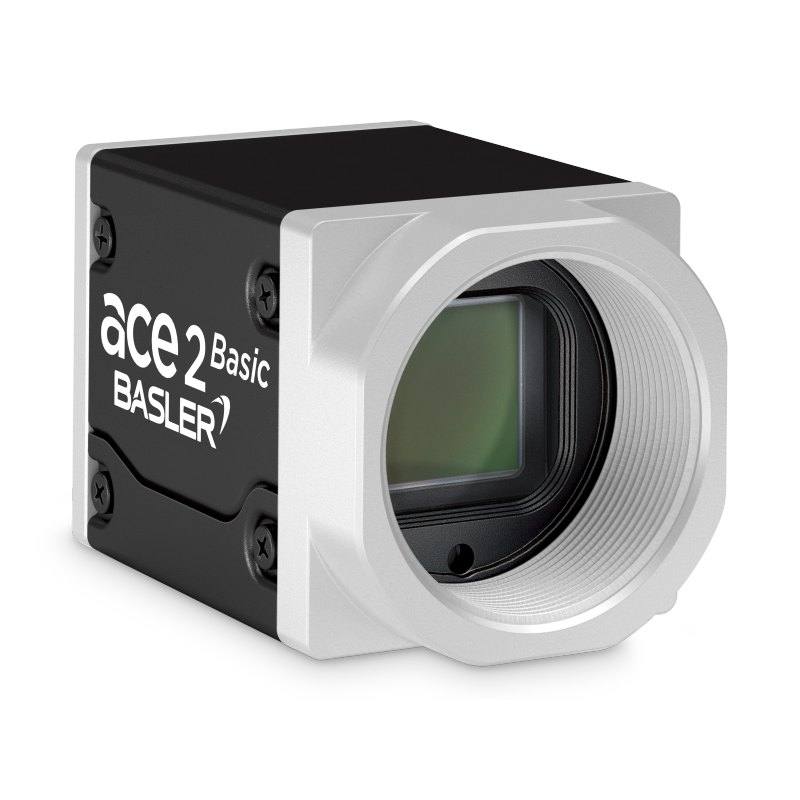
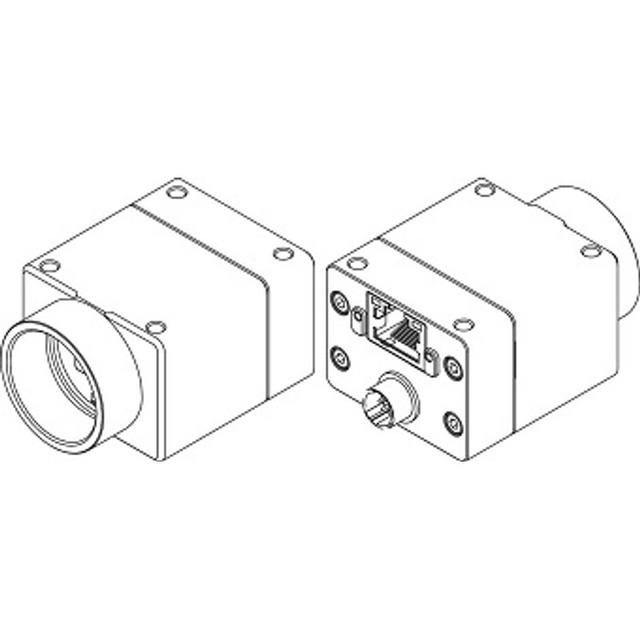
The Basler a2A4200-40um is part of the ace 2 R series, featuring a 4200 x 2160 pixel Gpixel GMAX2509 CMOS sensor with a 2/3" optical format and 2.5 µm pixel pitch. It achieves up to 40.2 fps at full resolution over a USB 3.0 SuperSpeed interface (USB3 Vision compliant), with global shutter for distortion-free imaging. The camera outputs 8, 10, or 12-bit monochrome data and includes one opto-coupled input and two GPIO lines via an M8 connector. It draws approximately 3.1 W from the USB bus and is rated IP30 with a compact 42.8 x 29 x 29 mm housing weighing under 85 g.
The Basler a2A4200-40um is built around the Gpixel GMAX2509, a 4200 x 2160 pixel CMOS sensor delivering a full 9.1 megapixel image at 40.2 frames per second. The 2/3" optical format (10.52 mm x 5.42 mm active area, 11.8 mm diagonal) sits in a well-established lens ecosystem and keeps glass costs predictable. With a 2.5 µm pixel pitch, the sensor packs high spatial density into that format, which translates directly to per-pixel spatial resolution: at typical inspection working distances, you can resolve fine surface features, narrow character strokes for OCR, and sub-millimetre dimensional details without resorting to a larger, more expensive sensor platform. The global shutter captures every pixel simultaneously, so fast-moving parts on a conveyor, rotating shafts, or components under robotic handling produce clean, geometrically undistorted frames — a property that is non-negotiable whenever measurements or pattern matching are downstream of the image.
The USB 3.0 SuperSpeed interface (USB3 Vision compliant, 5 Gbit/s) is what allows 9.1 MP at 40 fps to reach the host without bandwidth throttling. GenICam compliance means integration with pylon, Halcon, VisionPro, NI Vision, and any other GenTL-consuming SDK is plug-and-play; camera parameters are enumerated automatically rather than hard-coded. The camera draws approximately 3.1 W directly from the USB bus at 5 VDC, eliminating a separate power supply — a meaningful advantage when mounting at the end of a robot arm, in a cramped enclosure, or on a test jig that must be cabled quickly. Monochrome output in 8, 10, or 12-bit pixel formats gives the host full control over the sensitivity-versus-dynamic-range trade-off: 8-bit at maximum throughput, 12-bit for tasks that must distinguish faint contrast gradients such as subtle surface scratches or low-contrast inkjet print.
Triggering and synchronisation are handled by one opto-coupled input and two GPIO lines on an M8 connector, supporting hardware-synchronised acquisition with PLCs, encoder-based trigger signals, or strobe outputs to external lighting controllers. The 42.8 x 29 x 29 mm C-mount housing weighs approximately 85 g, making it straightforward to mount on standard 30 mm or 60 mm cage systems and comfortable on compact gantry arms. C-mount gives full access to the broad catalogue of vision lenses covering 2/3" format — from short-focal fixed-focal for wide-field packaging lanes to longer focal lengths for stand-off dimensional inspection. Operating temperature range is -10 to 60 °C with an IP30 ingress protection rating, appropriate for clean-room, electronics manufacturing, and general factory environments that are not subjected to direct coolant splash or heavy particulate.
Best for
High-resolution surface defect inspection on electronics PCBs, semiconductor wafers, and flat-panel components, where 9.1 MP at 40 fps provides enough pixels per unit area to resolve hairline cracks, solder bridges, or coating voids at production-line throughput.
Dimensional gauging of small mechanical parts — fasteners, stamped metal, medical implant components — where the global shutter eliminates motion blur and the 2.5 µm pixel pitch provides the spatial resolution needed for sub-pixel edge fitting at tight tolerances.
Industrial OCR and 1D/2D code reading on pharmaceutical labels, PCB silkscreens, and traceability markings, where monochrome sensitivity and 9.1 MP resolution keep character pixels high enough for reliable decode even at longer working distances or with small font sizes.
Robot-guided pick and place or bin picking on automotive and electronics assembly lines, where USB bus power simplifies cable management to the robot arm, the global shutter gives clean fiducial images of moving parts, and 40 fps supports fast update rates for vision-guided motion control.
Packaging inspection for fill level, label placement, and seal integrity on fast-moving lines, where full-resolution 40 fps acquisition keeps pace with moderate conveyor speeds while the trigger input synchronises frame capture precisely to product position via encoder or photo-eye.
Selection notes
Lens selection must cover the 2/3" sensor format (11.8 mm diagonal): lenses rated only for 1/2" or smaller will produce heavy vignetting at the corners of the 4200 x 2160 array. Confirm the lens image circle specification before procurement.
At 2.5 µm pixel pitch the sensor density is high; pair with a high-resolution lens rated for the 2/3" format and verify the lens resolves adequately at the chosen working aperture to extract the full benefit of the sensor's spatial density.
USB 3.0 cable length is practically limited to around 3–5 m for passive cables; active optical USB 3.0 cables or a USB 3.0 repeater are required for longer cable runs typical of overhead gantry or large conveyor installations. Verify host-controller chipset compatibility with Basler's supported hardware list, as USB 3.0 host-controller quality varies significantly.
The IP30 rating protects against solid objects larger than 2.5 mm but provides no moisture or dust ingress protection. For washdown zones, coolant-mist environments, or dusty grinding operations, an external camera housing with the appropriate IP rating is required.
The opto-coupled input and two GPIO lines on the M8 connector cover most single-camera trigger and strobe scenarios. Applications requiring multi-camera hardware synchronisation or precise inter-camera phase alignment should evaluate whether a frame grabber or synchronisation hub is needed, since USB 3.0 does not natively carry a synchronisation bus like CoaXPress or GigE PTP.
Specifications: General
Brand
Basler
Camera type
Area Scan
Specifications: Sensor
Resolution
9.1 MP
Horizontal resolution
4200 x 2160 px
Mono / color
Monochrome
Sensor manufacturer
Gpixel
Sensor model
Gpixel GMAX2509
Shutter
Global Shutter
Sensor size
2/3" (10.52 mm × 5.42 mm, 11.8 mm diagonal)
Pixel size
2.5 µm × 2.5 µm
Specifications: Performance
FPS
40.2 fps (40 fps typical)
Specifications: Interface
Interface
USB 3.0 (USB3 Vision, SuperSpeed 5 Gbit/s)
Protocols
USB3 Vision, GenICam
Specifications: Optics
Mount
C-mount
Specifications: Electrical
Power
USB bus powered, ~3.1 W @ 5 VDC
Power consumption
3.1 W
Specifications: Environment
IP rating
IP30
Operating temperature
-10 to 60 °C
Specifications: Mechanical
Dimensions
10.52 x 5.42 mm
Weight
85 g
Applications this camera is commonly selected for. Open one to see the full recommended hardware and approach.
Matched automatically by: lens mount fits the camera mount · lens image circle covers the camera sensor — this camera: C-mount · 2/3" (10.52 mm × 5.42 mm, 11.8 mm diagonal) sensor.
By category
All 198C-mount lenses 135Telecentric lenses 60F-mount / large-format lenses 3
By brand
All 198Omron / Sentech 66Basler 59iRAYPLE 48Datalogic / Datasensing 25
Get a first image quickly with the pylon Viewer, then move into the pylon SDK for your application. These cameras are GenICam/GenTL-compliant, so any compliant vision software can drive them as well.
Download and install the pylon Camera Software Suite for your OS from Basler. This provides the pylon Viewer, the GenTL transport-layer producers and the pylon SDK (C/C++/.NET/Python). On Windows the installer adds the needed drivers; on Linux follow the included setup notes for USB and network permissions.
2. Connect the camera and check the link
Cable the camera to its matching interface: GigE Vision to a GigE port (use a quality cable and, ideally, a dedicated NIC with jumbo frames enabled), USB3 Vision to a USB 3.x port with the supplied cable, or CoaXPress to the frame grabber. Provide power where required (PoE, USB bus power, or PoCXP). Open the pylon Viewer and confirm the camera appears in the device list; for GigE, make sure the camera and NIC are on the same subnet.
3. Grab a first image and set exposure, gain and pixel format
Select the camera in the pylon Viewer and start a continuous grab. Adjust exposure time and gain until the image is well exposed (avoid clipped highlights), set the pixel format (e.g. Mono8 or a Bayer/RGB format), and focus the lens. Use a test pattern if the lens or scene is not ready yet.
4. Configure triggering and acquisition
Decide between free-run and triggered acquisition. For synchronized capture, set the trigger source (software or a hardware line on the I/O connector), trigger mode and any debounce or exposure mode, then verify timing. Note the parameter names you change in the Viewer feature tree, as you will reuse them in code.
5. Move to the SDK or a GenICam-compliant library
Recreate your settings in code with the pylon SDK (C, C++, .NET or Python) to open the device, apply the same features and pull frames into your pipeline; pylon vTools and pylon AI can add processing blocks. Because the cameras are GenICam/GenTL standard, third-party vision libraries work too. Once the image stream is stable, you can route frames to a deep-learning inspection such as Rosepetal for automated defect detection.
Frequently asked questions
The camera delivers 40.2 fps at the full 4200 x 2160 pixel resolution over USB 3.0 SuperSpeed. Using region of interest (ROI) to reduce the active pixel area will increase frame rate proportionally.
No. The a2A4200-40um is USB bus powered, drawing approximately 3.1 W at 5 VDC directly from the USB 3.0 port. No separate power injector or power supply cable is needed, which simplifies installation in space-constrained or robot-mounted setups.
Yes. The Gpixel GMAX2509 sensor uses a global shutter, meaning all pixels integrate simultaneously. Moving parts are captured without the rolling-shutter skew or motion blur that would affect geometric measurements or pattern-match scores.
The camera outputs 8, 10, or 12-bit monochrome data. 8-bit maximises throughput and is sufficient for most binary or high-contrast inspection tasks. 12-bit provides 4096 grey levels and is the right choice when detecting subtle surface texture, low-contrast scratches, or faint ink variations where fine greyscale discrimination is critical. Note that 12-bit pixel data increases USB bandwidth per frame by 50% compared with 8-bit, which may reduce the sustainable frame rate at full resolution depending on host-controller throughput.
The camera uses a C-mount. Lenses selected for this camera must cover at least the 2/3" optical format (11.8 mm diagonal) to illuminate the full 4200 x 2160 pixel array without corner vignetting. Standard C-mount lenses designed for 2/3" or larger image circles are compatible.