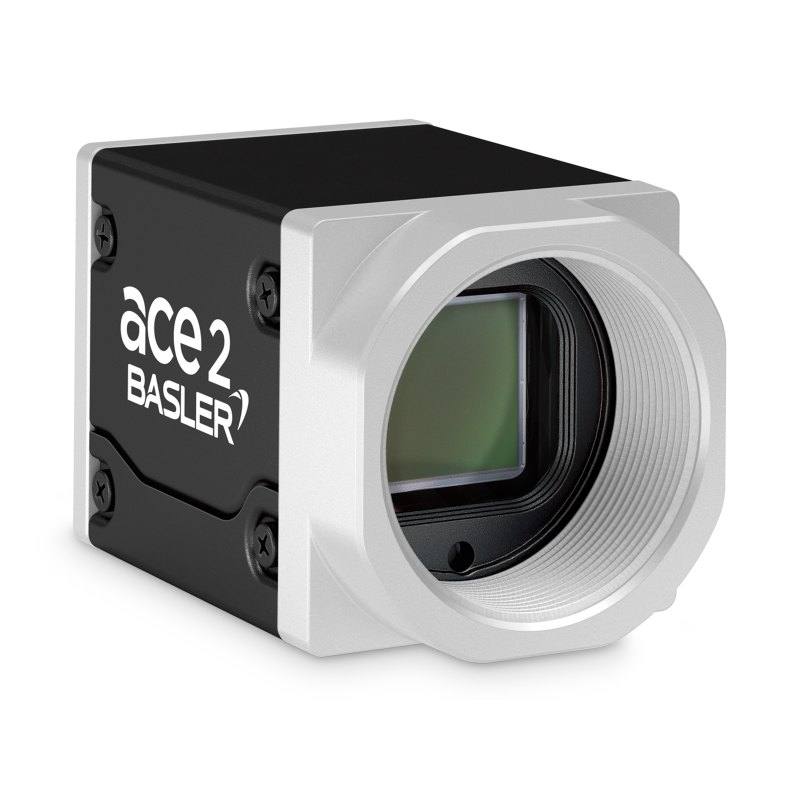
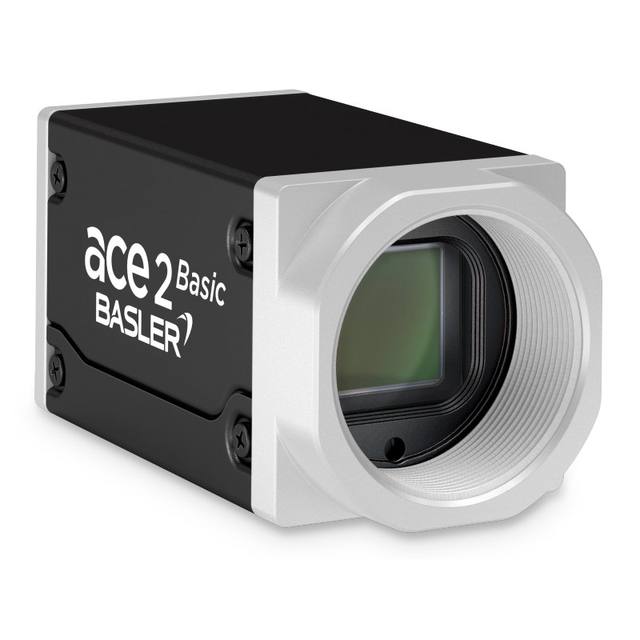
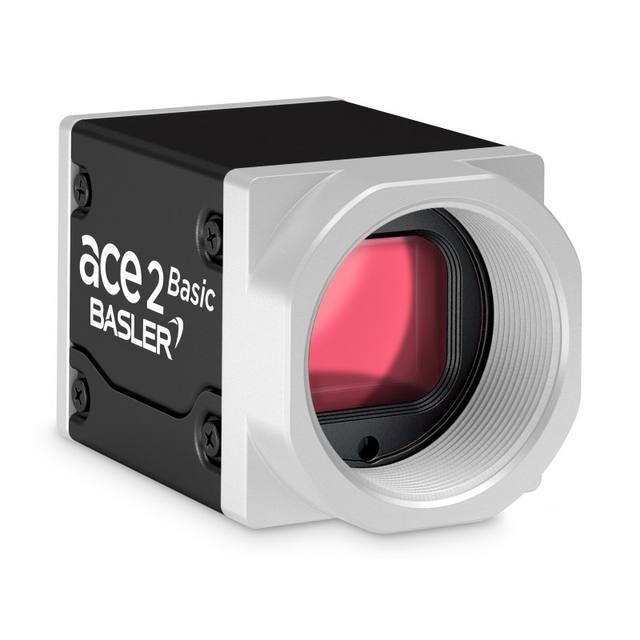
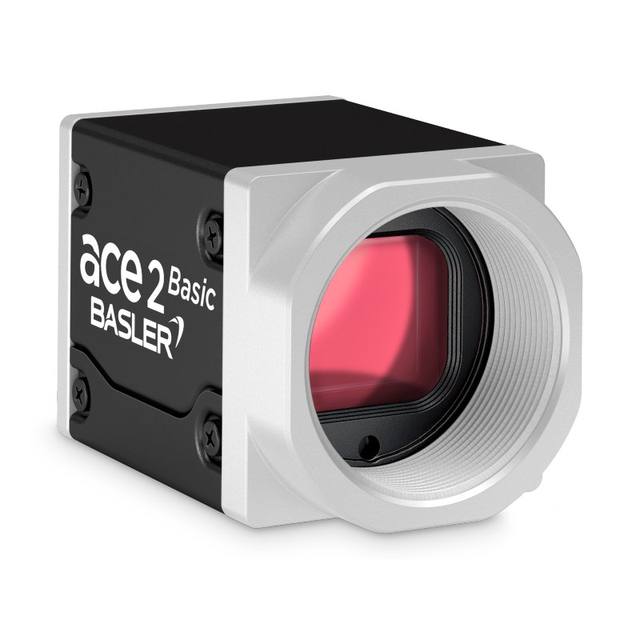
The Basler a2A5320-52cm is part of the ace 2 V product family, featuring the Sony IMX542 progressive scan CMOS sensor with a 1.1-inch format and 2.74 µm pixel size. It uses CoaXPress 2.0 (CXP-12) interface running up to 12.5 Gbps for high-bandwidth data transfer over coaxial cable up to 30 m. The camera delivers 52.4 fps at 8-bit depth with a 5320 x 3032 pixel resolution in a compact 29 x 29 x 50.2 mm box housing with C-mount lens attachment and IP30 protection. It supports free-run, hardware trigger, and software trigger synchronization modes, with power supplied via Power over CoaXPress at 24 VDC drawing approximately 3.8 W.
The Basler a2A5320-52cm is built around the Sony IMX542 Pregius S global shutter CMOS sensor, delivering 16.1 megapixels across a 5320 x 3032 pixel array with a 1.1-inch optical format and 2.74 µm pixel pitch. The global shutter architecture means every pixel integrates light simultaneously — no rolling distortion during fast conveyor motion, robot arm movement, or strobe-triggered acquisition. At 52.4 fps in 8-bit depth, the camera sustains throughput that keeps pace with high-rate production lines without sacrificing full-resolution output, making it equally capable at slow, repeatable metrology stations and rapid continuous inspection. The small 2.74 µm pixels demand lenses corrected for fine detail across a 1.1-inch image circle, but they also allow a compact 29 x 29 mm footprint — enabling tight multi-camera installations where mounting clearance is constrained.
The CoaXPress 2.0 CXP-12 interface operates at up to 12.5 Gbps over a single coaxial cable that simultaneously carries control signalling, trigger and I/O, and Power over CoaXPress at 24 VDC (3.8 W typical). A single coax run can reach 30 m without an active repeater, far beyond what USB3 Vision or GigE Vision can support without hubs or optical conversion — an important advantage in large-format press lines, conveyor halls, or automotive body-in-white cells where cameras are mounted away from the frame-grabber host. The camera is GenICam-compliant and supports free-run, hardware trigger, and software trigger synchronization modes, enabling integration with PLC-driven line triggers or encoder-based partial-scan windows. The CoaXPress frame-grabber at the host provides the deterministic latency and guaranteed bandwidth needed for time-sensitive AI inference pipelines.
The C-mount lens attachment is standard across a broad catalogue of industrial lenses corrected to 1.1 inch, giving integrators straightforward access to fixed focal lengths from wide-angle mapping to telephoto gauging. The IP30 rated box housing (50.2 x 29 x 29 mm, 76 g) suits standard enclosed machine enclosures operating from -10 to 50 °C. Because the sensor is monochrome, it is particularly well-matched to monochromatic LED illumination — narrow-band wavelengths that maximize contrast for surface texture, edge sharpness, and code contrast — and to polarized or structured-light setups where a Bayer pattern would attenuate signal. The combination of 16.1 MP resolution and 52 fps means small defects that would be smeared or undersampled on a lower-resolution camera remain fully resolved even at production speed.
Best for
High-speed surface defect inspection on automotive body panels, stamped metal parts, or semiconductor wafers where 16.1 MP resolution is required to resolve micro-scratches, pitting, and coating voids at line speed.
Dimensional gauging and geometric measurement of machined or moulded components, where the global shutter eliminates motion blur and the 5320-pixel horizontal array provides sub-pixel measurement across wide fields of view without stitching.
Pharmaceutical blister-pack and label inspection at 52 fps, where print legibility, OCR/OCV character integrity, and tamper-evident seal quality must all be confirmed simultaneously within a single camera's field.
Traceability code reading and verification — 2D matrix codes, DataMatrix, QR — on small electronics, PCBs, or packaging where high pixel density resolves fine cell modules and quiet zones without requiring a dedicated barcode reader.
Multi-camera automated optical inspection (AOI) of large flat-panel displays, PCB assemblies, or solar cells, where CXP-12 bandwidth and long coaxial cable reach allow frame grabbers to be rack-mounted remotely from the camera array.
Selection notes
Lens coverage must be rated for at least a 1.1-inch image circle — lenses designed for 2/3-inch or smaller sensors will vignette significantly at 16.1 MP on this sensor format. Verify the lens MTF at the corner to ensure resolution is maintained across the full 5320 x 3032 array.
A CXP-12 compatible frame-grabber is mandatory; CoaXPress is not natively supported by standard PC motherboards or USB/GigE NIC cards. Budget for the frame-grabber and factor in PCIe slot availability when planning the host system.
Power over CoaXPress supplies 24 VDC at 3.8 W through the same coax as data — confirm the frame-grabber or CXP hub provides PoCXP on the relevant port; otherwise a separate power injector or local 24 V supply must be routed to the camera.
The 2.74 µm pixel pitch is fine enough that diffraction limits resolution at apertures smaller than approximately f/5–f/8 depending on wavelength; design illumination and aperture together to avoid diffraction-limited MTF degradation at working aperture.
IP30 protection is suitable for enclosed machine enclosures free of direct liquid splash; applications in wash-down zones, cutting fluid mist, or heavy particulate environments require an additional enclosure or a camera rated IP65/IP67.
Specifications: General
Brand
Basler
Camera type
Area Scan
Specifications: Sensor
Resolution
16.1 MP
Horizontal resolution
5320 px
Mono / color
Monochrome
Sensor manufacturer
Sony (Pregius S)
Sensor model
Sony IMX542
Shutter
Global Shutter
Sensor size
1.1 inch (14.58 mm × 8.31 mm)
Pixel size
2.74 µm × 2.74 µm
Specifications: Performance
FPS
52 fps (52.4 fps @ 8-bit)
Specifications: Interface
Interface
CoaXPress CXP-12 (2.5–12.5 Gbps)
Protocols
GenICam, CoaXPress 2.0
Specifications: Optics
Mount
C-mount
Specifications: Electrical
Power
Power over CoaXPress (PoCXP) 24 VDC, 3.8 W typical
Specifications: Environment
IP rating
IP30
Operating temperature
-10 to 50 °C
Specifications: Mechanical
Housing material
Box
Dimensions
50.2 × 29 × 29 mm
Weight
76 g
Applications this camera is commonly selected for. Open one to see the full recommended hardware and approach.
Matched automatically by: lens mount fits the camera mount · lens image circle covers the camera sensor — this camera: C-mount · 1.1 inch (14.58 mm × 8.31 mm) sensor.
By category
All 67C-mount lenses 43Telecentric lenses 24
By brand
All 67Basler 34iRAYPLE 23Omron / Sentech 8Datalogic / Datasensing 2
Get a first image quickly with the pylon Viewer, then move into the pylon SDK for your application. These cameras are GenICam/GenTL-compliant, so any compliant vision software can drive them as well.
Download and install the pylon Camera Software Suite for your OS from Basler. This provides the pylon Viewer, the GenTL transport-layer producers and the pylon SDK (C/C++/.NET/Python). On Windows the installer adds the needed drivers; on Linux follow the included setup notes for USB and network permissions.
2. Connect the camera and check the link
Cable the camera to its matching interface: GigE Vision to a GigE port (use a quality cable and, ideally, a dedicated NIC with jumbo frames enabled), USB3 Vision to a USB 3.x port with the supplied cable, or CoaXPress to the frame grabber. Provide power where required (PoE, USB bus power, or PoCXP). Open the pylon Viewer and confirm the camera appears in the device list; for GigE, make sure the camera and NIC are on the same subnet.
3. Grab a first image and set exposure, gain and pixel format
Select the camera in the pylon Viewer and start a continuous grab. Adjust exposure time and gain until the image is well exposed (avoid clipped highlights), set the pixel format (e.g. Mono8 or a Bayer/RGB format), and focus the lens. Use a test pattern if the lens or scene is not ready yet.
4. Configure triggering and acquisition
Decide between free-run and triggered acquisition. For synchronized capture, set the trigger source (software or a hardware line on the I/O connector), trigger mode and any debounce or exposure mode, then verify timing. Note the parameter names you change in the Viewer feature tree, as you will reuse them in code.
5. Move to the SDK or a GenICam-compliant library
Recreate your settings in code with the pylon SDK (C, C++, .NET or Python) to open the device, apply the same features and pull frames into your pipeline; pylon vTools and pylon AI can add processing blocks. Because the cameras are GenICam/GenTL standard, third-party vision libraries work too. Once the image stream is stable, you can route frames to a deep-learning inspection such as Rosepetal for automated defect detection.
Frequently asked questions
The camera delivers 52.4 fps at full 5320 x 3032 resolution in 8-bit depth over CXP-12. Reducing bit depth or using region-of-interest (ROI) windowing can increase frame rate further, subject to the frame-grabber and host software configuration.
Yes. The camera uses Power over CoaXPress (PoCXP) at 24 VDC, drawing approximately 3.8 W typical through the same coax that carries the CXP-12 data stream, so no separate power cable is required at the camera end — provided the frame-grabber or CXP hub supports PoCXP output on that port.
The global shutter ensures all pixels capture the same instant in time, eliminating rolling-shutter skew on moving targets. However, a sufficiently short electronic exposure — or a strobe-synchronized LED — is still needed to freeze mechanical motion optically; the global shutter removes the geometric distortion from readout lag, not from motion blur during the exposure itself.
The camera uses a standard C-mount. Lenses must cover at least the 1.1-inch (14.58 mm x 8.31 mm) sensor format to avoid vignetting at the corners of the 16.1 MP array. Always confirm the lens datasheet specifies 1.1-inch or larger image circle coverage.
CoaXPress 2.0 at CXP-12 (12.5 Gbps) supports cable runs up to 30 m over a single coaxial cable without active repeaters, making it practical for large machine installations where the camera is mounted far from the industrial PC or frame-grabber chassis.