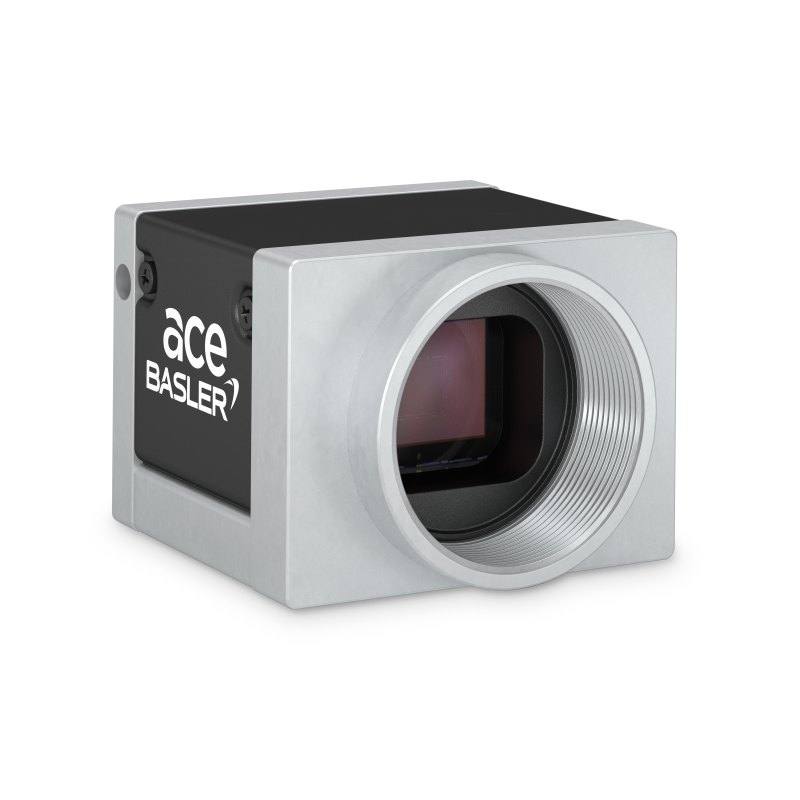
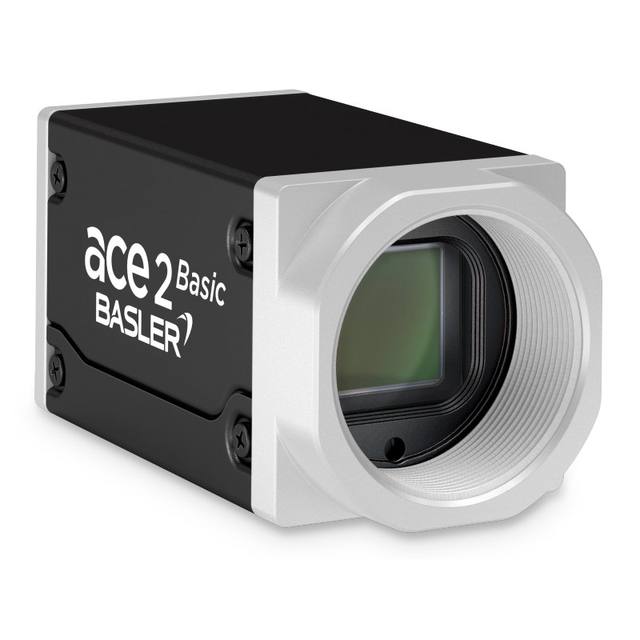
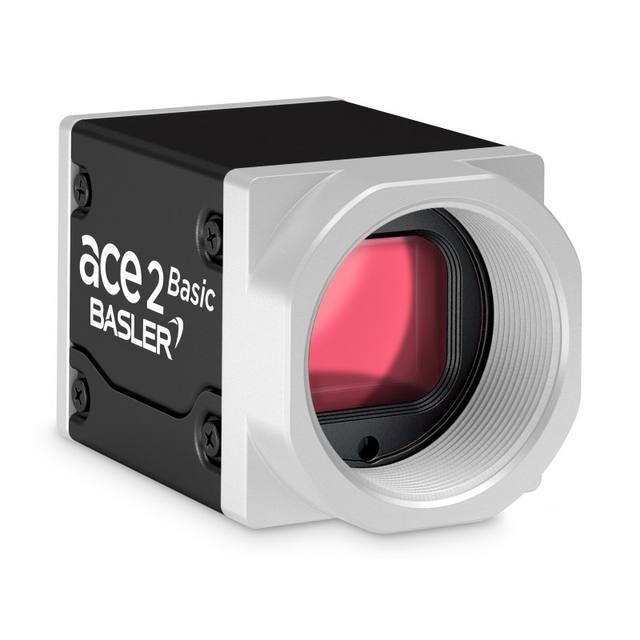
The acA4096-40um and acA4096-40uc are part of the Basler ace L USB 3.0 camera family, built around the Sony IMX255 1-inch format CMOS sensor with a 3.45 µm pixel pitch and global shutter. Both models deliver 9 MP (4096 x 2168 px) resolution at 42 fps over USB 3.0 (SuperSpeed, 5 Gbit/s) and comply with the USB3 Vision and GenICam standards. The mono variant (acA4096-40um) has a typical quantum efficiency of 70%, dynamic range of 72.8 dB, and SNR of 40.2 dB. Both cameras feature a compact 35.8 x 40 x 30 mm box housing with a C-mount lens interface and are powered entirely via the USB 3.0 interface.
Brand
Basler
Camera type
Area Scan
Interface
USB 3.0 (SuperSpeed, 5 Gbit/s)
Resolution
9 MP
Horizontal resolution
4096 x 2168 px
Mono / color
Mono (acA4096-40um) / Color (acA4096-40uc)
Sensor manufacturer
Sony Pregius
Sensor model
Sony IMX255
Shutter
Global Shutter
FPS
42.7 fps (per technical docs; 42 fps per product page)
The Basler acA4096-40um and acA4096-40uc are built around the Sony IMX255, a 1-inch format global shutter CMOS sensor from the Pregius series. The 1-inch optical format (14.13 mm × 7.45 mm active area, 15.97 mm diagonal) is a key design consideration: it demands C-mount lenses that are rated for at least 1-inch image circles, which rules out budget lenses designed for smaller 2/3-inch or 1/2-inch formats. The 3.45 µm pixel pitch is fine enough to resolve small details without oversampling, and the 4096 × 2168 pixel array yields a near-17:9 aspect ratio that maps well onto wide conveyor scenes or panoramic inspection fields. At full resolution the camera delivers 42 fps over USB 3.0 SuperSpeed (5 Gbit/s), which is sufficient for most continuous-motion inspection lines running at moderate belt speeds — an installer can expect roughly one frame every 24 ms with no ROI reduction needed.
Global shutter operation is the defining feature for motion-sensitive deployments. Unlike rolling shutter sensors, the IMX255 captures all pixels simultaneously, so parts moving on a conveyor, vibrating fixtures, or robot-mounted targets produce no skew or jello artifacts regardless of exposure timing. The mono variant (acA4096-40um) measures a typical quantum efficiency of 70%, a dynamic range of 72.8 dB, and an SNR of 40.2 dB — figures that reflect the Pregius generation's well-regarded sensitivity and low-noise floor. These numbers mean the camera can be used with shorter exposures (reducing motion blur on fast parts) while still maintaining adequate signal on surfaces lit with moderate illumination. The color variant (acA4096-40uc) trades some per-channel sensitivity for Bayer-array color capture, suited to applications where hue discrimination matters more than ultimate light efficiency. Both variants are powered entirely through the USB 3.0 cable at 3.6 W, eliminating the need for a separate power supply — a practical advantage for compact or portable inspection stations.
The compact 35.8 × 40 × 30 mm box housing weighing 130 g integrates straightforwardly into standard machine-vision mounting brackets without adding significant moment arm to gantry or robot installations. The C-mount lens interface is the industry standard for this resolution and format class, giving access to a wide ecosystem of fixed-focal, telecentric, and macro lenses. USB3 Vision and GenICam compliance means the camera is natively supported by all major machine-vision SDKs that implement a USB3 Vision GenTL producer — including Basler's own pylon SDK and any other GenICam-compliant framework — without custom drivers. The 0–50 °C operating temperature covers most indoor industrial environments, though high-ambient installations (near ovens, welding cells) should verify thermal headroom. The housing provides no rated IP protection from the published specs; installations near cutting fluid mist, wash-down zones, or heavy particulate should use an appropriate enclosure.
Best for
High-resolution surface and cosmetic defect inspection on flat parts (PCBs, battery cells, pharmaceutical blister packs) where 9 MP coverage eliminates the need for multiple lower-resolution cameras.
Dimensional measurement and gauging tasks — such as connector pitch verification, label placement, or cap torque confirmation — where fine 3.45 µm pixels provide sub-pixel interpolation accuracy across wide fields of view.
OCR/OCV and 1D/2D code reading on product labels or direct-part marks (DPM) where high pixel density ensures legible character capture at practical working distances without additional magnification.
Robot guidance and pick-and-place applications requiring distortion-free, motion-artifact-free images of parts at arbitrary orientations, where the global shutter prevents positional errors caused by sequential-row capture.
Packaging line inspection combining label verification, fill-level checks, and seal integrity assessment in a single camera station, leveraging the wide 4096-pixel horizontal span to cover full package width.
Selection notes
Lens image-circle compatibility is mandatory: the 1-inch (15.97 mm diagonal) sensor requires C-mount lenses explicitly rated for 1-inch format. Using a 2/3-inch or smaller lens will produce darkened or vignetted corners across a significant portion of the 4096 × 2168 array, degrading inspection accuracy at image edges.
USB cable length limits apply at USB 3.0 SuperSpeed: reliable operation typically requires cables of 3–5 m without an active repeater. Installations where the camera is more than 5 m from the host PC should plan for an industrial USB 3.0 active extension cable or a USB 3.0-to-fiber converter to avoid packet loss at 5 Gbit/s.
The 3.6 W power draw is delivered entirely through the USB port. Verify that the host PC's USB 3.0 controller or hub can supply the required current reliably. Passive USB hubs and some laptop ports may fall short under sustained operation.
For inspection tasks requiring sub-pixel measurement accuracy, lens distortion and chromatic aberration characteristics should be validated against the full 4096-pixel span. The wide 1-inch format amplifies barrel or pincushion distortion visible only at image edges; telecentric lenses or well-characterised fixed-focal lenses with software distortion correction are recommended for metrology applications.
The 0–50 °C operating temperature range covers standard factory environments, but the housing provides no rated IP protection from the published specs. Installations near cutting fluid mist, wash-down zones, or heavy particulate should use an appropriate enclosure or specify a lens with a sealed front element, and confirm that the camera body itself is adequately protected.
Specifications: General
Brand
Basler
Camera type
Area Scan
Specifications: Sensor
Resolution
9 MP
Horizontal resolution
4096 x 2168 px
Mono / color
Mono (acA4096-40um) / Color (acA4096-40uc)
Sensor manufacturer
Sony Pregius
Sensor model
Sony IMX255
Shutter
Global Shutter
Sensor size
1" (14.13 mm × 7.45 mm, diagonal 15.97 mm)
Pixel size
3.45 µm × 3.45 µm
Specifications: Performance
FPS
42.7 fps (per technical docs; 42 fps per product page)
Specifications: Interface
Interface
USB 3.0 (SuperSpeed, 5 Gbit/s)
Protocols
USB3 Vision, GenICam
Specifications: Optics
Mount
C-mount
Specifications: Electrical
Power
Via USB 3.0 interface
Power consumption
3.6 W
Specifications: Environment
Operating temperature
0 – 50 °C
Specifications: Mechanical
Dimensions
35.8 × 40 × 30 mm
Weight
130 g
Housing material
Box
Applications this camera is commonly selected for. Open one to see the full recommended hardware and approach.
Matched automatically by: lens mount fits the camera mount · lens image circle covers the camera sensor — this camera: C-mount · 1" (14.13 mm × 7.45 mm, diagonal 15.97 mm) sensor.
By category
All 90C-mount lenses 66Telecentric lenses 24
By brand
All 90Basler 34iRAYPLE 26Omron / Sentech 24Datalogic / Datasensing 6
Get a first image quickly with the pylon Viewer, then move into the pylon SDK for your application. These cameras are GenICam/GenTL-compliant, so any compliant vision software can drive them as well.
Download and install the pylon Camera Software Suite for your OS from Basler. This provides the pylon Viewer, the GenTL transport-layer producers and the pylon SDK (C/C++/.NET/Python). On Windows the installer adds the needed drivers; on Linux follow the included setup notes for USB and network permissions.
2. Connect the camera and check the link
Cable the camera to its matching interface: GigE Vision to a GigE port (use a quality cable and, ideally, a dedicated NIC with jumbo frames enabled), USB3 Vision to a USB 3.x port with the supplied cable, or CoaXPress to the frame grabber. Provide power where required (PoE, USB bus power, or PoCXP). Open the pylon Viewer and confirm the camera appears in the device list; for GigE, make sure the camera and NIC are on the same subnet.
3. Grab a first image and set exposure, gain and pixel format
Select the camera in the pylon Viewer and start a continuous grab. Adjust exposure time and gain until the image is well exposed (avoid clipped highlights), set the pixel format (e.g. Mono8 or a Bayer/RGB format), and focus the lens. Use a test pattern if the lens or scene is not ready yet.
4. Configure triggering and acquisition
Decide between free-run and triggered acquisition. For synchronized capture, set the trigger source (software or a hardware line on the I/O connector), trigger mode and any debounce or exposure mode, then verify timing. Note the parameter names you change in the Viewer feature tree, as you will reuse them in code.
5. Move to the SDK or a GenICam-compliant library
Recreate your settings in code with the pylon SDK (C, C++, .NET or Python) to open the device, apply the same features and pull frames into your pipeline; pylon vTools and pylon AI can add processing blocks. Because the cameras are GenICam/GenTL standard, third-party vision libraries work too. Once the image stream is stable, you can route frames to a deep-learning inspection such as Rosepetal for automated defect detection.
Frequently asked questions
The acA4096-40um/uc is specified to deliver 42 fps (42.7 fps per technical documentation) at the full 4096 × 2168 pixel resolution in continuous streaming mode over USB 3.0 SuperSpeed. No burst-only limitation is documented; the 5 Gbit/s USB 3.0 bandwidth is sufficient to sustain this throughput continuously, though host PC USB controller and storage performance must be adequate to consume the data stream without dropping frames.
No. Both the mono (acA4096-40um) and color (acA4096-40uc) variants draw all 3.6 W of operating power directly through the USB 3.0 interface. A standard USB 3.0 port capable of supplying the required current is sufficient. No external power cable is needed, which simplifies cable management.
Only C-mount lenses rated for a 1-inch image circle (at minimum 15.97 mm diagonal) are compatible with the full sensor array. Lenses designed for smaller formats such as 2/3 inch or 1/2 inch will produce corner vignetting or shading on the 4096 × 2168 array. Always verify the lens manufacturer's specified image circle before selection.
Global shutter eliminates motion-induced image distortion by capturing all pixels simultaneously, but it does not remove the need for adequate illumination during the exposure window. For fast-moving parts, short exposures are still required to freeze motion blur, and strobe lighting is often the most effective way to achieve the necessary peak intensity during those short exposures without exceeding the average power limits of continuous LED lights.
The acA4096-40um/uc complies with USB3 Vision and GenICam standards. Any machine-vision SDK that implements a USB3 Vision GenTL producer — including Basler's own pylon SDK and other GenICam-compliant frameworks — can work with the camera without custom drivers.