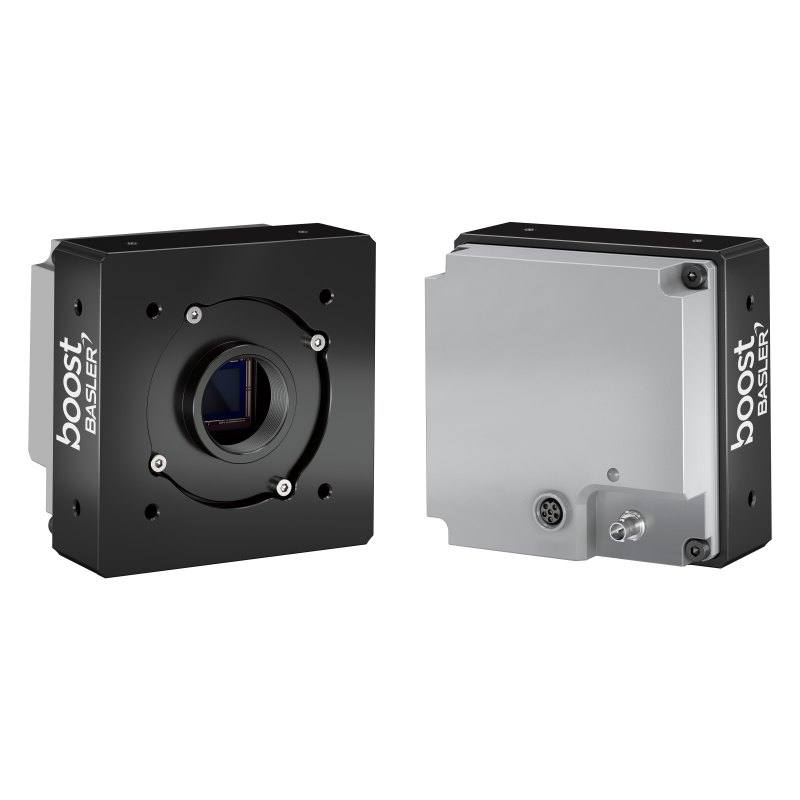
The Basler boost boA4112-68cc is a high-resolution color area-scan camera featuring the Sony IMX253LQR-C progressive-scan CMOS sensor with global shutter at 4112 × 3008 native resolution (12.3 MP). It communicates via CoaXPress 2.0 at up to 12.5 Gbps over a single Micro-BNC cable that also carries power (PoCXP), achieving up to 69 fps at 8-bit output. The camera measures 45 × 80 × 80 mm, weighs 480 g, and is compliant with GenICam, CoaXPress 2.0, CE, UL, and IP30 standards. Lens mounts (C-mount, F-mount, M42 variants) are sold separately and the camera is supported by Basler's pylon SDK on Windows and Linux.
Brand
Basler
Camera type
Area Scan
Interface
CoaXPress 2.0 (CXP-12), up to 12.5 Gbps
Resolution
12.3 MP
Horizontal resolution
4112 × 3008 px
Mono / color
Color
Sensor manufacturer
Sony Pregius
Sensor model
Sony IMX253LQR-C
Shutter
Global Shutter
FPS
69
Mount
C-mount, F-mount, M42 x 0.75, M42 x 1.0 (sold separately)
Sensor size
1.1 inch (confirmed correct per official Basler documentation)
The Basler boost boA4112-68cc is built around the Sony IMX253LQR-C, a 1.1-inch progressive-scan CMOS sensor in the Sony Pregius family, delivering a native 4112 x 3008 pixel (12.3 MP) color image with a pixel pitch of 3.45 x 3.45 µm. The global shutter architecture captures the entire frame simultaneously — every pixel starts and stops exposure at the same instant — which eliminates the motion artifacts that a rolling shutter would introduce on a moving conveyor, spinning component, or robotic arm. At 12.3 MP and 69 fps at 8-bit depth over a single Micro-BNC CXP-12 link (up to 12.5 Gbps), the camera can sustain throughput that would saturate GigE or USB3 Vision cameras by a wide margin. For installers this means you can run a single coaxial cable from frame-grabber to camera and receive both data and power (PoCXP, 24 VDC via the same Micro-BNC), simplifying cabling in tight enclosures and reducing the bill of materials for power injection.
The CoaXPress 2.0 (CXP-12) interface and GenICam compliance mean the camera is controlled via standard GenAPI register maps and integrates into any CXP-12 frame-grabber ecosystem without vendor-specific middleware beyond Basler's pylon SDK (Windows and Linux). The 45 x 80 x 80 mm body and 480 g mass are compact enough for most integrator-standard C-mount or F-mount lens towers; note that mount adapters — C-mount, F-mount, M42 x 0.75, and M42 x 1.0 — are sold separately, so you must specify the adapter matching your lens selection at the time of order. The 1.1-inch sensor format sets the minimum image-circle requirement for any lens: C-mount lenses rated for 1.1-inch or larger (typically designated for 4/3-inch or larger format) will cover the full sensor; lenses rated only for 2/3-inch or 1-inch will vignette at this resolution. Power consumption is 8.8 W, and IP30 protection covers the electronics against solid-particle ingress but not liquid — installations in wash-down zones require an external enclosure.
For lighting and trigger pairing, the global shutter unlocks strobe-mode lighting, letting integrators drive high-intensity LEDs at short pulse durations to freeze motion and control exposure without the banding artefacts that plague rolling-shutter sensors under pulsed illumination. The 0–50 °C operating temperature range suits factory floors and lab environments but is not rated for outdoor or deep-freeze use without additional thermal management. When selecting a color lens, bear in mind the 3.45 µm pixel pitch: to avoid aliasing at full resolution, the lens MTF at the Nyquist frequency (approximately 145 lp/mm at the sensor plane) should remain above roughly 20–30%, which is achievable with high-grade C-mount or F-mount macro lenses but can be a differentiator between mid-tier and premium glass at 12 MP class.
Best for
High-resolution color surface inspection — the 12.3 MP global-shutter sensor can resolve fine defects (scratches, color shifts, print misregistration) across wide fields of view on automotive panels, PCBs, or pharmaceutical blister packs without needing a multi-camera mosaic.
Dimensional measurement on production lines where parts move — global shutter locks geometry in a single exposure, preventing the pixel-level distortion that rolling shutter introduces, making the camera suitable for gauging tasks where sub-pixel accuracy matters.
Packaging print verification and OCR/OCV at line speed — 69 fps at full 12.3 MP gives enough cadence for high-throughput labeling lines while the color sensor distinguishes ink tones, date codes, and regulatory markings that monochrome processing would conflate.
Traceability and 2D code reading on components with large or variable-placement data-matrix or QR codes — the resolution surplus lets a single camera cover a broad search zone and still decode a small code without recentering optics.
Semiconductor and electronics AOI where the CXP-12 interface's high bandwidth eliminates frame-grabber buffering bottlenecks that would otherwise limit throughput in a multi-camera cell.
Selection notes
Lens mount adapter is required and sold separately — specify C-mount, F-mount, M42 x 0.75, or M42 x 1.0 at order time; the camera body ships without any mount installed, so forgetting this item will delay commissioning.
Lens image-circle must cover the 1.1-inch sensor format; standard 2/3-inch C-mount lenses will vignette at the corners. Confirm the lens datasheet lists coverage for 1.1-inch or the equivalent 4/3-inch format before purchasing.
CXP-12 frame-grabber required — this camera is not plug-and-play over a NIC the way GigE Vision cameras are. Budget for a compatible CXP-12 frame-grabber card (or multi-camera board) and verify PCIe slot availability in the host PC.
IP30 protection is suitable for clean factory environments but not for direct wash-down; if the installation involves coolant spray, condensation, or cleaning cycles, install the camera inside an IP65/IP67-rated enclosure with a flat optical window.
PoCXP (power over the Micro-BNC coax) is available but verify that the chosen frame-grabber supports PoCXP output at adequate current; some entry-level grabbers require an external 18.6–26 VDC supply to be connected in parallel.
Specifications: General
Brand
Basler
Camera type
Area Scan
Specifications: Sensor
Resolution
12.3 MP
Horizontal resolution
4112 × 3008 px
Mono / color
Color
Sensor manufacturer
Sony Pregius
Sensor model
Sony IMX253LQR-C
Shutter
Global Shutter
Sensor size
1.1 inch (confirmed correct per official Basler documentation)
Pixel size
3.45 × 3.45 µm
Specifications: Performance
FPS
69
Specifications: Interface
Interface
CoaXPress 2.0 (CXP-12), up to 12.5 Gbps
Protocols
GenICam, CoaXPress 2.0
Specifications: Optics
Mount
C-mount, F-mount, M42 x 0.75, M42 x 1.0 (sold separately)
Specifications: Electrical
Power
PoCXP (24 VDC via Micro-BNC) or 18.6–26 VDC external
Power consumption
8.8 W
Specifications: Environment
IP rating
IP30
Operating temperature
0–50 °C
Specifications: Mechanical
Dimensions
45 × 80 × 80 mm
Weight
480 g
Applications this camera is commonly selected for. Open one to see the full recommended hardware and approach.
Matched automatically by: lens mount fits the camera mount · lens image circle covers the camera sensor — this camera: C-mount, F-mount, M42 x 0.75, M42 x 1.0 (sold separately) · 1.1 inch (confirmed correct per official Basler documentation) sensor.
By category
All 67C-mount lenses 43Telecentric lenses 24
By brand
All 67Basler 34iRAYPLE 23Omron / Sentech 8Datalogic / Datasensing 2
Get a first image quickly with the pylon Viewer, then move into the pylon SDK for your application. These cameras are GenICam/GenTL-compliant, so any compliant vision software can drive them as well.
Download and install the pylon Camera Software Suite for your OS from Basler. This provides the pylon Viewer, the GenTL transport-layer producers and the pylon SDK (C/C++/.NET/Python). On Windows the installer adds the needed drivers; on Linux follow the included setup notes for USB and network permissions.
2. Connect the camera and check the link
Cable the camera to its matching interface: GigE Vision to a GigE port (use a quality cable and, ideally, a dedicated NIC with jumbo frames enabled), USB3 Vision to a USB 3.x port with the supplied cable, or CoaXPress to the frame grabber. Provide power where required (PoE, USB bus power, or PoCXP). Open the pylon Viewer and confirm the camera appears in the device list; for GigE, make sure the camera and NIC are on the same subnet.
3. Grab a first image and set exposure, gain and pixel format
Select the camera in the pylon Viewer and start a continuous grab. Adjust exposure time and gain until the image is well exposed (avoid clipped highlights), set the pixel format (e.g. Mono8 or a Bayer/RGB format), and focus the lens. Use a test pattern if the lens or scene is not ready yet.
4. Configure triggering and acquisition
Decide between free-run and triggered acquisition. For synchronized capture, set the trigger source (software or a hardware line on the I/O connector), trigger mode and any debounce or exposure mode, then verify timing. Note the parameter names you change in the Viewer feature tree, as you will reuse them in code.
5. Move to the SDK or a GenICam-compliant library
Recreate your settings in code with the pylon SDK (C, C++, .NET or Python) to open the device, apply the same features and pull frames into your pipeline; pylon vTools and pylon AI can add processing blocks. Because the cameras are GenICam/GenTL standard, third-party vision libraries work too. Once the image stream is stable, you can route frames to a deep-learning inspection such as Rosepetal for automated defect detection.
Frequently asked questions
The boA4112-68cc achieves up to 69 fps at full 4112 x 3008 resolution with 8-bit pixel depth over a single CXP-12 link.
The camera supports PoCXP, meaning 24 VDC can be delivered over the same Micro-BNC coaxial cable used for data, provided the frame-grabber supports PoCXP output. Alternatively, an external 18.6–26 VDC supply can be connected directly to the camera.
Yes — the boA4112-68cc uses a global shutter on the Sony IMX253LQR-C sensor, meaning all pixels integrate simultaneously. This eliminates the skew and wobble artefacts that rolling-shutter sensors produce when imaging parts in motion, which is essential for any dimensional or defect inspection on a moving conveyor.
The camera is supported by Basler's pylon SDK on both Windows and Linux. It is GenICam-compliant, so it also works with any third-party vision framework that supports the GenICam standard and a compatible CXP-12 frame-grabber driver.
The camera accepts C-mount, F-mount, M42 x 0.75, and M42 x 1.0 mount adapters, all sold separately — the camera body does not include a mount. Because the sensor is 1.1 inches diagonally, lenses must cover at least that image circle to avoid vignetting at full resolution.