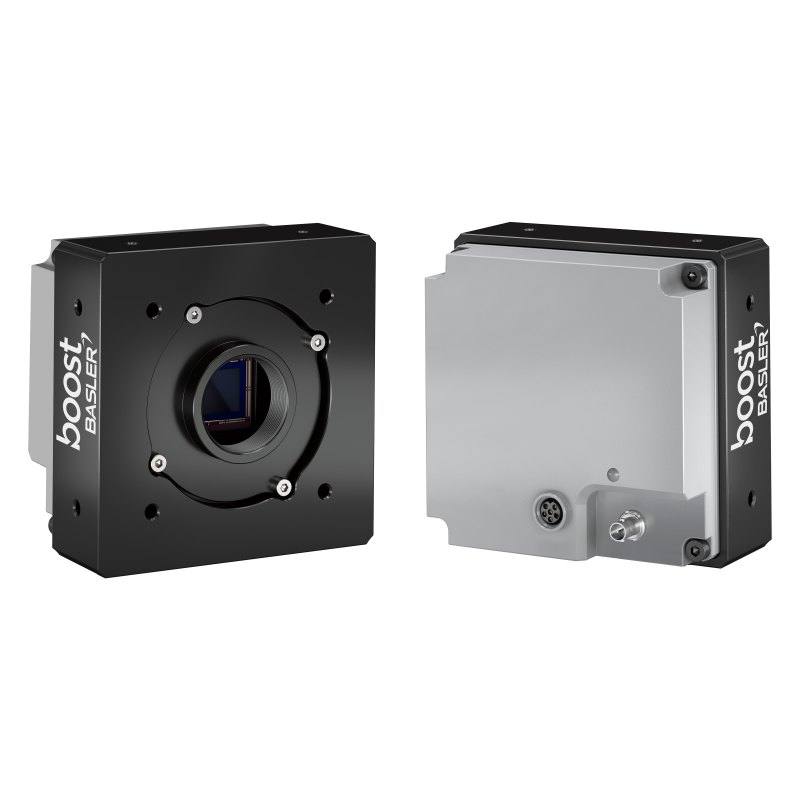
The Basler boost boA4112-68cm is a 12.3 MP monochrome area scan camera featuring the Sony IMX253LLR-C progressive scan CMOS sensor with a 1.1" format (17.6 mm effective diagonal) and 3.45 µm pixel pitch. It communicates via a single CoaXPress 2.0 (CXP-12) link supporting up to 12.5 Gbps, achieving up to 69 fps at 8-bit depth over a full 4096 × 3000 active pixel array. Power is delivered via Power-over-CoaXPress or external 24 VDC, and the camera is GenICam- and CoaXPress 2.0-compliant. It is housed in a compact 45 × 80 × 80 mm box body and is available with C-mount, F-mount, or M42 lens adapters.
The Basler boost boA4112-68cm is built around the Sony IMX253LLR-C, a 1.1" format CMOS sensor spanning 14.1 × 10.3 mm with a 17.6 mm effective diagonal. Its 4096 × 3000 active pixel array delivers 12.3 MP at a 3.45 µm pixel pitch — a combination that supports high spatial resolution without forcing the use of unusually long focal lengths, giving installers flexibility across a broad range of field-of-view and working-distance combinations. The global shutter architecture freezes motion across the entire frame simultaneously, eliminating the rolling-shutter skew and distortion that would otherwise degrade fast-moving or vibrating parts. At 8-bit output depth the camera sustains up to 69 fps over a single CXP-12 link, making it practical for inline inspection on production lines running at high throughput while still capturing the full megapixel image — no subregion compromise required for throughput.
The CoaXPress 2.0 (CXP-12) interface operates at up to 12.5 Gbps over a single coax cable. Alternatively, a standard 24 VDC supply (18.6–26 VDC range) can power the unit independently when the frame grabber does not support Power-over-CoaXPress or when the camera is farther from the cabinet than the PoCXP power budget permits. The compact 45 × 80 × 80 mm body at 480 g integrates into tight scanner nests or robotic end-of-arm tooling without excessive moment load. Power consumption of 8.4 W is predictable for thermal budgeting in sealed enclosures, and the IP30 rating handles typical factory-floor dust and light contamination, though it is not rated for wash-down environments. GenICam compliance ensures the camera integrates cleanly into any GenTL-based SDK or third-party vision runtime.
Lens mounting is highly flexible: the camera ships with a C-mount adapter and can be fitted with F-mount or M42 × 0.75 / M42 × 1 adapters, covering virtually every common industrial and photographic lens thread. For the 1.1" sensor, integrators should verify that chosen lenses carry image circle coverage for that format — underfilling will vignette the outer pixel columns. The 3.45 µm pixel pitch sets an upper bound on useful optical resolution; pairing with lenses whose MTF meets this at the working aperture preserves contrast at the Nyquist limit. For dimensional metrology or fine-defect work, telecentric lenses in M42 or C-mount can be mounted to suppress perspective error across depth-of-field variations.
Best for
High-resolution surface and defect inspection on fast-moving production lines where global shutter prevents motion artefacts and 69 fps sustains throughput — for example electronics PCB, semiconductor wafer, or battery electrode inspection.
Dimensional measurement and gauging applications requiring sub-pixel accuracy: the 4096 px horizontal resolution over a moderate field provides fine measurement increments, and the global shutter eliminates positional uncertainty from part motion.
Inline OCR/OCV and 2D/DPM code reading on packaging or pharma blister lines where high pixel density resolves small font heights and fine-pitch DataMatrix codes at production speeds.
Robotic guidance and bin-picking where the compact 80 × 80 mm footprint fits on end-of-arm tooling, global shutter captures the scene without motion blur as the arm moves, and CoaXPress keeps latency low over a single cable run.
High-resolution packaging inspection — label placement, fill-level, cap presence — where 12.3 MP allows a single camera to cover a wide label zone with enough resolution to detect small defects without multiple lower-resolution cameras.
Selection notes
Frame grabber requirement: CXP-12 demands a compatible CoaXPress 2.0 frame grabber. Verify that the chosen grabber card supports a single CXP-12 lane at 12.5 Gbps and, if PoCXP is intended, that the card's per-port power budget covers the camera's 8.4 W draw.
Lens image circle: the Sony IMX253LLR-C uses a 1.1" optical format (17.6 mm diagonal). Confirm that the selected C-mount, F-mount, or M42 lens is rated for 1.1" coverage; lenses rated only for 2/3" or 1" will vignette the corners and reduce effective resolution.
IP30 protection is sufficient for typical enclosed machine-vision stations but is not suitable for wet or wash-down environments. If the installation is in food processing or pharmaceutical wet areas, an IP67-rated housing or camera with higher ingress protection should be specified instead.
Monochrome only: applications that require colour differentiation (label colour verification, mixed-material sorting by hue) will need a separate colour camera or line-scan alternative. The monochrome sensor provides higher quantum efficiency and better SNR under the same illumination, which benefits low-contrast defect detection.
Power path planning: the camera can be powered via PoCXP through the CXP-12 cable or from an external 24 VDC source in the 18.6–26 VDC range. Confirm whether the chosen frame grabber supports PoCXP and has sufficient per-port power output before committing to a cable layout.
Specifications: General
Brand
Basler
Camera type
Area Scan
Specifications: Sensor
Resolution
12.3 MP
Horizontal resolution
4096 px
Mono / color
Monochrome
Sensor manufacturer
Sony Pregius
Sensor model
Sony IMX253LLR-C
Shutter
Global Shutter
Sensor size
1.1" (14.1 × 10.3 mm, 17.6 mm diagonal)
Pixel size
3.45 × 3.45 µm
Specifications: Performance
FPS
68
Specifications: Interface
Interface
CoaXPress 2.0 (CXP-12)
Protocols
GenICam, CoaXPress 2.0
Specifications: Optics
Mount
C-mount, F-mount, M42 × 0.75, M42 × 1
Specifications: Electrical
Power
PoCXP (Power over CoaXPress) or 24 VDC (18.6–26 VDC)
Power consumption
8.4 W
Specifications: Environment
IP rating
IP30
Operating temperature
0–50 °C
Specifications: Mechanical
Dimensions
45 × 80 × 80 mm
Weight
480 g
Applications this camera is commonly selected for. Open one to see the full recommended hardware and approach.
Matched automatically by: lens mount fits the camera mount · lens image circle covers the camera sensor — this camera: C-mount, F-mount, M42 × 0.75, M42 × 1 · 1.1" (14.1 × 10.3 mm, 17.6 mm diagonal) sensor.
By category
All 67C-mount lenses 43Telecentric lenses 24
By brand
All 67Basler 34iRAYPLE 23Omron / Sentech 8Datalogic / Datasensing 2
Get a first image quickly with the pylon Viewer, then move into the pylon SDK for your application. These cameras are GenICam/GenTL-compliant, so any compliant vision software can drive them as well.
Download and install the pylon Camera Software Suite for your OS from Basler. This provides the pylon Viewer, the GenTL transport-layer producers and the pylon SDK (C/C++/.NET/Python). On Windows the installer adds the needed drivers; on Linux follow the included setup notes for USB and network permissions.
2. Connect the camera and check the link
Cable the camera to its matching interface: GigE Vision to a GigE port (use a quality cable and, ideally, a dedicated NIC with jumbo frames enabled), USB3 Vision to a USB 3.x port with the supplied cable, or CoaXPress to the frame grabber. Provide power where required (PoE, USB bus power, or PoCXP). Open the pylon Viewer and confirm the camera appears in the device list; for GigE, make sure the camera and NIC are on the same subnet.
3. Grab a first image and set exposure, gain and pixel format
Select the camera in the pylon Viewer and start a continuous grab. Adjust exposure time and gain until the image is well exposed (avoid clipped highlights), set the pixel format (e.g. Mono8 or a Bayer/RGB format), and focus the lens. Use a test pattern if the lens or scene is not ready yet.
4. Configure triggering and acquisition
Decide between free-run and triggered acquisition. For synchronized capture, set the trigger source (software or a hardware line on the I/O connector), trigger mode and any debounce or exposure mode, then verify timing. Note the parameter names you change in the Viewer feature tree, as you will reuse them in code.
5. Move to the SDK or a GenICam-compliant library
Recreate your settings in code with the pylon SDK (C, C++, .NET or Python) to open the device, apply the same features and pull frames into your pipeline; pylon vTools and pylon AI can add processing blocks. Because the cameras are GenICam/GenTL standard, third-party vision libraries work too. Once the image stream is stable, you can route frames to a deep-learning inspection such as Rosepetal for automated defect detection.
Frequently asked questions
The boA4112-68cm uses a single CoaXPress 2.0 CXP-12 link. You need a frame grabber card that supports at least one CXP-12 lane at 12.5 Gbps. If you wish to power the camera via PoCXP you also need a grabber with sufficient per-port power output to supply the camera's 8.4 W.
Yes — the camera ships with a C-mount adapter. However, the sensor is 1.1" format (17.6 mm diagonal), so you must verify that each lens is rated for 1.1" image circle coverage. Lenses designed for smaller formats will vignette the outer pixel area. F-mount and M42 × 0.75 / M42 × 1 adapters are also available if your lens inventory uses those threads.
Global shutter means all pixels on the 4096 × 3000 array are exposed simultaneously. This eliminates the rolling-shutter effect (where fast-moving parts appear skewed or distorted) that affects CMOS sensors with sequential row readout. For inspection of objects moving on a conveyor or vibrating fixtures, global shutter is the correct choice to avoid measurement errors or false defect calls.
The camera achieves up to 69 fps at 8-bit depth over the full 4096 × 3000 active pixel array on a single CXP-12 link. No subregion restriction is required to reach this frame rate, which is a direct result of the 12.5 Gbps CXP-12 bandwidth.
The camera can be powered either via Power-over-CoaXPress (PoCXP) through the CXP-12 cable itself, or from an external 24 VDC source in the 18.6–26 VDC range. PoCXP eliminates a separate power cable when the frame grabber supports it. The camera draws 8.4 W.