Skip to content
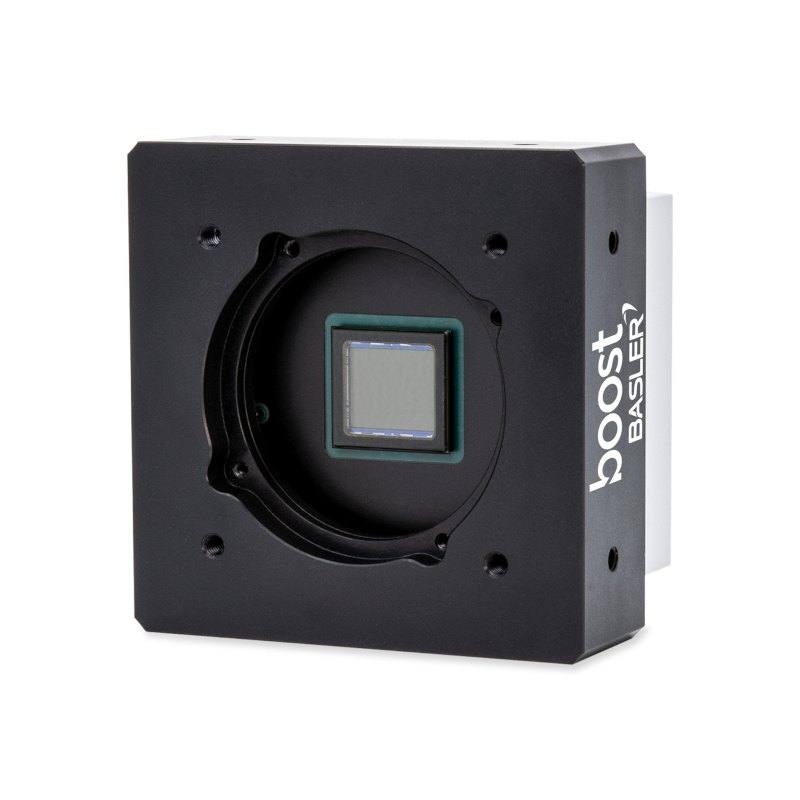
Basler boA5320-150cm machine vision camera
  • Rosepetal compatible
  • Recommended by AIS Vision

Basler boost boA5320-150cm

boA5320-150cm

The Basler boA5320-150cm is an industrial area scan camera in the boost family, delivering 5320 x 3032 pixel (16.1 MP) monochrome images at up to 150 fps via dual CXP-12 (CoaXPress 2.0) connections. It uses the Sony IMX532 CMOS sensor with a 1.1-inch format, 2.74 µm pixels, and a global shutter for distortion-free capture of moving objects. The camera supports GenICam and CoaXPress 2.0 protocols, is powered via Power over CoaXPress or an external 18.6–26 VDC supply, and carries CE/RoHS, FCC, and UL compliance with an IP30 enclosure rating. Its compact 45 x 80 x 80 mm housing accepts C-mount, F-mount, M42x0.75, and M42x1 lenses.

Brand
Basler
Camera type
Area Scan
Interface
CoaXPress CXP-12 (2x, CoaXPress 2.0)
Resolution
16.1 MP
Horizontal resolution
5328 px (native); 5320 px is nominal/marketing value
Mono / color
Monochrome
Sensor manufacturer
Sony (Pregius S)
Sensor model
Sony IMX532-AAMJ-C
Shutter
Global Shutter
FPS
149.81 fps (max, 2x CXP-12)
Mount
C-mount, F-mount, M42x0.75, M42x1
Sensor size
1.1 inch (14.6 x 8.3 mm)

Technical overview

The Basler boA5320-150cm pairs a Sony IMX532 Pregius S CMOS sensor with a 1.1-inch optical format (14.6 x 8.3 mm active area) and 2.74 µm square pixels to deliver 16.1 MP (5320 x 3032 nominal) monochrome images at up to ~150 fps. The global shutter architecture means every pixel is exposed simultaneously, so fast-moving parts on a conveyor, rotating workpieces, or strobe-lit lines produce geometrically clean frames with no row-skew or motion artefacts — a critical requirement wherever you are measuring dimensions or reading codes rather than simply detecting presence. At full resolution the camera sustains 149.81 fps, giving a data rate that demands the dual CXP-12 interface: two coaxial cables, each carrying 12.5 Gbit/s, yield a combined 25 Gbit/s throughput that keeps up with the sensor without throttling. Power-over-CoaXPress (PoCXP) means the same two cables that carry image data can supply the camera's 10.4 W load, substantially simplifying cabling on multi-camera gantries or robot arms where routing a separate power loom is impractical.

The dual CXP-12 connection is handled by a CoaXPress 2.0 frame grabber installed in the host PC, and the camera speaks GenICam, so it integrates with any SFNC-compliant SDK — Basler's own pylon, Stemmer Imaging's Common Vision Blox, Cognex VisionPro, or open-source Aravis — without vendor-locked drivers. The AUX power input (18.6–26 VDC) is available as a backup or sole supply when PoCXP is not provided by the grabber. The compact 45 x 80 x 80 mm, 442 g housing is rated IP30, meaning it is suited for clean factory environments but requires supplementary enclosure or pressurization in dusty or wet areas. Operating temperature spans 0–50 °C, covering most climate-controlled production lines without active cooling. The mount system is unusually versatile: C-mount, F-mount, M42x0.75, and M42x1 threads are all supported, letting integrators choose from a wide range of telecentric, macro, or large-format lenses sized for the 1.1-inch image circle without adapters.

At 16.1 MP with 2.74 µm pixels the camera resolves fine features across a wide field of view simultaneously. For a 300 mm wide inspection window the resulting ground-sampling distance is roughly 56 µm/pixel, sufficient to catch sub-millimetre surface defects or to read DataMatrix codes printed at 6 mil cell pitch. The monochrome-only output maximises quantum efficiency for the sensor's pixel size and removes the Bayer interpolation error that would otherwise degrade dimensional accuracy in colour sensors. When paired with structured or collimated monochromatic lighting (e.g., a blue or green LED bar matched to the peak QE of a silicon sensor), the combination of high-resolution, global shutter, and narrow-band illumination makes the boA5320-150cm especially effective for surface-texture analysis and sub-pixel edge detection. The high frame rate also supports multi-image averaging or HDR bracketing workflows at throughputs that would not be achievable at lower fps, useful when part reflectivity varies significantly across a batch.

Best for

  • High-throughput surface and defect inspection on fast-moving conveyors where both high resolution and zero motion blur are required simultaneously — the global shutter and ~150 fps eliminate the need to slow the line.
  • Dimensional measurement of precision machined or stamped components, where 16.1 MP provides enough pixel budget to cover a wide FOV while still resolving tolerances in the tens of microns when fitted with a telecentric or high-quality fixed-focal lens on the M42 or C-mount.
  • High-density 1D/2D barcode and DataMatrix traceability reading on automotive, electronics, or pharmaceutical packaging lines where codes may be presented at any angle and at line speed — the global shutter prevents code distortion and the resolution supports small, high-density symbologies.
  • Multi-zone PCB or semiconductor wafer inspection tasks where a single camera must cover a large substrate in one shot, reducing station count and eliminating stitching artefacts that arise from multi-camera mosaics.
  • Battery cell and electrode surface inspection in EV manufacturing, where high frame rates allow 100 % inline coverage of continuously moving electrode material and the monochrome sensor maximises contrast on metallic or carbon-black surfaces under diffuse or darkfield LED illumination.

Selection notes

  • The dual CXP-12 interface is mandatory for full-fps operation — the host system must have a CoaXPress 2.0 frame grabber with two CXP-12 ports and drivers compatible with GenICam/CoaXPress 2.0. If only a single CXP-12 port is available, frame rate will be limited to approximately half; GigE or USB3 grabbers are not compatible.
  • The 1.1-inch sensor format requires a lens with an image circle of at least 17.6 mm (the diagonal of the 14.6 x 8.3 mm sensor). C-mount lenses designed for 2/3-inch or 1-inch sensors will show heavy vignetting at full resolution. Verify the lens datasheet specifies coverage for 1.1-inch or Type 1.1 format before ordering.
  • IP30 offers only basic protection against solid particle ingress and provides no moisture protection. Installations in wash-down, high-humidity, or dusty environments will require a sealed camera enclosure or an air-purge housing; budget for this in system design and ensure the chosen enclosure does not obstruct the mount or add thermal mass that pushes operating temperature above 50 °C.
  • Power-over-CoaXPress simplifies wiring but the 10.4 W load must be confirmed against the PoCXP budget of the specific frame grabber. Some entry-level grabbers limit PoCXP output per port; if the budget is insufficient, provision the AUX 18.6–26 VDC supply line alongside the coax cables.
  • At 2.74 µm pixel pitch and 16.1 MP, data volumes are high even in ROI or binning modes — plan PC-side storage and processing pipelines (NVMe RAID, GPU-accelerated processing) accordingly to sustain the ~150 fps throughput without dropped frames in continuous inspection cycles.

Specifications: General
BrandBasler
Camera typeArea Scan

Specifications: Sensor
Resolution16.1 MP
Horizontal resolution5328 px (native); 5320 px is nominal/marketing value
Mono / colorMonochrome
Sensor manufacturerSony (Pregius S)
Sensor modelSony IMX532-AAMJ-C
ShutterGlobal Shutter
Sensor size1.1 inch (14.6 x 8.3 mm)
Pixel size2.74 µm x 2.74 µm

Specifications: Performance
FPS149.81 fps (max, 2x CXP-12)

Specifications: Interface
InterfaceCoaXPress CXP-12 (2x, CoaXPress 2.0)
ProtocolsGenICam, CoaXPress 2.0

Specifications: Optics
MountC-mount, F-mount, M42x0.75, M42x1

Specifications: Electrical
PowerPower over CoaXPress (PoCXP) or AUX 18.6–26 VDC
Power consumption10.4 W
Supply voltage18.6–26 VDC

Specifications: Environment
IP ratingIP30
Operating temperature0–50 °C

Specifications: Mechanical
Dimensions45 x 80 x 80 mm
Weight442 g
Housing materialBox

Frequently asked questions

Related technical guides

Rosepetal · AI

Test this camera with Rosepetal

Validate your visual inspection with AI: send us sample images and we evaluate the case on your hardware.

AIS Vision · Integration

We validate camera + lens + lighting

AIS Vision defines and tests the optimal combination of camera, optics and lighting for your application before you buy.