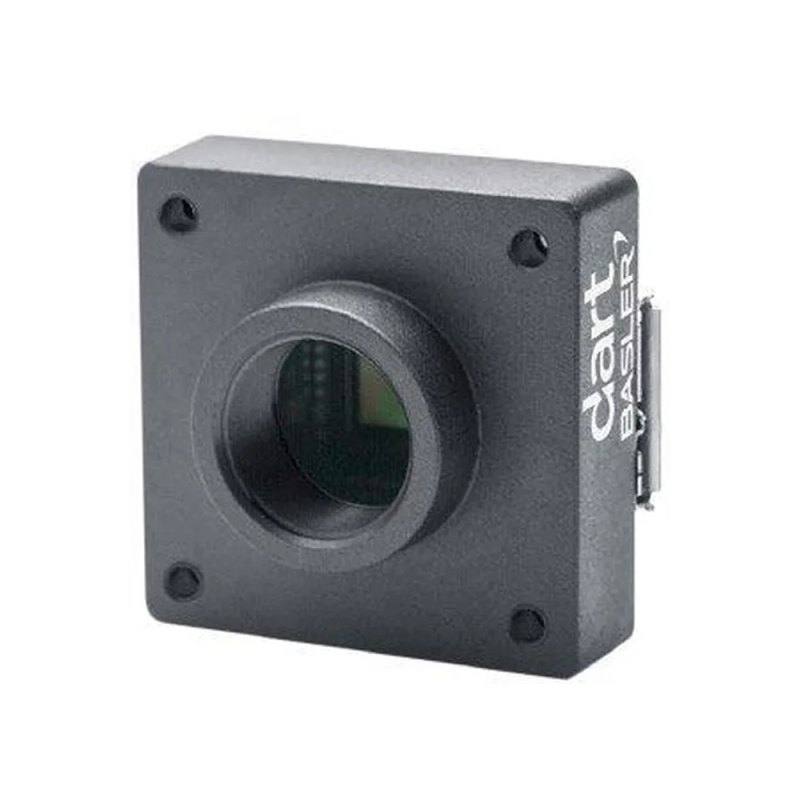
The daA720-520um belongs to Basler's dart R series of board-level cameras, designed for embedded and space-constrained machine vision applications. It uses the Sony IMX287LLR-C progressive scan CMOS sensor with a 1/2.9" format and 6.9 µm pixel pitch, providing 720×540 px resolution (0.39 MP) with a global shutter. The camera communicates via USB 3.0 SuperSpeed (5 Gbit/s) and is compliant with the USB3 Vision and GenICam 2.x standards. It is available in bare board, S-mount, and CS-mount configurations, consuming approximately 2 W at 5 VDC.
The Basler daA720-520um belongs to the dart R series of board-level cameras and is built around the Sony IMX287LLR-C, a 1/2.9" Pregius global shutter CMOS sensor with a 4.97 × 3.73 mm active area and 6.9 µm square pixels. The global shutter architecture means every pixel is exposed simultaneously, eliminating the rolling-shutter distortion that plagues fast or laterally-moving targets on conveyor lines — an essential property when imaging parts that cannot be strobed to a dead stop. At 720 × 540 px (0.39 MP) the resolution is deliberately modest, which is exactly what allows the sensor to sustain up to 523 fps over USB 3.0 SuperSpeed at full frame; the default pipeline rate sits at 197.9 fps, leaving substantial headroom for ROI-based acceleration or multi-camera USB hub deployments where host bandwidth must be shared.
The camera communicates via USB 3.0 SuperSpeed at 5 Gbit/s and is fully compliant with the USB3 Vision and GenICam 2.x standards, so it drops into any compliant SDK without custom drivers. Power is drawn entirely from the USB bus at approximately 2 W / 5 VDC, removing the need for a separate power supply or I/O breakout board in embedded builds. The board-level form factor measures just 19.9 × 29.3 × 29 mm and weighs 15 g, making it practical to mount inside robotic end-effectors, inside gantry housings, or alongside PCBs in compact OEM instruments. Three mounting configurations — bare board, S-mount, and CS-mount — give integrators a clear path from bare-board prototyping to a CS-lens production fixture on the same imaging core.
Lighting and trigger pairing should account for the camera's high frame rate and monochrome sensitivity. Because the Sony IMX287 is a Pregius global shutter sensor in monochrome configuration, it delivers strong quantum efficiency across the visible and near-infrared spectrum, making it a natural candidate for strobed near-IR illumination where surface contrast is better than under white light. The 6.9 µm pixel pitch gives useful dynamic range without excessive read noise, supporting continuous operation under stable factory lighting as well as triggered strobe setups. For lens selection, the 1/2.9" image circle (4.97 × 3.73 mm) is covered by standard S-mount (M12) board lenses and, in the CS-mount configuration, by compact CS-format lenses — both widely available in focal lengths from 2.8 mm to 25 mm. Installers targeting sub-millimetre feature detection should budget for lenses resolving comfortably above the Nyquist limit imposed by the 6.9 µm pixel pitch.
Best for
High-speed inline inspection of small electronics components — solder joints, chip placement, connector seating — where up to 523 fps eliminates motion blur on fast conveyor lines without an external motion-stop mechanism.
Robot guidance and pick-and-place applications in embedded end-effector housings where the 15 g weight, bus-powered USB operation, and bare-board or S-mount form factor make cable routing and integration into tight enclosures practical.
Barcode, DataMatrix, and 1D/2D traceability reading on fast-moving labels or direct part marks, where the global shutter prevents the character skew that rolling-shutter cameras produce at high belt speeds.
Compact OEM instruments — benchtop inspection stations, handheld scanners, medical device sub-assemblies — that require a fully standards-compliant GenICam camera consuming under 2 W with no external power rail.
Dimensional gauging and presence/absence verification tasks in electronics, automotive, or pharma lines where 0.39 MP resolution is sufficient and frame-rate throughput, not pixel count, is the bottleneck.
Selection notes
Resolution ceiling: at 0.39 MP (720 × 540 px) the daA720-520um is optimised for speed over detail. Verify that your smallest critical feature subtends at least 3–5 pixels at the intended working distance before committing; applications requiring sub-pixel metrology over large fields of view should step up to a higher-resolution dart or ace model.
USB host bandwidth management: each camera saturates a portion of the 5 Gbit/s USB 3.0 bus. When deploying multiple cameras on a single host, use a dedicated USB 3.0 host controller per camera or an externally powered industrial USB hub with independent controller chips — shared hubs under a single USB root will throttle sustained frame rates below the 523 fps maximum.
Operating temperature range splits by housing: the mounted (S-mount or CS-mount) configuration is rated 0–50 °C, while the bare board extends to 75 °C — relevant for installations near heat sources where the lens barrel or housing would otherwise be the limiting factor.
Lens mount choice drives the optical path length: the CS-mount configuration accepts CS-mount and, with an adapter ring, C-mount lenses. The S-mount (M12) configuration constrains you to M12 board lenses with shorter back focal distances. Confirm the lens back focal length matches the chosen mount variant before ordering optics.
Trigger and strobe integration: the camera supports hardware triggering for synchronised multi-camera or strobe-flash setups, but GPIO is routed through the board-level connector rather than a standalone I/O connector on the housing — verify connector pinout compatibility with your strobe controller or PLC I/O card early in the design.
Specifications: General
Brand
Basler
Camera type
Area Scan
Specifications: Sensor
Resolution
0.39 MP
Horizontal resolution
720 × 540 px
Mono / color
Monochrome
Sensor manufacturer
Sony Pregius
Sensor model
Sony IMX287LLR-C
Shutter
Global Shutter
Sensor size
1/2.9" (4.97 × 3.73 mm)
Pixel size
6.9 × 6.9 µm
Specifications: Performance
FPS
up to 523 fps (197.9 fps default)
Specifications: Interface
Interface
USB 3.0 SuperSpeed (5 Gbit/s)
Protocols
USB3 Vision, GenICam 2.x
Specifications: Optics
Mount
CS-Mount / S-Mount / No-Mount
Specifications: Electrical
Power
USB (≈2 W @ 5 VDC)
Power consumption
2 W
Specifications: Environment
Operating temperature
0–50 °C (mounted), 0–75 °C (bare board)
Specifications: Mechanical
Dimensions
19.9 × 29.3 × 29 mm
Weight
15 g
Housing material
Board Level
Applications this camera is commonly selected for. Open one to see the full recommended hardware and approach.
Matched automatically by: lens mount fits the camera mount · lens image circle covers the camera sensor — this camera: CS-Mount / S-Mount / No-Mount · 1/2.9" (4.97 × 3.73 mm) sensor.
By category
All 244C-mount lenses 179Telecentric lenses 62F-mount / large-format lenses 3
By brand
All 244Omron / Sentech 81iRAYPLE 66Basler 65Datalogic / Datasensing 32
Get a first image quickly with the pylon Viewer, then move into the pylon SDK for your application. These cameras are GenICam/GenTL-compliant, so any compliant vision software can drive them as well.
Download and install the pylon Camera Software Suite for your OS from Basler. This provides the pylon Viewer, the GenTL transport-layer producers and the pylon SDK (C/C++/.NET/Python). On Windows the installer adds the needed drivers; on Linux follow the included setup notes for USB and network permissions.
2. Connect the camera and check the link
Cable the camera to its matching interface: GigE Vision to a GigE port (use a quality cable and, ideally, a dedicated NIC with jumbo frames enabled), USB3 Vision to a USB 3.x port with the supplied cable, or CoaXPress to the frame grabber. Provide power where required (PoE, USB bus power, or PoCXP). Open the pylon Viewer and confirm the camera appears in the device list; for GigE, make sure the camera and NIC are on the same subnet.
3. Grab a first image and set exposure, gain and pixel format
Select the camera in the pylon Viewer and start a continuous grab. Adjust exposure time and gain until the image is well exposed (avoid clipped highlights), set the pixel format (e.g. Mono8 or a Bayer/RGB format), and focus the lens. Use a test pattern if the lens or scene is not ready yet.
4. Configure triggering and acquisition
Decide between free-run and triggered acquisition. For synchronized capture, set the trigger source (software or a hardware line on the I/O connector), trigger mode and any debounce or exposure mode, then verify timing. Note the parameter names you change in the Viewer feature tree, as you will reuse them in code.
5. Move to the SDK or a GenICam-compliant library
Recreate your settings in code with the pylon SDK (C, C++, .NET or Python) to open the device, apply the same features and pull frames into your pipeline; pylon vTools and pylon AI can add processing blocks. Because the cameras are GenICam/GenTL standard, third-party vision libraries work too. Once the image stream is stable, you can route frames to a deep-learning inspection such as Rosepetal for automated defect detection.
Frequently asked questions
The daA720-520um can deliver up to 523 fps at the full 720 × 540 px resolution over USB 3.0 SuperSpeed. The default pipeline operates at 197.9 fps; reaching 523 fps requires enabling the camera's maximum acquisition mode. Reducing the ROI may allow higher line rates within the sensor's internal limits, but 523 fps is the published full-frame maximum.
No. The camera is fully bus-powered from the USB 3.0 port at approximately 2 W / 5 VDC. No separate power supply, power injector, or I/O breakout board is required, which simplifies embedded and OEM integration.
Global shutter exposes every pixel simultaneously, so fast lateral motion — typical on conveyor belts, robotic arms, or vibrating fixtures — produces no line-by-line skew or wobble artefacts. If your targets are stationary or can be strobed to very short effective exposures, a rolling-shutter camera can work; for everything else on a moving line, the global shutter in this camera is the decisive advantage.
The camera ships in three hardware variants sharing the same imaging core: bare board (no mount), S-mount (M12 thread), and CS-mount. The 1/2.9" image circle (4.97 × 3.73 mm active area) is covered by virtually all S-mount board lenses and by CS-format lenses in the CS-mount configuration. C-mount lenses can be used on the CS-mount variant with a C-to-CS adapter ring.
The camera is compliant with USB3 Vision and GenICam 2.x standards. It works natively with Basler's pylon Camera Software Suite and integrates without custom drivers into any GenICam-compliant framework, including third-party machine vision environments built on GenICam.