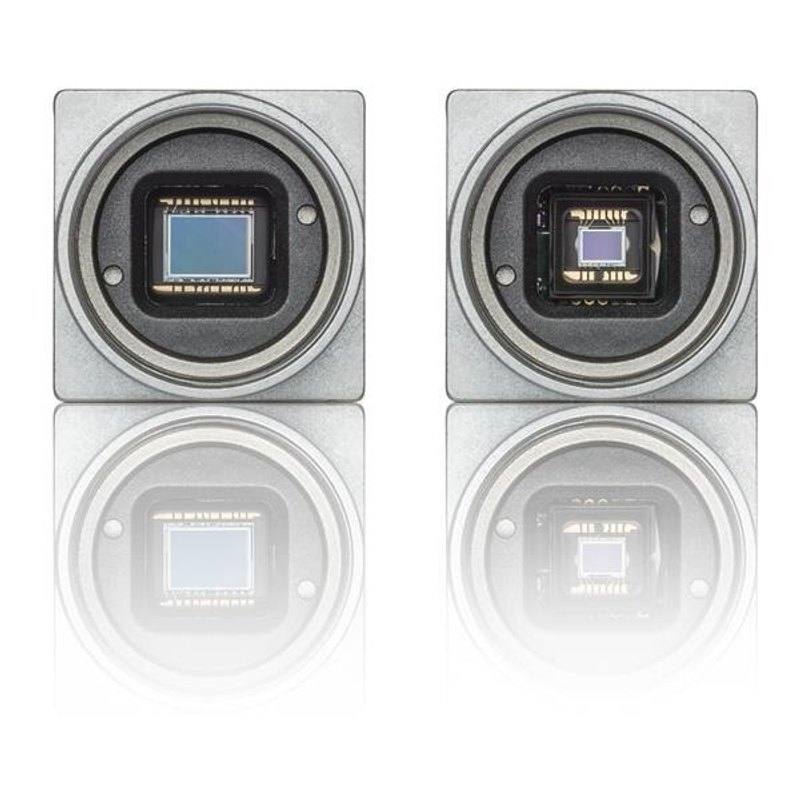
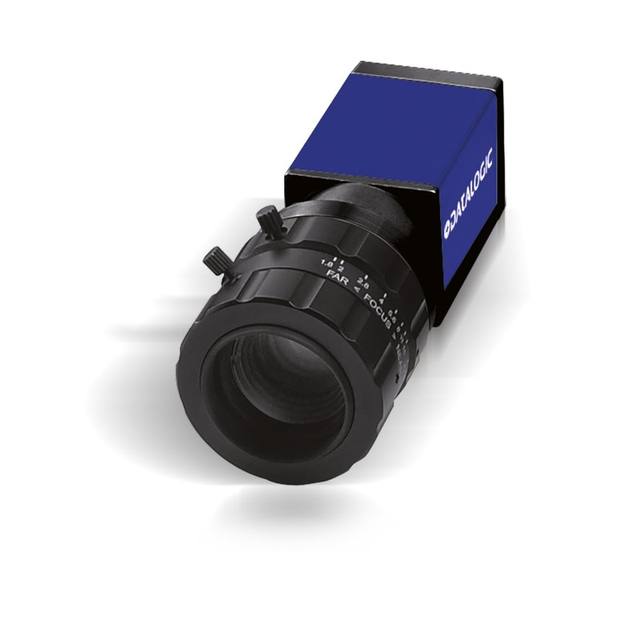
USB3.0 Vision area scan camera with 2448 x 2048 (5 MP) resolution, 2/3" global shutter CMOS sensor and 35 fps. Compact housing for use with Datasensing MX-U Series USB3.0 vision processors. Highest resolution in the U Series, suited for detailed inspection tasks.
The Datasensing U198 (CAM-U198-USB3) is a 5 MP monochrome area scan camera built around a 2/3-inch global shutter sensor, delivering a horizontal resolution of 2448 px over a USB3 Vision interface. As an area scan device it captures a full two-dimensional frame in a single exposure, which makes it straightforward to integrate for inspecting discrete parts or fixed fields of view without the precise, continuous part motion that line scan systems require. The 5 MP resolution provides enough pixels to resolve fine features, small print and tight tolerances across a usefully sized field of view.
The global shutter is the defining characteristic for motion handling: every pixel begins and ends its exposure simultaneously, so moving objects are captured without the skew or smear that a rolling shutter would introduce. Combined with a frame rate of 35 fps, this suits applications where parts move past the camera on a conveyor or indexing fixture, or where the camera itself is mounted on a moving stage, and where geometric accuracy of the captured image is important. The monochrome sensor records luminance directly rather than interpolating colour through a filter array, which typically yields higher effective spatial detail and better light sensitivity per pixel, both helpful for edge-finding, gauging and text reading.
The camera draws power over its USB connection, simplifying cabling because data and power share a single bus, and it conforms to the USB3 Vision and GenICam standards. GenICam compliance means the device exposes a standardised feature interface, so it can be configured and acquired from by any compliant host software or vision library rather than being locked to a proprietary SDK. It is also listed as Rosepetal-ready, indicating compatibility with that platform for AI-based workflows.
Best for
Dimensional measurement and gauging of parts in motion, where the global shutter preserves geometric accuracy and the 5 MP resolution supports tight tolerances
AI-based defect inspection on surfaces and components that benefit from high pixel counts to resolve small flaws
Industrial OCR and OCV for reading printed codes, date marks, labels and engraved text where monochrome detail aids character segmentation
High-resolution inspection of discrete parts on conveyors or indexing stations at moderate throughput up to 35 fps
Integration with Rosepetal-based AI vision pipelines for training and deploying inspection models
Selection notes
Match the lens to the 2/3-inch sensor format and to a 5 MP class image circle so the optics can actually resolve the available pixels across the full frame; an under-specified lens will throw away the resolution advantage at the corners.
Plan lighting around the monochrome sensor: it captures luminance only, so use the wavelength and geometry (diffuse, directional, backlight) that maximise contrast for your feature, rather than relying on colour separation.
The global shutter pairs well with strobed or pulsed illumination to freeze motion; size exposure and lighting together so you can run near 35 fps without motion blur or underexposure.
Confirm USB3 cabling and host capacity: USB3 Vision has practical cable-length limits, so for longer runs consider active or optical USB3 cables, and ensure the host controller and bus bandwidth can sustain the full 5 MP data rate; if your layout needs long cabling or many cameras on one trunk, a different interface may be more appropriate.
If the application needs colour discrimination, line scan geometry for continuous web material, or higher frame rates than 35 fps, evaluate a different model.
Specifications: General
Camera type
Area scan
Specifications: Sensor
Resolution
5 MP
Horizontal resolution
2448 px
Mono / color
Monochrome
Shutter
Global shutter
Sensor size
2/3"
Specifications: Performance
FPS
35 fps
Specifications: Interface
Interface
USB3 Vision
Protocols
USB3 Vision, GenICam
Specifications: Optics
Mount
C-mount
Specifications: Electrical
Power
USB
Specifications: Commercial
Rosepetal-ready
Yes
This product groups every purchasable order code that shares the same sensing method, range and output. Cable length, connector type and operation mode (Light-ON/Dark-ON, NO/NC) vary by order code below.
Family variants with highlighted differences
Model
Mono / color
Interface
Availability
5 MP Monochrome USB3 Vision Base
Monochrome
USB3 Vision
On request
Applications this camera is commonly selected for. Open one to see the full recommended hardware and approach.
1. Install the IMPACT Software Suite and connect the camera
Install the IMPACT Software Suite on your PC, which provides both the configuration/viewer tools and the SDK. For a GigE Vision model (E100, M or U series), connect it to a dedicated NIC and, for USB3 models, use a certified USB3 cable and port. Power the camera and confirm it enumerates.
2. Bring the camera online and verify the link
For GigE Vision, put the camera and the host NIC on the same subnet (a static IP on the camera matching the NIC range is the most reliable starting point); for USB3, confirm the device is recognized. Open the IMPACT viewer/device tool, discover the camera, and verify a stable connection before streaming. Enabling jumbo frames on the NIC helps GigE throughput.
3. Set exposure, gain and trigger, then grab a first image
In the IMPACT tools, start a live stream and adjust exposure and gain until the image is well-lit without saturation; set white balance on color models. Begin in free-run (continuous) mode to confirm imaging, then switch to hardware or software trigger as your application requires. Capture and save a reference image once the scene looks correct.
4. Build a vision tool or move to the SDK/API
Use the IMPACT point-and-click vision tools to assemble an inspection, or use the IMPACT SDK to access the camera and results programmatically and feed them into your HMI/PLC application. As these are GenICam/GenTL-compliant devices, you can alternatively drive them from any GenICam-compliant third-party vision library if your pipeline standardizes on one.
5. Route the stable feed to deep-learning inspection (optional)
Once you have a stable, repeatable image, the feed can be sent to a deep-learning inspection platform such as Rosepetal for defect detection or classification tasks that go beyond rule-based tooling. Keep lighting, optics and trigger timing fixed so the images reaching the model stay consistent.
Frequently asked questions
Yes. It uses a 2/3-inch global shutter sensor, so all pixels are exposed simultaneously and moving objects are captured without rolling-shutter skew or smear, making it suitable for parts in motion.
It is a 5 MP camera with a horizontal resolution of 2448 px, and it is monochrome. Monochrome sensors record luminance directly, which typically gives higher effective detail and better light sensitivity than an equivalent colour sensor.
It connects over a USB3 Vision interface and is powered over the same USB connection, so data and power share one cable. It also supports the GenICam standard for configuration and acquisition.
Up to 35 fps at full 5 MP resolution, which supports inspection of parts moving on conveyors or indexing fixtures at moderate throughput when paired with adequate lighting.
Yes. Because it complies with USB3 Vision and GenICam, it exposes a standardised feature interface that any compliant host software or vision library can drive. It is also listed as Rosepetal-ready for AI-based inspection workflows.