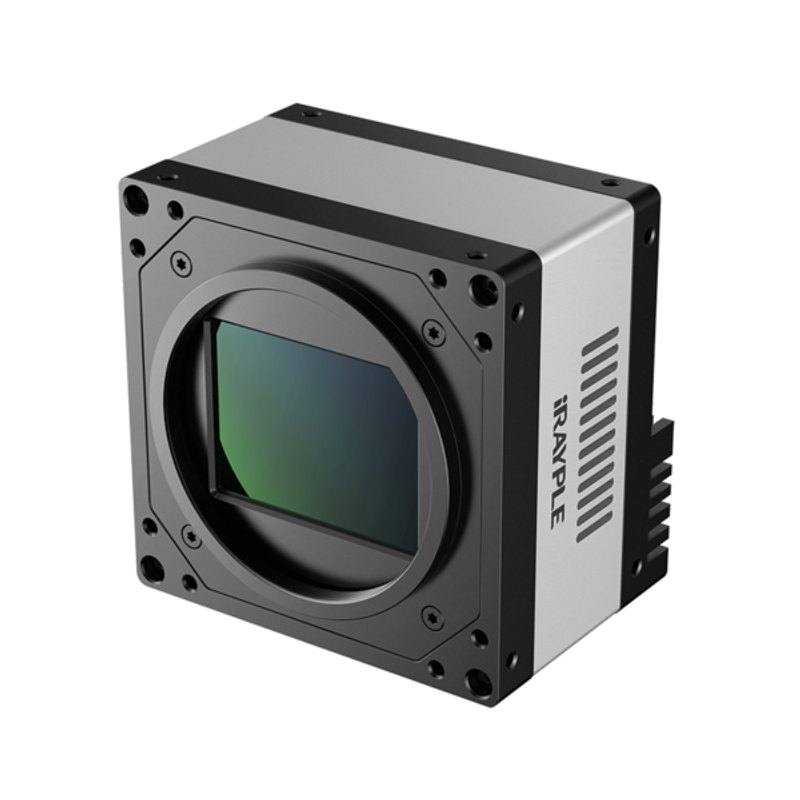
iRAYPLE 7000 Series 2.3MP Area Scan Camera (GigE / USB3)
A7200MG30E
The iRAYPLE A7200 7000-series is a family of compact (29×29mm) 2.3MP area scan cameras sharing a 1/1.2-inch Sony Pregius global-shutter CMOS sensor platform. The GigE models (MG30E mono, CG30E color) feature a Sony IMX249 sensor running at 38fps with GigE Vision V2.0 / GenICam, 256MB on-board cache, PoE or DC 9V–24V power, and a 29×29×42mm body weighing 88g. The USB3 model A7200CU001E also uses the IMX249 at 38.7fps, while the A7200CU130E upgrades to a Sony IMX174 sensor achieving 164fps; both USB3 variants measure 29×29×29mm and weigh 60g. All models share a C-mount, 6-pin Hirose GPIO, opto-isolated I/O, and support ROI, binning/mirror, hardware/software trigger, and ISP functions including gamma, LUT, black-level correction and SPC.
The iRAYPLE A7200 series is built around Sony's Pregius global-shutter CMOS platform, with the IMX249 sensor powering the GigE variants (A7200MG30E mono, A7200CG30E color) and the USB3 A7200CU001E (color), and the higher-speed IMX174 sensor driving the A7200CU130E (color). All variants share a 1920 × 1200-pixel (2.3 MP) resolution, 1/1.2-inch optical format, and 5.86 × 5.86 µm square pixels — a pixel pitch that balances spatial resolution, dynamic range, and sensitivity for general-purpose industrial inspection under controlled lighting. The global shutter eliminates the motion artifacts that rolling-shutter designs produce on fast-moving parts or conveyor lines, making the family reliable for both triggered and free-running acquisition without geometric distortion in the image.
Interface choice defines how the camera integrates into a machine. The two GigE models deliver 38 fps over standard Cat-5e/6 cable up to 100 m, accept Power-over-Ethernet so a single cable carries data and power, and also support DC 9 V–24 V via a separate supply — practical for multi-camera lines where a managed PoE switch provides centralized power. Both comply with GigE Vision V2.0 and GenICam, so they drop into any standard industrial vision framework without driver work. The USB3 variants use the USB3 Vision + GenICam stack; the IMX249-based CU001E matches the GigE frame rate at 38.7 fps while the IMX174-based CU130E reaches 164 fps at full resolution, making it the right pick when parts move rapidly or when a high-speed triggered strobe must be synchronized to a short exposure window. Power on USB3 models comes from the USB bus or an optional DC 9 V–24 V input via the Hirose connector.
All four variants share the same C-mount, a compact 29 × 29 mm cross-section, 2.8 W consumption, and an operating range of −30 °C to +50 °C. The GigE body measures 29 × 29 × 42 mm and weighs 88 g; the USB3 body is a shorter 29 × 29 × 29 mm at 60 g. The 6-pin Hirose GPIO provides opto-isolated I/O for hardware triggering from a PLC, encoder, or photoelectric sensor, and the 256 MB on-board cache (GigE models) absorbs burst traffic spikes. On-camera ISP functions — gamma, LUT, black-level correction, SPC, ROI, binning, and mirror — reduce host-side processing load. The compact cross-section and low weight allow mounting in tight robot-arm or inline fixture positions where larger cameras cannot fit.
Best for
High-speed part inspection on conveyors where the 164 fps A7200CU130E, global shutter, and hardware trigger combine to freeze motion at throughputs that would blur a standard 30 fps camera.
Distributed multi-camera GigE lines where PoE simplifies cable routing and GigE Vision V2.0 compliance ensures interoperability with any GenICam-compliant frame grabber or vision software.
Robot-guidance and pick-and-place cells requiring a lightweight (60–88 g), compact (29 × 29 mm cross-section) body that can mount directly on an arm without affecting payload, while global shutter prevents the skew that rolling-shutter cameras introduce when the robot is moving.
OCR/OCV, code reading, and 2D dimensional measurement tasks that demand stable, distortion-free images — the Sony Pregius global-shutter sensor and 5.86 µm pixel pitch provide the contrast and geometric fidelity these applications require.
Harsh-environment stations operating across a −30 °C to +50 °C range, such as automotive press-shop or cold-chain packaging lines, where the wide thermal tolerance keeps the camera online without heating enclosures.
Selection notes
Choose the A7200MG30E (mono GigE) for maximum sensitivity, contrast, and processing speed in surface-defect or OCR applications; reserve the color variants (A7200CG30E, A7200CU001E, A7200CU130E) for tasks where hue discrimination — label verification, color-code sorting, or cosmetic inspection — is required.
The 1/1.2-inch sensor format requires C-mount lenses with an image circle large enough to cover that format; using a lens rated only for a smaller format such as 1/1.8-inch will produce vignetted corners and degrade edge-of-field resolution.
At 164 fps (A7200CU130E) the effective exposure window is very short — plan strobe lighting accordingly. The opto-isolated Hirose GPIO supports hardware trigger-to-strobe synchronization, but confirm that the lighting controller's minimum pulse width matches the camera's exposure time at the chosen frame rate.
USB3 cable runs are limited to approximately 3–5 m with standard cables before signal integrity degrades; for longer runs or multi-camera topologies, choose the GigE variants and note that the 256 MB on-board cache on GigE models buffers burst frames when network congestion occurs.
The camera has no IP-rated enclosure specified in the product data — in washdown or high-particulate environments, a protective housing will be required to maintain reliable operation.
Specifications: General
Brand
iRAYPLE
Camera type
Area Scan
Specifications: Sensor
Resolution
2.3 MP
Horizontal resolution
1920 × 1200 px
Mono / color
Mono (A7200MG30E) / Color (A7200CG30E, A7200CU001E, A7200CU130E)
Sensor manufacturer
Sony Pregius
Sensor model
Sony IMX249 (GigE & USB3/IMX249 variants); Sony IMX174 (A7200CU130E)
Follow these steps to bring up your iRAYPLE camera, capture a first image, and move from the viewer to your own application. The flow is the same across the A, AE, AX and L series; only the physical interface differs.
Download and install the iRAYPLE machine-vision SDK together with its viewer client for your operating system. The installer provides the camera drivers, the GenTL producer, and the viewer you will use for first light. For GigE Vision models, also install or enable the bundled filter/performance driver on the network adapter to maximize throughput.
2. Connect the camera to the correct interface
Wire the camera to its matching host interface: a dedicated Gigabit (or 10 GigE) NIC for GigE Vision models, a USB3 Vision port with a quality cable for USB3 models, or a frame grabber for CoaXPress models. Power the camera (PoE, USB bus power, or PoCXP / external supply as applicable). For GigE Vision, put the NIC and camera on the same subnet and, where supported, enable jumbo frames.
3. Detect and open the camera in the viewer
Launch the iRAYPLE viewer, run device enumeration, and select your camera from the discovered list. Open it to load the device feature tree (GenICam node map). If a GigE camera is found but cannot be opened, correct the IP configuration so the camera and NIC are in the same address range.
4. Set exposure, gain and trigger, then grab a first image
Start with continuous (free-run) acquisition under stable lighting. Adjust exposure time and gain for a well-exposed, low-noise image, set the pixel format (e.g. Mono8 or a Bayer/RGB format), and tune white balance on color models. Once the live image looks correct, switch trigger mode to hardware or software trigger to synchronize capture with your process, and verify a single triggered frame.
5. Move from the viewer to the SDK or a GenICam library
With imaging confirmed, reproduce the same settings in code using the SDK's C/C++ or Python API: enumerate, open, configure the relevant GenICam features, register a frame callback or grab loop, and convert frames to your pipeline's buffer format. Since the cameras are GenICam/GenTL-compliant, you can alternatively drive them from a third-party GenICam vision library. From here a stable image stream can feed a deep-learning inspection step such as Rosepetal for automated quality control.
Frequently asked questions
The A7200CU130E, using the Sony IMX174 sensor over USB3, reaches 164 fps at full 1920 × 1200 resolution. The remaining three variants (IMX249-based GigE at 38 fps, and USB3 CU001E at 38.7 fps) run at substantially lower rates.
Yes. The GigE variants (A7200MG30E and A7200CG30E) support Power-over-Ethernet (PoE), so a PoE-capable switch or injector delivers both data and power over a single Cat-5e/6 cable. A DC 9 V–24 V supply via the Hirose connector is an alternative if PoE is unavailable.
Yes. All four models — both GigE and both USB3 — use a global shutter, meaning all pixels integrate light simultaneously. This eliminates rolling-shutter motion blur and geometric skew on fast-moving parts.
All variants use a standard C-mount. The sensor measures 1/1.2 inches, so the chosen lens must project an image circle large enough to cover that format to avoid vignetting.
Yes. GigE models comply with GigE Vision V2.0 and GenICam; USB3 models comply with USB3 Vision and GenICam. Both standards are natively supported by major vision frameworks and SDKs, requiring no custom drivers.