Skip to content
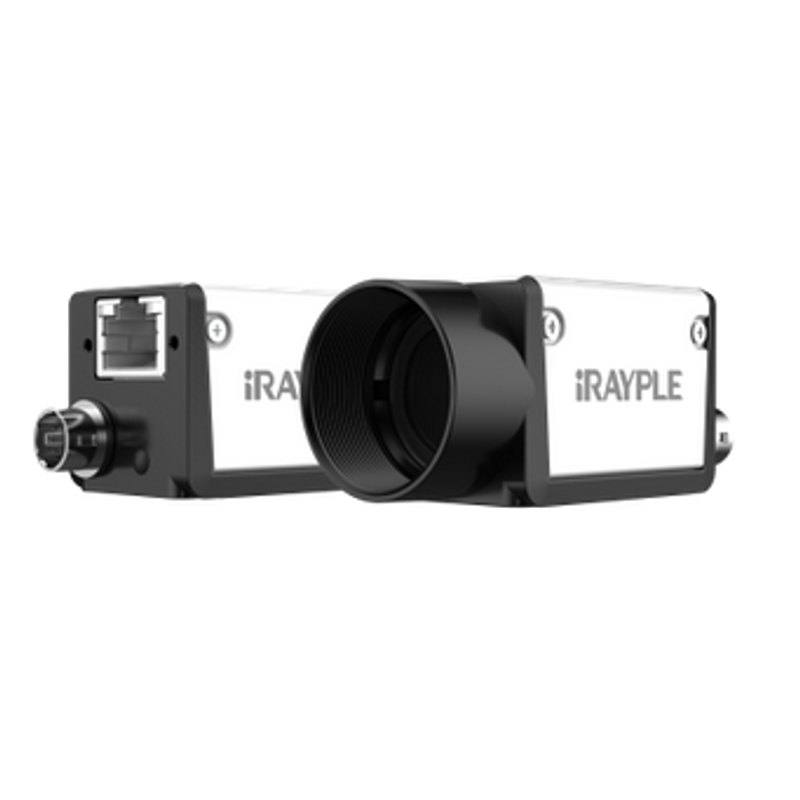
iRAYPLE A7A20MG9E / A7A20MG400E / A7A20CG9E / A7A20CG400E / A7A20CU201E / A7A20CU30E / A7A20CK401E (4096x3000, IMX304/IMX253, ~12MP) machine vision camera
  • Rosepetal compatible
  • Recommended by AIS Vision

iRAYPLE A Series 12MP Area Scan Cameras (A7A20 Family)

A7A20MG9E

The A7A20 family from Zhejiang HuaRay Technology (iRAYPLE) covers seven model variants at 4096x3000 resolution (12.29 MP) using a Sony IMX304 (most variants) or IMX253 (A7A20CU30E) 1.1-inch global-shutter CMOS sensor with 3.45 µm pixels. Interface options span GigE/PoE (9 fps, up to 256 MB onboard cache, GigE Vision V2.0 / GenICam), USB3.0 (30–30.5 fps, USB3 Vision / GenICam), and CameraLink V2.0 (20 fps, up to 2.5 Gbps bandwidth). Bodies are available in two compact form factors: 29×44×58 mm (91–100 g, rectangular) and 29×29×42–44 mm (80–100 g, cube), both with C-mount, opto-isolated GPIO via 6-pin Hirose, and full ISP support including SPC, LUT, gamma, denoising, and sharpening.

Brand
iRAYPLE
Camera type
Area Scan
Resolution
12.29 MP
Horizontal resolution
4096 × 3000 px
Sensor manufacturer
Sony Pregius
Sensor model
Sony IMX304 / IMX253
Sensor size
1.1 inch CMOS
Pixel size
3.45 µm × 3.45 µm
Shutter
Global Shutter
FPS
9 fps (GigE) / 20 fps (CameraLink) / 30–30.5 fps (USB3)
Interface
GigE (A7A20xG9E, A7A20xG400E), USB3 (A7A20xU201E, A7A20CU30E), CameraLink (A7A20CK401E)
Mount
C-mount

Technical overview

The iRAYPLE A7A20 family delivers 12.29 MP resolution at 4096 x 3000 pixels on a 1.1-inch Sony Pregius global-shutter CMOS sensor — either IMX304 or IMX253 depending on variant. The 3.45 µm pixel pitch is small enough to extract fine surface detail while the 1.1-inch optical format gives installers access to a wide selection of industrial C-mount lenses covering that format without vignetting. Global shutter eliminates the motion distortion that rolling-shutter sensors introduce on fast-moving parts or under strobe illumination, making the A7A20 a reliable choice wherever a conveyor, robot, or indexing dial keeps targets in motion during exposure. The low 2.4 W power draw and operating range of -30 °C to +50 °C mean the camera can be mounted close to process heat sources or inside refrigerated enclosures without auxiliary cooling.

Interface choice within the family directly shapes how the camera integrates into a line. The GigE variants (A7A20xG9E, A7A20xG400E) run at 9 fps over standard Cat5e/Cat6 cabling, comply with GigE Vision V2.0 and GenICam, and accept Power-over-Ethernet so a single cable carries both data and power — reducing wiring complexity in multi-camera arrays. An onboard cache of up to 256 MB on the GigE models buffers frames during network contention bursts, protecting against dropped images in busy factory Ethernet environments. The USB3 variants (A7A20CU201E, A7A20CU30E) step up to 30–30.5 fps and are powered directly from the USB3 port, making them attractive for compact bench-top or robot-mounted setups where cable count matters. The CameraLink variant (A7A20CK401E) reaches 20 fps at up to 2.5 Gbps bandwidth and accepts PoCL or DC 9–24 V, suiting high-throughput inline stations that already carry a frame grabber.

All variants share the same compact rectangular body (29 × 44 × 58 mm, 91–100 g) or cube body (29 × 29 × 42–44 mm, 80–100 g), with a C-mount lens seat and a 6-pin Hirose connector providing opto-isolated GPIO for hardware triggering and strobe output. Full ISP support — including SPC shading correction, LUT, gamma, denoising, and sharpening — is accessible through GenICam-compliant software, allowing integrators to tune image quality without writing custom firmware. Mono (MG) variants are the natural choice for high-contrast inspection under monochromatic LED lighting; color (CG, CU, CK) variants add Bayer-pattern decoding for applications that rely on hue as a defect or classification cue.

Best for

  • High-resolution surface and cosmetic defect inspection on electronics PCBs, semiconductor wafers, or battery cell surfaces, where the 12.29 MP frame resolves fine scratches, voids, or contamination across a wide field without stitching.
  • Inline traceability and OCR/OCV on pharmaceutical blister packs or automotive labels, where global shutter prevents character smear on moving lines and 4096 px across the field provides character detail even at wide working distances.
  • Dimensional measurement and robot guidance tasks that require sub-pixel repeatability — the Sony Pregius sensor's well-characterized noise floor and the ISP shading correction preserve geometric accuracy across the full 1.1-inch image circle.
  • Packaging inspection on food, consumer goods, or medical device lines where the -30 °C to +50 °C operating range covers chilled or heated zones and PoE cabling simplifies multi-camera overhead mounts.
  • Compact robot-arm or gantry-mounted inspection using the USB3 cube-body variants, where low weight (from 80 g), bus power, and 30 fps support tight cycle times without a dedicated power supply at the end-effector.

Selection notes

  • Interface and frame rate must match line speed: GigE at 9 fps suits slower conveyors or step-and-repeat indexing; USB3 at 30 fps handles faster cycle times; CameraLink at 20 fps requires a frame grabber but offers deterministic latency and high sustained bandwidth. Choose the interface tier before selecting a variant.
  • The 1.1-inch C-mount format constrains lens selection — confirm that the chosen lens is specified to cover the 1.1-inch (17.6 mm diagonal) image circle at the target aperture, or corner shading will reduce effective resolution at the edges of the 4096 × 3000 frame.
  • Mono vs. color is a workflow decision: IMX304-based mono (MG) variants pair with narrowband LED lighting for maximum contrast on surface defects; color (CG, CU, CK) variants are needed only when hue carries inspection-critical information such as color-coding verification or label color grading. Mono sensors also offer slightly better low-light sensitivity at equivalent pixel size.
  • The opto-isolated GPIO on the 6-pin Hirose connector supports hardware trigger input and strobe output — plan to use line-triggered capture synchronized to a PLC or encoder rather than software trigger whenever targets move, to guarantee consistent exposure timing and avoid motion blur at 3.45 µm pixels.
  • Power supply planning: GigE models support PoE or DC 6–26 V via the Hirose connector; USB3 models draw power from the host port (verify the host controller supplies adequate current for multiple cameras); CameraLink models accept PoCL or DC 9–24 V, which must be confirmed against the frame grabber's PoCL capability.

Specifications: General
BrandiRAYPLE
Camera typeArea Scan

Specifications: Sensor
Resolution12.29 MP
Horizontal resolution4096 × 3000 px
Sensor manufacturerSony Pregius
Sensor modelSony IMX304 / IMX253
Sensor size1.1 inch CMOS
Pixel size3.45 µm × 3.45 µm
ShutterGlobal Shutter
Mono / colorMono (MG variants) / Color (CG, CU, CK variants)

Specifications: Performance
FPS9 fps (GigE) / 20 fps (CameraLink) / 30–30.5 fps (USB3)

Specifications: Interface
InterfaceGigE (A7A20xG9E, A7A20xG400E), USB3 (A7A20xU201E, A7A20CU30E), CameraLink (A7A20CK401E)
ProtocolsGigE Vision V2.0 / USB3 Vision / CameraLink V2.0 / GenICam

Specifications: Optics
MountC-mount

Specifications: Electrical
PowerPoE (GigE models) / USB (USB3 models) / PoCL or DC 9–24V (CameraLink)
Power consumption2.4 W
Supply voltagePoE or DC 6–26 V via Hirose

Specifications: Environment
Operating temperature-30 °C to +50 °C

Specifications: Mechanical
Dimensions29 × 44 × 58 mm (excl. lens mount and connector)
Weight91 g

Frequently asked questions

Related technical guides

Rosepetal · AI

Test this camera with Rosepetal

Validate your visual inspection with AI: send us sample images and we evaluate the case on your hardware.

AIS Vision · Integration

We validate camera + lens + lighting

AIS Vision defines and tests the optimal combination of camera, optics and lighting for your application before you buy.