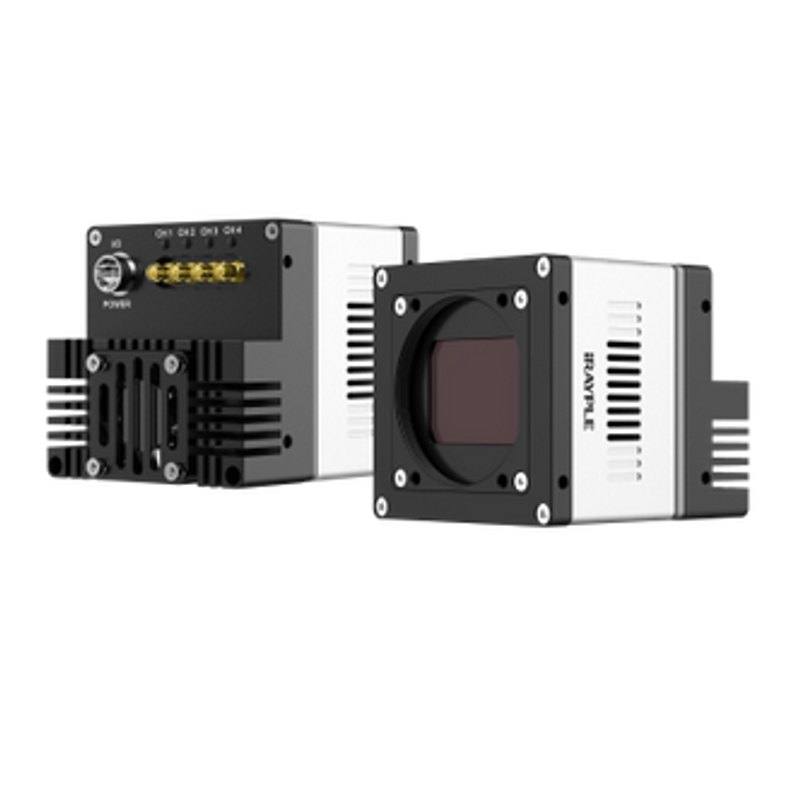
The iRAYPLE A9A87MX703E is part of the AX Large Area Scan series from Zhejiang HuaRay Technology (iRAYPLE), featuring the Gpixel GMAX2518 CMOS sensor with 2.5 µm pixels in an 11.27 mm × 10.24 mm format. It delivers 4496×4096 resolution (18 MP) at up to 64 fps via a dual-channel CoaXPress CXP-6 interface with theoretical bandwidth of 2×6.25 Gbps and PoCXP support. The camera supports global shutter, hardware/software/free-run triggering, ROI, block FFC, and outputs Mono8/10/12 formats. Its compact 50×50×44.8 mm body weighs 240 g, accepts a C-mount lens, and is compliant with CoaXPress and GenICam standards.
Brand
iRAYPLE
Camera type
Area Scan
Interface
CoaXPress CXP-6 (2×6.25 Gbps)
Resolution
18 MP
Horizontal resolution
4496 px (iRAYPLE-specific active area; sensor die is 4508 H)
The iRAYPLE A9A87MX703E is built around Gpixel's GMAX2518 CMOS sensor, a large-format global-shutter imager that exposes all 18 megapixels (4496 × 4096) simultaneously. The 2.5 µm pixel pitch across an 11.27 mm × 10.24 mm active area means each pixel subtends a very small ground-sample distance at typical working distances, giving the camera the spatial density required to resolve fine surface features — sub-millimetre scratches, micro-cracks, or printed character details — across a comparatively wide field of view. The global shutter is the critical choice here: every row exposes at the same instant, so parts moving on a conveyor or indexing under the camera produce no rolling-shutter skew, which would otherwise corrupt dimensional measurements and edge-based defect calls. At 64 fps full-frame, the camera sustains throughput of roughly 1.18 gigapixels per second, enabling high-line-rate inspection without sacrificing pixel count or resorting to ROI cropping in most applications.
Data transfer is handled by a dual-channel CoaXPress CXP-6 link with a theoretical peak bandwidth of 2 × 6.25 Gbps (12.5 Gbps total). This is sufficient for the 18 MP stream at 64 fps in Mono8 or Mono10 pixel formats; at Mono12 the raw pixel data rate approaches the link ceiling, so frame rate or ROI reduction may be needed depending on grabber and cable overhead. Two coax cables carry both image data and the reverse control channel, while PoCXP eliminates the need for a separate power supply if the frame grabber supports it; a 24 V DC auxiliary input via 6-pin Hirose is also available for setups that cannot supply PoCXP. The host side must be a CXP frame grabber; there is no GigE or USB3 fallback, which means cable runs can extend to tens of metres with standard 75 Ω coax — a practical advantage in large machine enclosures or when the PC is mounted away from the inspection zone. GenICam compliance ensures the camera integrates with any standard SDK, including common vision software platforms, so custom feature access (ROI definition, block flat-field correction, and Mono8/10/12 pixel-format selection) does not require vendor-specific drivers.
Physically, the 50 × 50 × 44.8 mm body and 240 g mass sit in the compact-box form factor that integrates readily into tight fixture designs. The C-mount accepts a broad range of standard machine-vision lenses; installers should note that the 11.27 × 10.24 mm sensor diagonal of approximately 15.2 mm falls within the coverage envelope of lenses rated for 1-inch (16 mm diagonal) or larger image circles — lenses designed only for 2/3-inch sensors will vignette. The operating temperature range of −30 °C to +40 °C accommodates outdoor or cold-chain enclosures. Hardware, software, and free-run trigger modes are all supported, so the camera can be slaved to a PLC encoder signal for precise part-synchronised capture, driven by a vision controller software trigger, or run continuously for applications such as stop-and-inspect stations.
Best for
High-resolution surface defect inspection of flat or near-flat materials — including display glass, PCB bare boards, and metal sheet — where 18 MP at 64 fps provides both the spatial resolution to catch micro-defects and the frame rate to keep pace with conveyor throughput.
Semiconductor wafer and panel macro-inspection tasks that require a large field of view in a single shot, eliminating the stitching artefacts introduced when lower-resolution cameras must tile multiple acquisitions across a 200 mm or larger substrate.
Dimensional gauging on moving parts where global shutter is non-negotiable; the simultaneous-exposure architecture prevents geometric distortion of edges caused by part motion, so caliper-style pixel-count measurements remain accurate.
Automotive component surface inspection — stampings, castings, or injection-moulded plastic trim — where the combination of high pixel count and fast frame rate allows a single camera to cover wide panels without sacrificing the sub-pixel accuracy needed for scratch and dent detection.
Industrial OCR and OCV on high-density labels, data-matrix arrays, or pharmaceutical blister packs, where 18 MP resolves individual character strokes or cell boundaries across a full-tray field of view in one frame.
Selection notes
Lens image-circle requirement: the GMAX2518 sensor measures approximately 15.2 mm diagonally, so only lenses rated for a 1-inch or larger image circle will illuminate the full 4496 × 4096 active area without corner shading. Verify the lens datasheet image-circle specification before procurement.
Frame grabber compatibility is mandatory: the CXP-6 interface requires a compatible two-channel CoaXPress frame grabber in the host PC. There is no GigE, USB3, or Camera Link fallback. Confirm grabber slot availability (PCIe ×4 or ×8 typically) and driver compatibility with your vision software stack before ordering.
Lighting and trigger synchronisation: at 64 fps the frame period is approximately 15.6 ms, so strobe lighting triggered from the camera's hardware trigger output (or the PLC signal driving the camera) is strongly recommended to freeze motion and maintain consistent illumination intensity. Continuous LED illumination at full drive current across a full production shift will shorten emitter life; strobe mode at higher peak current delivers equivalent photon flux with far lower average power dissipation.
Pixel format and bandwidth trade-off: Mono12 output provides 12-bit dynamic range useful for gradient-based surface inspection, but the raw data rate at full frame and 64 fps approaches the 12.5 Gbps link ceiling — verify that your grabber and cable plant can sustain the required throughput, or use ROI to reduce data volume. Mono8 halves the data volume and is sufficient for high-contrast defect calls or barcode reading where grey-level precision is less critical. Choose the pixel format deliberately at system design time.
Thermal management in enclosures: the camera dissipates approximately 8 W in a 50 × 50 mm footprint. In sealed enclosures or stacked multi-camera arrays, verify that ambient temperature at the camera body stays within the −30 °C to +40 °C operating range; forced-air or heat-sink provisions may be required at duty cycles near maximum fps.
Specifications: General
Brand
iRAYPLE
Camera type
Area Scan
Specifications: Sensor
Resolution
18 MP
Horizontal resolution
4496 px (iRAYPLE-specific active area; sensor die is 4508 H)
Mono / color
Monochrome
Sensor manufacturer
Gpixel
Sensor model
GMAX2518
Shutter
Global Shutter
Sensor size
11.27 mm × 10.24 mm
Pixel size
2.5 µm × 2.5 µm
Specifications: Performance
FPS
64 fps
Specifications: Interface
Interface
CoaXPress CXP-6 (2×6.25 Gbps)
Protocols
CoaXPress, GenICam
Specifications: Optics
Mount
C-mount
Specifications: Electrical
Power
DC 24V / PoCXP (6-pin Hirose), ~8 W
Power consumption
8 W
Specifications: Environment
Operating temperature
-30 to +40 °C
Specifications: Mechanical
Dimensions
50 × 50 × 44.8 mm
Weight
240 g
Applications this camera is commonly selected for. Open one to see the full recommended hardware and approach.
Matched automatically by: lens mount fits the camera mount · lens image circle covers the camera sensor — this camera: C-mount · 11.27 mm × 10.24 mm sensor.
By category
All 90C-mount lenses 66Telecentric lenses 24
By brand
All 90Basler 34iRAYPLE 26Omron / Sentech 24Datalogic / Datasensing 6
Follow these steps to bring up your iRAYPLE camera, capture a first image, and move from the viewer to your own application. The flow is the same across the A, AE, AX and L series; only the physical interface differs.
Download and install the iRAYPLE machine-vision SDK together with its viewer client for your operating system. The installer provides the camera drivers, the GenTL producer, and the viewer you will use for first light. For GigE Vision models, also install or enable the bundled filter/performance driver on the network adapter to maximize throughput.
2. Connect the camera to the correct interface
Wire the camera to its matching host interface: a dedicated Gigabit (or 10 GigE) NIC for GigE Vision models, a USB3 Vision port with a quality cable for USB3 models, or a frame grabber for CoaXPress models. Power the camera (PoE, USB bus power, or PoCXP / external supply as applicable). For GigE Vision, put the NIC and camera on the same subnet and, where supported, enable jumbo frames.
3. Detect and open the camera in the viewer
Launch the iRAYPLE viewer, run device enumeration, and select your camera from the discovered list. Open it to load the device feature tree (GenICam node map). If a GigE camera is found but cannot be opened, correct the IP configuration so the camera and NIC are in the same address range.
4. Set exposure, gain and trigger, then grab a first image
Start with continuous (free-run) acquisition under stable lighting. Adjust exposure time and gain for a well-exposed, low-noise image, set the pixel format (e.g. Mono8 or a Bayer/RGB format), and tune white balance on color models. Once the live image looks correct, switch trigger mode to hardware or software trigger to synchronize capture with your process, and verify a single triggered frame.
5. Move from the viewer to the SDK or a GenICam library
With imaging confirmed, reproduce the same settings in code using the SDK's C/C++ or Python API: enumerate, open, configure the relevant GenICam features, register a frame callback or grab loop, and convert frames to your pipeline's buffer format. Since the cameras are GenICam/GenTL-compliant, you can alternatively drive them from a third-party GenICam vision library. From here a stable image stream can feed a deep-learning inspection step such as Rosepetal for automated quality control.
Frequently asked questions
Yes — 64 fps is the rated full-frame rate at 4496 × 4096 (18 MP). No resolution sacrifice or ROI restriction is required to reach that figure, though defining an ROI can increase frame rate further if a smaller field of view is acceptable for a specific application.
Both options are supported. The camera accepts PoCXP (Power over CoaXPress) from a compatible frame grabber, which eliminates a separate power run. Alternatively, a 24 V DC supply can be connected via the 6-pin Hirose connector. The camera draws approximately 8 W regardless of which power path is used.
Global shutter is standard on the A9A87MX703E — it is a fixed characteristic of the Gpixel GMAX2518 sensor used in this camera. There is no rolling-shutter variant of this model.
The camera outputs Mono8, Mono10, and Mono12. For dimensional gauging and surface-gradient inspection where sub-grey-level precision matters, Mono12 maximises dynamic range — but verify your grabber can sustain the data rate at full frame and 64 fps. For barcode, OCR, or binary-contrast defect detection where grey depth is less critical, Mono8 halves the data rate and eases grabber and storage requirements.
The camera uses a C-mount. However, the sensor diagonal is approximately 15.2 mm, which exceeds the image circle of lenses designed for 2/3-inch (11 mm diagonal) sensors. You must use a lens specified for a 1-inch or larger image circle — such as a 1-inch or 4/3-inch rated C-mount lens — to avoid vignetting at the corners of the 4496 × 4096 frame.