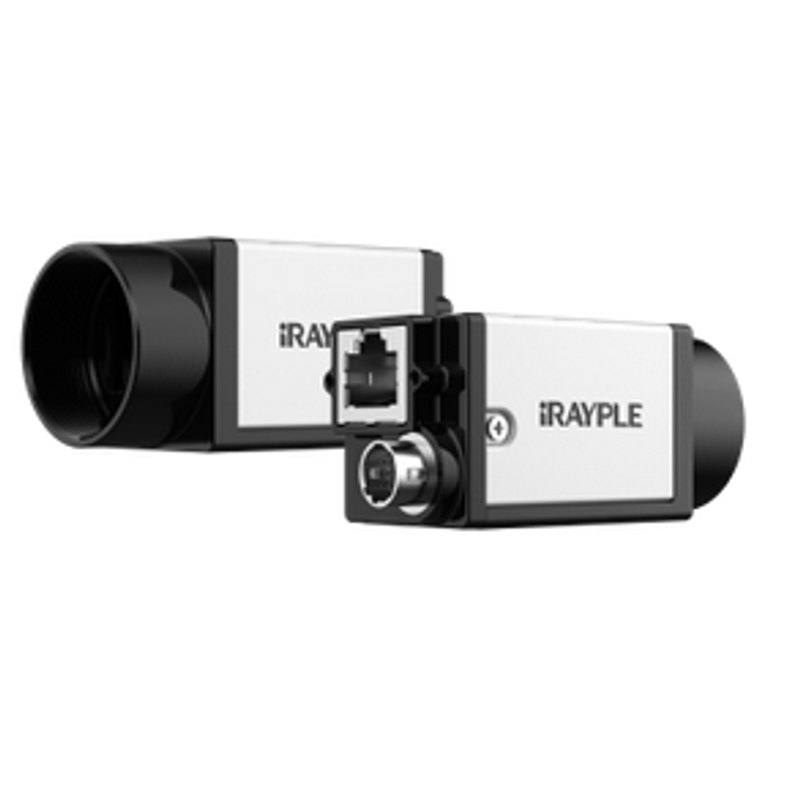
The iRAYPLE AE3504MG010E (mono) and AE3504CG010E (color) are 5.0 MP GigE area scan cameras built around the OnSemi AR0521 1/2.5" CMOS sensor, delivering 2592 × 1944 resolution at 23 fps with a rolling shutter and 2.2 µm pixel pitch. Both models feature a Gigabit Ethernet interface with PoE (IEEE 802.3af), 256 MB on-board image buffer, opto-isolated GPIO (1× input, 1× output, 1× configurable), and a 12-bit ADC pipeline supporting Mono8/10/10Packed/12/12Packed pixel formats. They conform to GigE Vision V2.0 and GenICam standards, offer hardware/software trigger and free-run modes, and are housed in a compact 29 × 29 × 42 mm aluminum body weighing 88 g.
The iRAYPLE AE3504MG010E is a 5.0 MP GigE area scan camera built on the OnSemi AR0521 CMOS sensor in a 1/2.5" optical format, delivering 2592 × 1944 pixels at 23 fps over a Gigabit Ethernet link. With a 2.2 µm pixel pitch, the AR0521 provides good spatial sampling density for a 1/2.5" chip, meaning a correctly chosen C-mount lens can resolve fine surface texture, small print characters, or narrow dimensional features without significant aliasing. The 12-bit ADC pipeline — exposed through Mono8, Mono10, Mono10Packed, Mono12, and Mono12Packed pixel formats — gives the mono variant genuine 4096-level dynamic range on the wire when 12-bit output is selected, which is valuable for scenes with mixed bright reflections and dark recesses, such as machined metal surfaces or PCB inspection under ring lighting. The color variant (AE3504CG010E) shares the identical mechanical and electrical design and can be substituted wherever hue discrimination is needed — for instance separating label colors on pharmaceutical packaging.
The camera's GigE Vision V2.0 and GenICam-compliant interface means it slots into any compliant SDK (Halcon, VisionPro, OpenCV via GenTL, iRAYPLE's own SDK) without proprietary driver lock-in, and the built-in 256 MB on-board image buffer absorbs transient Ethernet latency spikes in busy switched networks, reducing dropped-frame risk in multi-camera line installations. PoE (IEEE 802.3af) is a significant installation convenience: a single Cat 5e/6 cable carries both image data and up to 15.4 W available power, though this camera consumes only 3 W, leaving ample headroom. For installations where a managed PoE switch is impractical, the alternative DC 9–24 V supply via Hirose connector provides flexibility in panel-mount or robot-arm configurations. Opto-isolated GPIO (one dedicated input, one dedicated output, one configurable line) supports hardware trigger from a PLC, encoder, or photoelectric sensor, as well as a strobe output to synchronize a pulsed light source — both standard needs in production-line timing.
The rolling-shutter architecture is an important selection consideration: because rows are exposed sequentially, any object moving faster than the row-readout time will exhibit skew distortion. At 23 fps the sensor is well-suited to stationary or slow-moving targets — component trays on a pick-and-place nest, label inspection on a stoppable conveyor, or dimensional gauging of fixtured parts — but not to high-speed continuous web or fast rotary applications where a global shutter would be required. The compact 29 × 29 × 42 mm aluminum body at 88 g makes mounting straightforward in tight gantry brackets or robot end-effectors, and the C-mount accepts a wide ecosystem of standard industrial and machine-vision lenses sized for 1/2.5" to 2/3" image circles. Operating temperature is rated 0 °C to +50 °C, which covers most factory-floor and climate-controlled lab environments but excludes outdoor or cold-chain applications without additional enclosure provisions.
Best for
PCB and SMT inspection — the 5 MP resolution at 2592 × 1944 provides sufficient pixel density to resolve component placement offsets, solder-paste coverage, and fine pitch markings on densely populated boards when paired with a macro or telecentric C-mount lens and a coaxial or ring light matched to board reflectance.
Pharmaceutical and packaging label inspection — the color variant (AE3504CG010E) can verify printed text, bar codes, and label color consistency on blister packs or cartons at 23 fps, while the 12-bit ADC captures subtle ink-density gradients that 8-bit cameras clip.
Dimensional measurement of fixtured parts — stationary or slow-moving parts fixtured in a jig allow the rolling shutter to operate without motion-skew artifacts, and the 2.2 µm pixel pitch delivers sub-pixel interpolation accuracy when calibrated against a traceable reference target.
Robot guidance and bin picking in structured environments — at 88 g the camera adds minimal mass to a robot arm; the hardware trigger input allows the robot controller to fire an acquisition at a known pose, and the 256 MB buffer holds multiple frames while the robot's Ethernet link services other traffic.
Traceability code reading (1D/2D, DPM) — for codes printed or laser-etched on electronics, automotive parts, or battery cells, the mono variant's 12-bit dynamic range resolves low-contrast DPM marks and the GenICam interface makes exposure tuning scriptable from any compliant reader framework.
Selection notes
Rolling shutter imposes a motion budget: verify that the target's displacement during one full-frame readout is below the acceptable positional error for your tolerance. For high-speed conveyor lines where parts cannot be stopped or back-lit strobed to a very short exposure, evaluate a global-shutter camera instead.
The 1/2.5" sensor format constrains lens selection — choose a C-mount lens with an image circle rated for 1/2.5" or larger. Using a lens designed for a smaller format will cause vignetting at the image corners, degrading edge measurement accuracy. Many low-cost C-mount lenses are rated for 1/3"; confirm the datasheet image circle before ordering.
PoE simplifies cabling but requires a GigE switch or injector that supports IEEE 802.3af. If your control cabinet already has a DC 24 V rail, the Hirose connector power path eliminates the need for a PoE switch entirely; both paths are supported by the hardware.
For multi-camera installations on a common Gigabit Ethernet switch, note that each camera at full resolution and 23 fps generates approximately 116 MB/s of raw pixel data at Mono8 format, rising to approximately 232 MB/s at Mono12 format (12-bit data stored in 16-bit words). A managed switch with per-port QoS and jumbo frame support is recommended to avoid packet collisions when four or more cameras share an uplink.
The 12-bit ADC is only useful downstream if the host acquisition software is configured to request a 12-bit pixel format (Mono12 or Mono12Packed). Many vision frameworks default to Mono8 for compatibility; explicitly set the pixel format in the GenICam feature tree to unlock the full dynamic range for high-contrast or HDR scenes.
Specifications: General
Brand
iRAYPLE
Camera type
Area Scan
Specifications: Sensor
Resolution
5.0 MP
Horizontal resolution
2592 × 1944 px
Mono / color
Mono (MG) / Color (CG)
Sensor manufacturer
onsemi (ON Semiconductor)
Sensor model
AR0521
Shutter
Rolling
Sensor size
1/2.5 inch
Pixel size
2.2 µm × 2.2 µm
Specifications: Performance
FPS
23 fps
Specifications: Interface
Interface
GigE (1 Gbps, PoE)
Protocols
GigE Vision V2.0, GenICam
Specifications: Optics
Mount
C-mount
Specifications: Electrical
Power
PoE / DC 9–24 V via Hirose
Power consumption
3 W
Supply voltage
PoE or DC 9–24 V via Hirose connector
Specifications: Environment
Operating temperature
0°C – +50°C
Specifications: Mechanical
Dimensions
29 × 29 × 42 mm (excl. lens mount & rear connector)
Weight
88 g
Applications this camera is commonly selected for. Open one to see the full recommended hardware and approach.
Follow these steps to bring up your iRAYPLE camera, capture a first image, and move from the viewer to your own application. The flow is the same across the A, AE, AX and L series; only the physical interface differs.
Download and install the iRAYPLE machine-vision SDK together with its viewer client for your operating system. The installer provides the camera drivers, the GenTL producer, and the viewer you will use for first light. For GigE Vision models, also install or enable the bundled filter/performance driver on the network adapter to maximize throughput.
2. Connect the camera to the correct interface
Wire the camera to its matching host interface: a dedicated Gigabit (or 10 GigE) NIC for GigE Vision models, a USB3 Vision port with a quality cable for USB3 models, or a frame grabber for CoaXPress models. Power the camera (PoE, USB bus power, or PoCXP / external supply as applicable). For GigE Vision, put the NIC and camera on the same subnet and, where supported, enable jumbo frames.
3. Detect and open the camera in the viewer
Launch the iRAYPLE viewer, run device enumeration, and select your camera from the discovered list. Open it to load the device feature tree (GenICam node map). If a GigE camera is found but cannot be opened, correct the IP configuration so the camera and NIC are in the same address range.
4. Set exposure, gain and trigger, then grab a first image
Start with continuous (free-run) acquisition under stable lighting. Adjust exposure time and gain for a well-exposed, low-noise image, set the pixel format (e.g. Mono8 or a Bayer/RGB format), and tune white balance on color models. Once the live image looks correct, switch trigger mode to hardware or software trigger to synchronize capture with your process, and verify a single triggered frame.
5. Move from the viewer to the SDK or a GenICam library
With imaging confirmed, reproduce the same settings in code using the SDK's C/C++ or Python API: enumerate, open, configure the relevant GenICam features, register a frame callback or grab loop, and convert frames to your pipeline's buffer format. Since the cameras are GenICam/GenTL-compliant, you can alternatively drive them from a third-party GenICam vision library. From here a stable image stream can feed a deep-learning inspection step such as Rosepetal for automated quality control.
Frequently asked questions
Yes. The camera provides opto-isolated GPIO with one dedicated input, one dedicated output, and one configurable line. The input accepts a hardware trigger signal from a PLC, encoder pulse, or photoelectric sensor, and the output line can drive a strobe signal to synchronize a pulsed LED light source with the exposure window.
The camera's ADC pipeline is 12 bits, and it supports Mono12 and Mono12Packed pixel formats in addition to Mono8, Mono10, and Mono10Packed. To use 12-bit depth, the host software must request the Mono12 or Mono12Packed format via the GenICam feature tree; Mono8 is the common default but discards the lower four bits of ADC output.
Yes. The camera supports PoE to the IEEE 802.3af standard, so a compatible PoE switch or midspan injector provides both data and power over a single Cat 5e or Cat 6 cable. The camera consumes only 3 W, well within the 15.4 W 802.3af budget. Alternatively, DC 9–24 V can be supplied through the Hirose connector if PoE infrastructure is not available.
Yes. The camera conforms to GigE Vision V2.0 and GenICam standards, which are supported by all major machine vision SDKs including Halcon, Cognex VisionPro, National Instruments Vision, and OpenCV via a GenTL-compliant transport layer. No proprietary driver is required beyond a standard GigE Vision transport provider.
The camera uses a standard C-mount. The sensor is 1/2.5" in optical format. The chosen lens must have an image circle rated for at least 1/2.5" to avoid corner vignetting. Many machine-vision C-mount lenses are rated for 2/3" or 1" image circles, which fully cover the sensor; lenses rated for 1/3" or smaller will vignette.