Skip to content
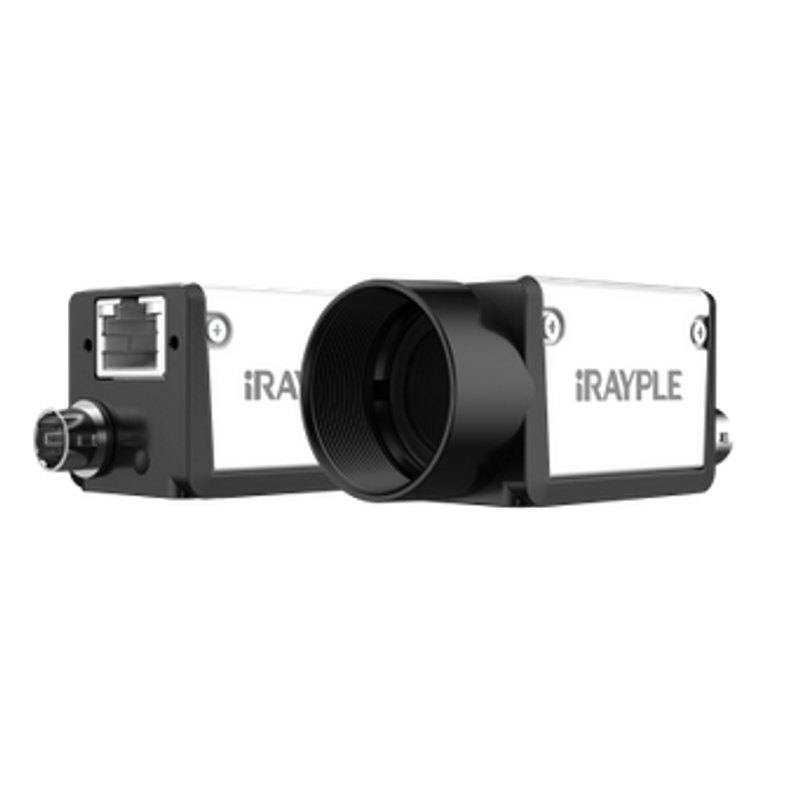
iRAYPLE AH3800CG010E (3840x2160, IMX678, GigE) machine vision camera
  • Rosepetal compatible
  • Recommended by AIS Vision

iRAYPLE AH3800CG010E

AH3800CG010E

The AH3800CG010E is part of iRAYPLE's AH Pro series of GigE industrial area scan cameras featuring the Sony IMX678 STARVIS 2 back-illuminated CMOS sensor with 1/1.8" optical format and 2.0 µm square pixels, outputting 3840×2160 at up to 14.5 fps. The camera conforms to GigE Vision V2.0 and GenICam standards, supporting 1 Gbps Ethernet transmission up to 100 m, with PoE or DC 9–24 V wide-voltage power via a 6-pin Hirose connector. A powerful onboard ISP provides sharpness, denoising, gamma, LUT, black-level correction, white balance, and colour matrix processing, and 256 MB on-board cache ensures reliable data delivery. The camera supports software trigger, hardware trigger, and free-run acquisition modes and carries CE, FCC, and RoHS certifications.

Brand
iRAYPLE
Camera type
Area Scan
Interface
GigE (1 Gbps, up to 100 m)
Resolution
8.39 MP
Horizontal resolution
3840 px (H)
Mono / color
Colour
Sensor manufacturer
Sony STARVIS 2 (IMX678)
Sensor model
Sony IMX678
Shutter
Rolling Shutter
FPS
14.5 fps
Mount
C-mount
Sensor size
1/1.8" (8.86 mm diagonal)

Technical overview

The AH3800CG010E is built around Sony's IMX678 STARVIS 2 back-illuminated CMOS sensor — a 1/1.8" optical format device with 2.0 µm square pixels arranged in a 3840 × 2160 (8.39 MP) array. Back-illumination is the key advantage here: it improves photon collection at each pixel compared with front-illuminated designs, making the camera noticeably more sensitive under the constrained, non-ideal lighting conditions common in production environments. The 1/1.8" format gives you an 8.86 mm diagonal image circle on a C-mount body that broadens the compatible lens ecosystem and allows well-specified optics to cover the full sensor without vignetting. The rolling shutter architecture means the rows are exposed sequentially rather than simultaneously; at 14.5 fps on a GigE interface the camera is well-suited to stationary or slow-moving parts, conveyor-fed inspection at controlled belt speeds, or any station where a mechanical or optical trigger can freeze motion. Applications involving fast lateral movement without triggering, or those sensitive to skew artefacts on rapidly rotating parts, should weigh this characteristic carefully.

Connectivity is GigE Vision V2.0 and GenICam compliant over standard 1 Gbps Ethernet, with cable runs up to 100 m — an important infrastructure advantage in large factory cells or multi-camera gantries where USB3 would demand active repeaters or managed cabling. Power is supplied either via Power over Ethernet or a discrete DC 9–24 V wide-voltage supply through a 6-pin Hirose connector, giving integrators genuine flexibility: a PoE switch eliminates a separate power run to each camera, while the Hirose DC option suits cells that already have a 24 V rail available and no managed switch. On-board 256 MB cache buffers image data against transient network congestion, reducing dropped frames on busy segments. The onboard ISP delivers sharpness enhancement, denoising, gamma, LUT, black-level correction, white balance, and colour matrix processing — useful when the downstream processing pipeline is lightweight or running on an embedded host and cannot afford to perform these corrections in software at 8 MP and above.

For trigger and acquisition control the camera supports free-run, software trigger, and hardware trigger modes. Hardware trigger is the practical choice for most synchronised inspection stations: a PLC output or proximity sensor fires the exposure at the precise moment the part is in the field of view, sidestepping the rolling-shutter motion sensitivity. The CE, FCC, and RoHS certifications satisfy the compliance requirements for deployments in European and North American automated lines, and the −30 °C to +50 °C operating range covers most indoor industrial environments including unheated warehouses and cold-chain packaging lines. The colour output makes it directly applicable to appearance, cosmetic grading, label-colour verification, and code-contrast tasks where a monochrome camera would require additional processing or a filter wheel.

Best for

  • High-resolution surface and cosmetic inspection of flat or planar parts — PCBs, display panels, battery pouch cells, or automotive stampings — where 8.39 MP resolves fine defects (scratches, pits, colour blemishes) in a single frame without stitching.
  • Pharmaceutical and food-packaging label verification: reading printed lot codes, expiry dates, and regulatory text (OCR/OCV) alongside colour-correct barcode and 2D-code reading on a single camera station thanks to the IMX678's colour fidelity and onboard white balance.
  • Logistics and e-commerce sortation where a GigE infrastructure is already in place and camera cable runs exceed the practical limit of USB3 — the 100 m Ethernet reach lets a single network drop serve multiple camera positions on a long conveyor.
  • Robot guidance in semiconductor or electronics assembly where a colour image aids object classification and the PoE option simplifies wiring on a robot arm or gantry without an additional power cable.
  • Packaging line print-quality and fill-level inspection operating at controlled conveyor speeds, where the rolling shutter's sensitivity advantage under moderate strobe illumination outweighs its motion constraints and the wide operating temperature tolerates unheated packing halls.

Selection notes

  • Rolling shutter suitability: confirm that part velocity at the working distance keeps pixel displacement during the full-frame readout below one pixel, or that a hardware trigger and a suitably short strobe pulse will effectively freeze the scene. Fast lateral motion without a strobe will produce skew artefacts across the 3840-pixel-wide frame.
  • Lens selection for the 1/1.8" format: verify that the chosen C-mount lens specifies image circle coverage of at least 8.86 mm diagonal. Under-specified lenses will vignette at the corners of the 3840 × 2160 array. At 2.0 µm pixel pitch the resolving demand on the lens is high — specify an optic rated for the spatial frequencies appropriate to a 2 µm pixel.
  • GigE bandwidth ceiling: at 3840 × 2160 × 14.5 fps × 8 bits (Bayer raw), throughput approaches the 1 Gbps link limit. Running multiple cameras on a shared unmanaged switch without IGMP snooping will cause contention. Use a managed switch with jumbo-frame and flow-control support.
  • PoE budget: standard PoE (802.3af) supplies up to 15.4 W at the switch port. Confirm that the camera's actual consumption fits within the switch port's PoE budget, particularly if other powered devices share the same switch.
  • Onboard ISP vs. raw output: the ISP pipeline (denoising, sharpness, colour matrix) is advantageous for human-readable output but may alter the radiometric fidelity needed for quantitative pixel-level measurement. For metrology or AI-training dataset capture, evaluate whether ISP processing should be disabled or its parameters carefully calibrated.

Specifications: General
BrandiRAYPLE
Camera typeArea Scan

Specifications: Sensor
Resolution8.39 MP
Horizontal resolution3840 px (H)
Mono / colorColour
Sensor manufacturerSony STARVIS 2 (IMX678)
Sensor modelSony IMX678
ShutterRolling Shutter
Sensor size1/1.8" (8.86 mm diagonal)
Pixel size2.0 µm × 2.0 µm

Specifications: Performance
FPS14.5 fps

Specifications: Interface
InterfaceGigE (1 Gbps, up to 100 m)
ProtocolsGigE Vision V2.0, GenICam

Specifications: Optics
MountC-mount

Specifications: Electrical
PowerPoE / DC 9–24 V (Hirose)

Specifications: Environment
Operating temperature-30 °C to +50 °C

Frequently asked questions

Related technical guides

Rosepetal · AI

Test this camera with Rosepetal

Validate your visual inspection with AI: send us sample images and we evaluate the case on your hardware.

AIS Vision · Integration

We validate camera + lens + lighting

AIS Vision defines and tests the optimal combination of camera, optics and lighting for your application before you buy.