The STC-BBS43POE-BC (monochrome) and STC-BCS43POE-BC (color) are board-level GigE Vision cameras in Omron Sentech's B-Series, using a 1/2.9" Sony IMX287 global-shutter CMOS sensor at 720 x 540 pixels (0.4MP) with 6.9 µm square pixels. Both models support Power over Ethernet (IEEE 802.3af Class 2) and comply with GigE Vision 2.1 and GenICam SFNC 2.4, including IEEE 1588 PTP for synchronization. The compact 38 x 38 mm board form factor with C-mount lens attachment is designed for OEM machine vision integration in space-constrained equipment. Maximum full-resolution frame rate is 282.8 fps at 8-bit, with 8/10/12-bit output supported; the color model adds Bayer and RGB8 pixel formats and an IR-cut filter.
The STC-BBS43POE-BC (monochrome) and STC-BCS43POE-BC (color) are built around Sony's IMX287 Pregius global-shutter CMOS sensor in a 1/2.9" format, delivering 720 x 540 pixels at 6.9 µm square pixel pitch. The global shutter architecture means every pixel integrates and reads out simultaneously — there is no image skew or rolling-shutter distortion when capturing fast-moving parts or under strobe illumination. At full 720 x 540 resolution the camera sustains 282.8 fps in 8-bit mode, which is an unusually high frame rate for a 0.4 MP imager and makes these models practical for high-throughput inline inspection, burst capture of transient events, or latency-sensitive robot guidance loops. The relatively large 6.9 µm pixel also provides good light-gathering ability for a sensor of this format, easing lighting budget constraints in dimly controlled environments.
The interface is GigE Vision 2.1 over 1000BASE-T Ethernet with Power over Ethernet (IEEE 802.3af Class 2, 5.1 W draw), so a single Cat-5e or Cat-6 cable delivers both image data and power to the camera — eliminating a separate power supply and simplifying cable management inside a machine. IEEE 1588 PTP synchronisation is supported natively, enabling precise multi-camera timing without external trigger wiring when several cameras are clocked from the same PTP grandmaster. GenICam SFNC 2.4 compliance ensures the camera enumerates identically across all major GigE Vision-compatible machine vision SDKs and open-source GenTL consumers, reducing integration risk. The C-mount lens attachment accepts the broad catalogue of C-mount optics available from Omron Sentech and third-party suppliers, giving installers flexibility in focal length selection for the target field of view and working distance.
The board-level form factor — 38 × 38 mm footprint, 40.1 mm depth (BBS43) or 40.4 mm depth (BCS43), approximately 49 g — is intended for OEM embedding into equipment where volume and mass budgets are tight. The BBS43 monochrome variant outputs 8, 10, or 12-bit pixel data; the BCS43 color variant adds Bayer-pattern and RGB8 pixel formats and incorporates an IR-cut filter, making it suitable where color differentiation (label color, product tint, coating presence) is part of the inspection. Operating temperature is rated 0 to +67 °C at the sensor, which covers standard factory floor and lightly thermally stressed enclosures; integrators building into enclosures with elevated ambient temperatures should account for the board's own dissipation when sizing ventilation.
Best for
High-speed inline presence/absence and defect detection on fast-moving conveyors — the 282.8 fps full-resolution rate and global shutter allow clean, unblurred captures of parts traveling at high line speeds without reducing resolution via ROI.
OEM machine integration where PCB space and cable count must be minimised — the 38 × 38 mm board footprint and single-cable PoE connection reduce mechanical and electrical overhead compared with boxed cameras requiring separate power.
Multi-camera synchronised inspection cells — IEEE 1588 PTP support allows several cameras to share a common time reference over the existing GigE network, enabling consistent multi-angle or stereo triggering without a dedicated hardware trigger bus.
Robot guidance and pick-and-place applications requiring distortion-free image capture — the Sony IMX287 global shutter eliminates rolling-shutter artefacts that would misregister feature positions when the robot arm or part is in motion.
Color-based quality sorting or label verification (BCS43 color variant) — the Bayer/RGB8 output with integrated IR-cut filter supports color classification tasks such as cap color verification, label artwork inspection, or surface coating uniformity assessment.
Selection notes
Lens selection and field of view: the 1/2.9" sensor (approximately 4.97 × 3.73 mm active area at 6.9 µm × 720 × 540) is a relatively small format — verify that candidate C-mount lenses specify an image circle covering at least 1/2.9". Using a lens designed for a larger format is acceptable; using one specified only for 1/3" or smaller may clip corners.
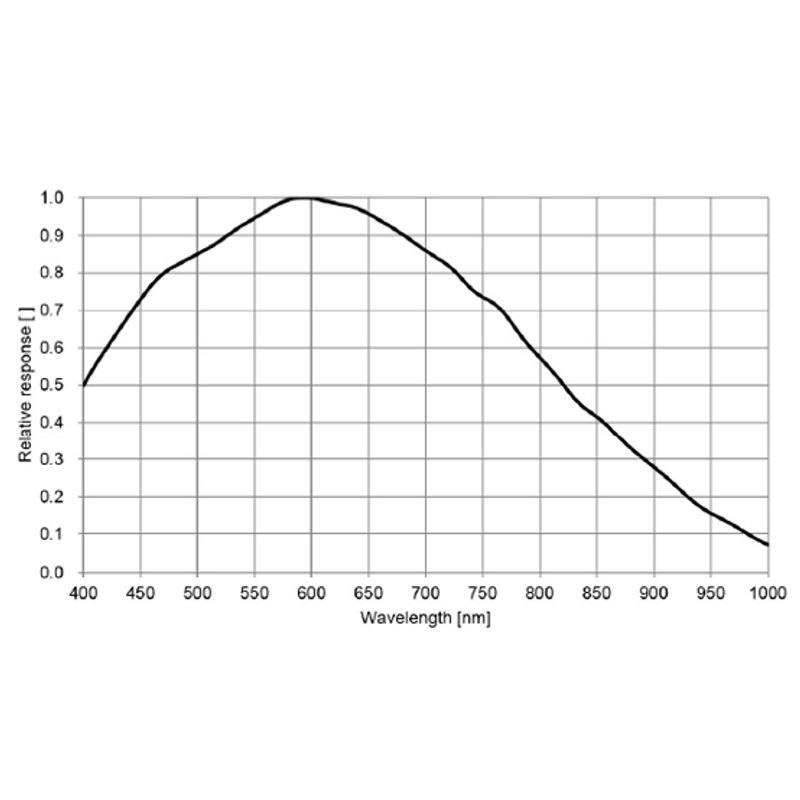
Monochrome vs. color variant: choose the BBS43 monochrome model for maximum sensitivity, higher bit-depth dynamic range benefit, and tasks where color carries no inspection information (dimensional measurement, barcode reading, scratch detection). Choose the BCS43 only when color differentiation is required — the IR-cut filter in the color variant attenuates near-infrared illumination, so IR-only lighting schemes will not work with the BCS43.
Thermal management for embedded installs: the camera is rated to +67 °C sensor temperature, not ambient. In enclosed OEM assemblies with limited airflow, board self-heating (5.1 W) adds to ambient temperature seen at the sensor. Ensure the thermal design of the enclosure keeps the sensor below the rated limit under worst-case ambient conditions.
Network infrastructure and latency: at 282.8 fps with 720 × 540 × 8-bit frames the raw pixel throughput is approximately 110 MB/s — well within GigE bandwidth, but the host NIC, switch port, and driver must be tuned (jumbo frames, receive buffer size, interrupt moderation) for sustained streaming. Dedicate a NIC port or VLAN to camera traffic if the network carries other data.
PTP synchronisation requires a compatible network topology: IEEE 1588 PTP accuracy degrades through unmanaged switches. For tight multi-camera synchronisation, use PTP-aware (boundary-clock or transparent-clock) managed switches between the PTP grandmaster and the cameras; consumer or unmanaged switches introduce variable latency that broadens synchronisation jitter.
These steps take an Omron Sentech (STC) camera from the box to a stable first image and on to your own application. They apply across the GigE Vision, USB3 Vision and CoaXPress STC families; the interface only changes how you cable and power the camera.
Download and install the Sentech SDK on the host PC. The package provides StViewer, the viewing and configuration software you use to bring the camera up, and StApi, the programming SDK you integrate later. Because the cameras are GenICam/GenTL-compliant, StApi also registers a GenTL producer, so any GenICam-compliant third-party vision software can discover and drive the camera as an alternative front end.
2. Cable, power and connect the camera
Connect according to the interface. GigE Vision: link to a Gigabit NIC (use PoE or the separate power input) and put the camera and host on the same subnet; for USB3 Vision use a USB 3.x port and a certified cable; for CoaXPress (STC) connect to a CoaXPress frame grabber, which also supplies Power-over-Coax. Then open StViewer and let it enumerate the camera. If a GigE camera does not appear, check the IP configuration and firewall, and on USB3 confirm the host bandwidth and driver.
3. Configure exposure, gain and white balance
Open the device in StViewer and start a live stream. Set exposure and gain for a well-exposed, low-noise image: raise exposure first and only add gain when more light or a faster shutter is not an option, keeping exposure short enough to freeze motion on global-shutter models. On colour cameras, run white balance under your actual production lighting. Adjust the lens aperture and focus on a representative target before tuning anything else.
4. Set the trigger and grab a first image
Start in free-run (continuous) acquisition to confirm a clean, stable image. For inline inspection switch to hardware or software triggering: select the trigger source, set the active edge and any delay, and wire the strobe or illumination to the camera's I/O so lighting fires with each exposure. Acquire and save a frame in StViewer; this saved image is your reference for the SDK stage and for downstream inspection.
5. Move to the StApi SDK (or any GenICam software)
Once the image is stable, reproduce the same settings in code. Use StApi to open the device, apply the GenICam features you validated in StViewer (exposure, gain, trigger, pixel format) and grab frames into your application via the bundled C++, C, C#/.NET or Python interfaces; the included samples are the fastest starting point. Prefer a different stack? The same GenICam/GenTL camera works with third-party vision libraries. With a reliable feed, you can route it into a deep-learning inspection such as Rosepetal for AI-based defect detection.
Frequently asked questions
The camera reaches 282.8 fps at full 720 × 540 resolution in 8-bit mode. No resolution reduction (ROI) is needed to achieve this rate — it is the rated full-frame throughput.
Yes. The camera supports Power over Ethernet per IEEE 802.3af Class 2 and draws 5.1 W. A PoE-capable switch port or mid-span injector on the same Cat-5e/6 cable that carries GigE image data provides all required power.
Yes. The Sony IMX287 uses a global shutter, meaning all pixels expose simultaneously. This eliminates the rolling-shutter skew that distorts moving subjects and allows clean strobe-frozen images of fast-moving parts — the shutter pulse duration, not the frame rate, governs motion freeze.
The camera uses a C-mount. Lenses must cover the 1/2.9" sensor format (approximately 4.97 × 3.73 mm active area). Lenses rated for larger formats (1/2", 2/3", 1") will also work; lenses specified only for 1/3" or smaller formats may vignette.
No. The BCS43 color variant includes an integrated IR-cut filter that attenuates near-infrared wavelengths to maintain color accuracy. If IR illumination (e.g., 850 nm or 940 nm) is required, the BBS43 monochrome variant — which has no IR-cut filter — should be selected instead.