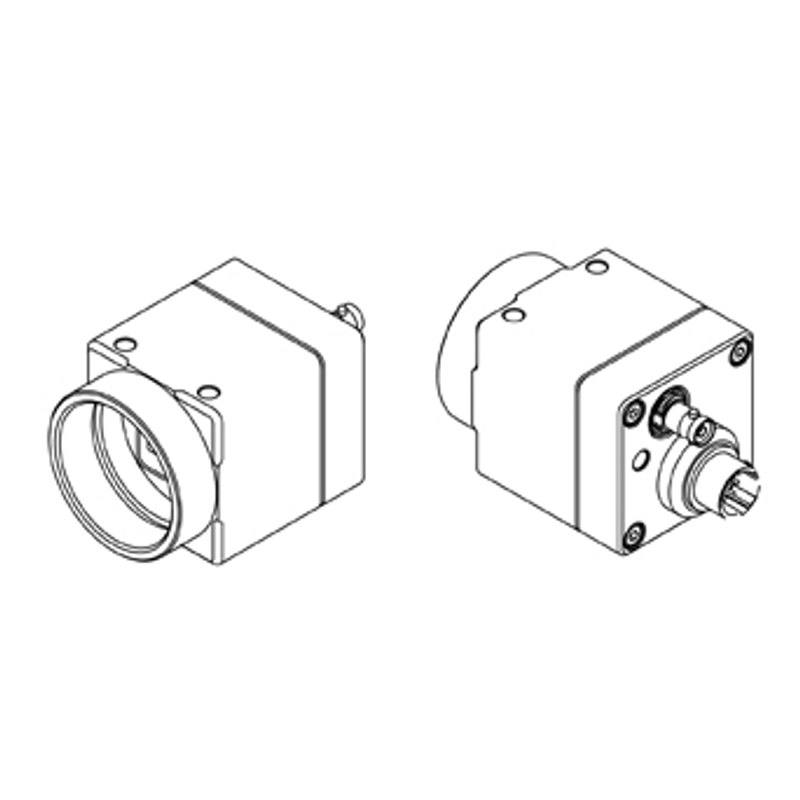
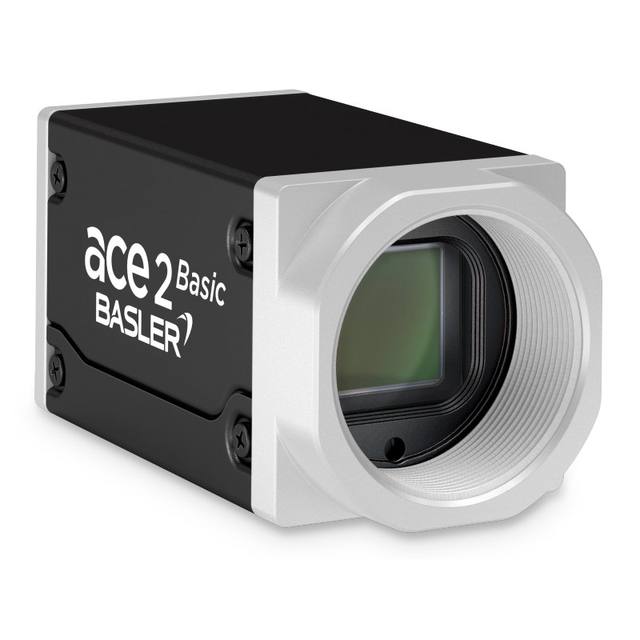
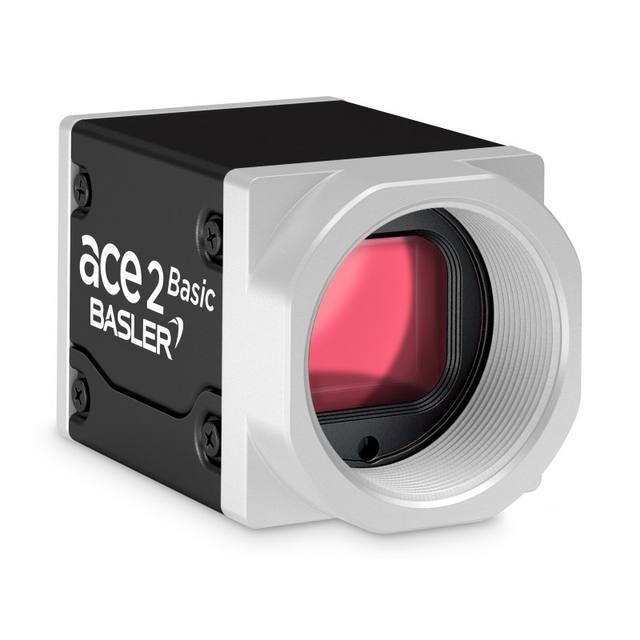
The STC-MBS1221CXP121 (monochrome) and STC-MCS1221CXP121 (color) are 12-megapixel industrial area scan cameras built around the Sony IMX545 1/1.1-inch global shutter CMOS sensor with 2.74 µm square pixels at 4096 × 3000 effective resolution. Both models use a single-lane CXP-12 CoaXPress 2.0 interface via Micro BNC connector, achieving a maximum frame rate of 68.3 fps. The cameras are powered by PoCXP or an external 18.5–26 Vdc supply, consume 3.6 W or less, and are housed in a compact 29 × 29 × 40 mm C-mount body weighing approximately 54 g. Pixel formats are Mono8/10/12 for the monochrome variant and BayerRG8/10/12 for the color variant.
Brand
Omron / Sentech
Camera type
Area Scan
Interface
CoaXPress CXP-12 (1 lane)
Resolution
12 MP
Horizontal resolution
4096 px
Mono / color
Mono (STC-MBS1221CXP121) / Color (STC-MCS1221CXP121)
The STC-MBS1221CXP121 (mono) and STC-MCS1221CXP121 (color) are built around Sony's IMX545, a Pregius S global shutter CMOS sensor delivering 4096 × 3000 effective pixels at a 2.74 µm pixel pitch on a 1/1.1-inch optical format. Global shutter capture eliminates the rolling-shutter skew and partial-exposure artifacts that arise when imaging moving parts or when the camera is itself in motion on a robot arm — every pixel integrates light simultaneously. At 68.3 fps full resolution over a single CXP-12 lane, the camera can sustain throughput that would require two lanes at lower CoaXPress generations, making it a practical choice for high-cadence inspection lines where parts move continuously rather than stop-and-go. The 2.74 µm pixel is small enough to achieve 12 MP within a compact 1/1.1-inch circle, which keeps C-mount lens costs manageable and lets integrators select from the broad catalog of APS-C format optics without sourcing larger-format glass.
The single-lane Micro BNC CoaXPress 2.0 interface simplifies cabling considerably: one coax carries full bidirectional control, trigger, and 12-bit image data simultaneously, with Power over CoaXPress (PoCXP) eliminating a separate power run to the camera head. An external 18.5–26 Vdc input is also available for installations where the frame grabber does not supply PoCXP. The camera body measures 29 × 29 × 40 mm and weighs 54 g — dimensions and mass close to those of a 5 MP GigE camera — so it can be integrated into tight multi-camera arrays or mounted on collaborative robots without significant counterbalance redesign. Power draw at or below 3.6 W is low enough that a standard PoCXP budget covers multiple heads on one grabber port chain. GenICam compliance means configuration, ROI control, and pixel-format selection (Mono8/10/12 for the monochrome variant; BayerRG8/10/12 for the color variant) are handled through the standard API without vendor-specific SDKs.
The C-mount with a 1/1.1-inch image circle pairs well with high-resolution fixed-focal C-mount lenses designed for the Sony IMX format family. Installers should verify lens image circle coverage at full 4096 × 3000 resolution — a lens rated for 1-inch sensors may show corner shading at the outermost pixels of the 1/1.1-inch chip. The 2.74 µm pixel demands lenses with resolving power sufficient to project a sharp point spread function onto that pitch; practically, a lens MTF that holds at ≥ 50 lp/mm across the image circle avoids being the bottleneck in the optical chain. For dimensional measurement applications the color variant's Bayer mosaic trades one-quarter of the effective luminance pixels for color information; when sub-pixel edge accuracy matters on monochromatic features, the monochrome model is the preferred selection. The operating temperature window of 0 to +40 °C covers climate-controlled factory environments; installations in non-conditioned spaces or near heat sources should plan for forced-air or conduction cooling to keep the enclosure within range.
Best for
High-resolution surface and defect inspection on fast-moving lines — 12 MP at 68.3 fps provides both the spatial detail to resolve fine defects and the throughput to keep pace with high-cadence conveyors without hardware triggering gaps.
Dimensional gauging and metrology of small parts — 4096 px across a field of view translates to sub-pixel measurement resolution when combined with a calibrated telecentric or low-distortion C-mount lens; the global shutter avoids geometric distortion from part motion during exposure.
Robot-mounted vision for pick-and-place and part location — the 54 g body and single coax cable (image + power + trigger over PoCXP) minimize payload mass and cabling complexity on robot wrists and gantries.
Multi-camera array inspection where channel count and cable density are constrained — a single CXP-12 lane per camera means one coax per head rather than multiple GigE ports or USB hubs, and the 29 × 29 mm footprint allows close-packed mounting for wide-web or panoramic coverage.
Semiconductor, electronics, and medical-device traceability — 12 MP global shutter provides the pixel budget to decode fine 2D codes and read small OCR fonts at production speed without a separate dedicated reader station.
Selection notes
Lens image circle must cover the full 1/1.1-inch sensor diagonal — confirm the lens datasheet explicitly rates coverage for this format rather than assuming a standard 1-inch or C-mount lens is sufficient, as vignetting at the chip corners will reduce effective resolution.
Frame grabber compatibility is required — CoaXPress 2.0 CXP-12 single-lane requires a grabber with at least one CXP-12 port; verify the grabber's PoCXP current budget if you intend to eliminate the external DC supply, since multiple cameras on a single grabber can exhaust the power rail.
Pixel format selection trades bit depth against bandwidth — Mono12 or BayerRG12 fully exploits the sensor's dynamic range but increases raw data volume; Mono8/BayerRG8 allows the frame rate to be maintained more easily within storage and processing budgets on high-throughput lines.
Choose monochrome (STC-MBS1221CXP121) for dimensional gauging and edge-detection tasks where luminance resolution and sensitivity matter most; choose color (STC-MCS1221CXP121) only when color-based classification, stain detection, or label verification is explicitly required and the loss of effective luminance pixels is acceptable.
Thermal management planning is necessary in enclosures — at 3.6 W in a 29 × 29 mm footprint, heat flux density is non-trivial; ensure the mounting plate or housing provides a conduction path to keep sensor temperature within the 0–40 °C operating range, especially in multi-camera installations where neighboring cameras add to local ambient heat.
Specifications: General
Brand
Omron / Sentech
Camera type
Area Scan
Specifications: Sensor
Resolution
12 MP
Horizontal resolution
4096 px
Mono / color
Mono (STC-MBS1221CXP121) / Color (STC-MCS1221CXP121)
Sensor manufacturer
Sony Pregius S
Sensor model
Sony IMX545
Shutter
Global Shutter
Sensor size
1/1.1 inch
Pixel size
2.74 µm
Specifications: Performance
FPS
68.3 fps
Specifications: Interface
Interface
CoaXPress CXP-12 (1 lane)
Protocols
CoaXPress 2.0 / GenICam
Specifications: Optics
Mount
C-Mount
Specifications: Electrical
Power
PoCXP or external +18.5 to +26 Vdc
Power consumption
3.6 W
Specifications: Environment
Operating temperature
0 to +40 °C
Specifications: Mechanical
Dimensions
29 × 29 × 40 mm
Weight
54 g
Applications this camera is commonly selected for. Open one to see the full recommended hardware and approach.
These steps take an Omron Sentech (STC) camera from the box to a stable first image and on to your own application. They apply across the GigE Vision, USB3 Vision and CoaXPress STC families; the interface only changes how you cable and power the camera.
Download and install the Sentech SDK on the host PC. The package provides StViewer, the viewing and configuration software you use to bring the camera up, and StApi, the programming SDK you integrate later. Because the cameras are GenICam/GenTL-compliant, StApi also registers a GenTL producer, so any GenICam-compliant third-party vision software can discover and drive the camera as an alternative front end.
2. Cable, power and connect the camera
Connect according to the interface. GigE Vision: link to a Gigabit NIC (use PoE or the separate power input) and put the camera and host on the same subnet; for USB3 Vision use a USB 3.x port and a certified cable; for CoaXPress (STC) connect to a CoaXPress frame grabber, which also supplies Power-over-Coax. Then open StViewer and let it enumerate the camera. If a GigE camera does not appear, check the IP configuration and firewall, and on USB3 confirm the host bandwidth and driver.
3. Configure exposure, gain and white balance
Open the device in StViewer and start a live stream. Set exposure and gain for a well-exposed, low-noise image: raise exposure first and only add gain when more light or a faster shutter is not an option, keeping exposure short enough to freeze motion on global-shutter models. On colour cameras, run white balance under your actual production lighting. Adjust the lens aperture and focus on a representative target before tuning anything else.
4. Set the trigger and grab a first image
Start in free-run (continuous) acquisition to confirm a clean, stable image. For inline inspection switch to hardware or software triggering: select the trigger source, set the active edge and any delay, and wire the strobe or illumination to the camera's I/O so lighting fires with each exposure. Acquire and save a frame in StViewer; this saved image is your reference for the SDK stage and for downstream inspection.
5. Move to the StApi SDK (or any GenICam software)
Once the image is stable, reproduce the same settings in code. Use StApi to open the device, apply the GenICam features you validated in StViewer (exposure, gain, trigger, pixel format) and grab frames into your application via the bundled C++, C, C#/.NET or Python interfaces; the included samples are the fastest starting point. Prefer a different stack? The same GenICam/GenTL camera works with third-party vision libraries. With a reliable feed, you can route it into a deep-learning inspection such as Rosepetal for AI-based defect detection.
Frequently asked questions
Power over CoaXPress (PoCXP) is supported, so a compatible CXP-12 frame grabber can supply the camera over the same Micro BNC coax that carries data and trigger. An external 18.5–26 Vdc input is also available for grabbers that do not provide PoCXP or for installations that prefer a dedicated power rail. Camera power consumption is rated at 3.6 W or less.
68.3 fps is the rated maximum frame rate at full 4096 × 3000 resolution over the single CXP-12 lane. Reducing the region of interest (ROI) can increase frame rate further, subject to the frame grabber's line-rate limits.
Yes — both models share the same C-mount, 1/1.1-inch sensor format, and 2.74 µm pixel pitch, so optically they are interchangeable. The only practical consideration is that the color variant's Bayer filter may benefit from an IR-cut filter in the optical path to avoid color fringing, which is not needed for the monochrome model.
The monochrome model supports Mono8, Mono10, and Mono12; the color model supports BayerRG8, BayerRG10, and BayerRG12. For dimensional gauging where sub-pixel interpolation depends on accurate intensity gradients, Mono12 provides the greatest dynamic range and is the preferred choice when storage and processing bandwidth allow.
The camera is GenICam and CoaXPress 2.0 compliant, so any GenICam-compatible software framework — including common vision libraries and frame grabber SDKs that expose the GenICam API — can configure and stream the camera. Vendor-specific software is not required, which simplifies integration into existing machine vision platforms.