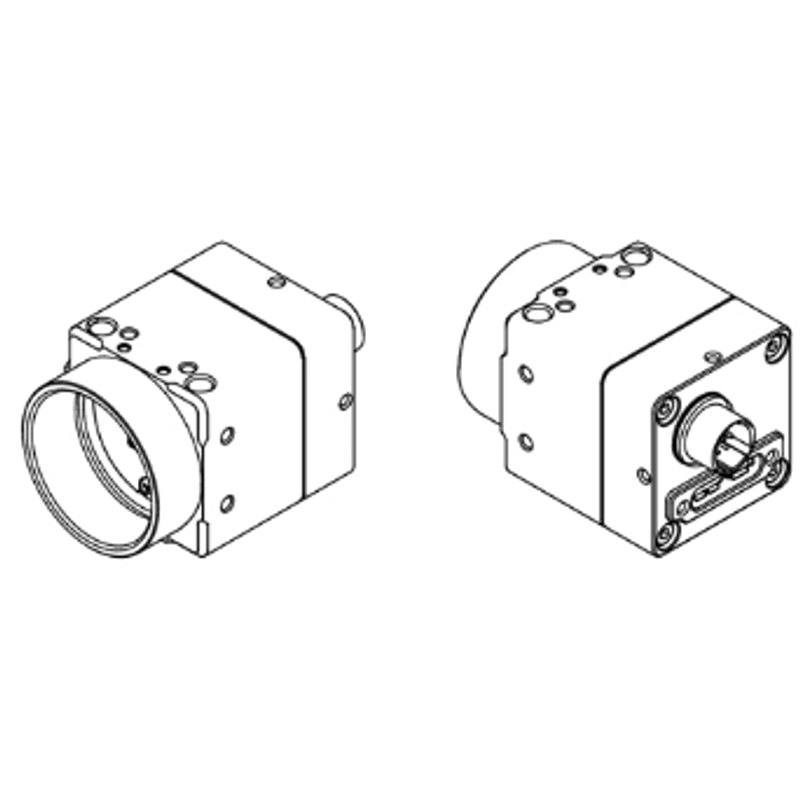
The STC-MBS43U3V (mono) and STC-MCS43U3V (color) are compact USB3 Vision area-scan cameras from Omron Sentech featuring the Sony IMX287 1/2.9" CMOS sensor with 720 x 540 effective pixels (0.4MP) and a 6.9 µm pixel pitch. Both models use a global shutter and deliver up to 527.1 fps over a USB 3.0 interface compliant with USB3 Vision 1.0.1 and GenICam. The cameras are bus-powered from USB (+5V, ≤3.4W), fit a C-mount lens, and measure just 28 x 28 x 40 mm at approximately 46 g, supporting full scan and ROI modes with multiple trigger types and defective pixel correction for up to 2,048 pixels.
The STC-MBS43U3V and STC-MCS43U3V are built around the Sony IMX287, a first-generation Pregius global-shutter CMOS sensor in a 1/2.9" optical format. The 720 x 540 pixel array delivers 0.4 MP of resolution with a 6.9 µm pixel pitch — a relatively large pixel for this resolution class, which translates directly into strong photon collection and high signal-to-noise ratio at short exposure times. Global shutter operation means every pixel integrates simultaneously, so fast-moving parts, spinning labels, and vibrating assemblies are captured without the spatial distortion that a rolling shutter would introduce. At full 720 x 540 resolution the camera sustains 527.1 fps over USB 3.0, placing it firmly in high-speed inspection territory; paired with ROI windowing, frame rates can be pushed even higher to match faster conveyor speeds or to satisfy tight cycle-time budgets without overloading the host CPU with full-frame data.
The interface is USB 3.0 compliant with USB3 Vision 1.0.1 and GenICam, so any compliant SDK or vision runtime can enumerate and control the camera without proprietary drivers. Critically, the camera is bus-powered at +5 V drawing no more than 3.4 W, which eliminates a separate power supply and simplifies cable routing to a single USB cable — a meaningful advantage in dense multi-camera fixtures or space-constrained robotic end-effectors. The lens mount is C-mount, the dominant standard in industrial imaging, giving access to a wide ecosystem of fixed-focal-length and telecentric lenses. The aluminium housing measures 28 x 28 x 40 mm and weighs 46 g, making this one of the more compact C-mount cameras available; it sits comfortably in standard 30 mm lens-bracket systems and on collaborative-robot wrist mounts without adding meaningful payload. The operating temperature range of -25 to +64 °C covers most factory floor environments, though condensation avoidance should be considered at the lower end.
The monochrome variant (STC-MBS43U3V) will suit the majority of precision inspection tasks where contrast and spatial resolution matter more than hue information: surface-defect detection, OCR/OCV on printed text, barcode and 2D-code reading, and dimensional gauging all benefit from mono's full sensor sensitivity and freedom to tune illumination wavelength with bandpass filters. The color variant (STC-MCS43U3V) targets applications where color differentiation is genuinely required — pharmaceutical tablet sorting by coating colour, label color verification, or assembly guidance where color-coded wiring or components must be distinguished. Defective pixel correction for up to 2,048 pixels and support for multiple trigger types (including hardware trigger for precise synchronisation with a strobe or encoder) round out a feature set aimed squarely at demanding production-line integration.
Best for
High-speed small-part inspection on fast conveyors: 527.1 fps at 720 x 540 with global shutter resolves defects on components moving at several metres per second without motion blur or skew artefacts.
Compact robotic vision — wrist-mounted or fixed in a tight cell: at 28 x 28 x 40 mm and 46 g, the camera fits standard robot wrist brackets and draws only 3.4 W from the USB bus, keeping cable count and payload to a minimum.
OCR, OCV, and 2D code reading on electronics or pharmaceutical lines: the 6.9 µm pixel gives high sensitivity to fine contrast at short exposure, and the global shutter eliminates character skew on moving substrates.
Dimensional measurement and gauging of small components: the monochrome variant with a C-mount telecentric lens produces distortion-free images suitable for sub-pixel edge detection.
Multi-camera inspection fixtures on a shared USB hub: bus power and GenICam compliance allow several cameras to be deployed without per-camera PSUs or per-vendor SDKs, reducing wiring complexity and software integration effort.
Selection notes
Lens selection must respect the 1/2.9" sensor format — lenses must be rated to cover the 1/2.9" image circle; lenses sized for 1/3" or smaller formats will vignette because their image circle is smaller than the sensor diagonal. Verify the C-mount lens back-focal distance is compatible with any spacers or filter holders in the optical path.
The 6.9 µm pixel pitch is generous for a 0.4 MP sensor, which improves low-light and short-exposure performance, but the relatively modest total resolution means the field of view must be matched carefully to the smallest feature that needs to be resolved; for parts wider than roughly 50–70 mm where sub-millimetre defects matter, a higher-resolution camera may be needed.
Bus power (+5 V, ≤3.4 W) requires a USB 3.0 port capable of delivering the full current. Long cables, unpowered hubs, or ports on some embedded boards may not supply adequate current; use a powered hub or active cable extender if cable runs exceed 3–4 m.
Hardware trigger inputs support synchronisation with strobe lighting controllers and encoder-based line triggers; ensure the trigger voltage levels and timing specification of the chosen lighting controller are matched to the camera's trigger interface before finalising the wiring design.
The -25 to +64 °C operating range is adequate for most controlled factory environments but does not carry an IP rating per the published specs; the camera should be protected from coolant mist, dust ingress, or direct wash-down in harsh process environments.
Specifications: General
Brand
Omron / Sentech
Camera type
Area Scan
Specifications: Sensor
Resolution
0.4 MP
Horizontal resolution
720 x 540 px
Mono / color
Mono (STC-MBS43U3V) / Color (STC-MCS43U3V)
Sensor manufacturer
Sony Pregius Gen 1
Sensor model
Sony IMX287
Shutter
Global Shutter
Sensor size
1/2.9"
Pixel size
6.9 µm
Specifications: Performance
FPS
527.1 fps (full scan)
Specifications: Interface
Interface
USB 3.0 (USB3 Vision 1.0.1)
Protocols
USB3 Vision 1.0.1, GenICam
Specifications: Optics
Mount
C-Mount
Specifications: Electrical
Power
USB bus power (+5V, ≤3.4W)
Power consumption
3.4 W
Specifications: Environment
Operating temperature
-25 to +64 °C
Specifications: Mechanical
Dimensions
28 x 28 x 40 mm
Weight
46 g
Housing material
Aluminium
Applications this camera is commonly selected for. Open one to see the full recommended hardware and approach.
These steps take an Omron Sentech (STC) camera from the box to a stable first image and on to your own application. They apply across the GigE Vision, USB3 Vision and CoaXPress STC families; the interface only changes how you cable and power the camera.
Download and install the Sentech SDK on the host PC. The package provides StViewer, the viewing and configuration software you use to bring the camera up, and StApi, the programming SDK you integrate later. Because the cameras are GenICam/GenTL-compliant, StApi also registers a GenTL producer, so any GenICam-compliant third-party vision software can discover and drive the camera as an alternative front end.
2. Cable, power and connect the camera
Connect according to the interface. GigE Vision: link to a Gigabit NIC (use PoE or the separate power input) and put the camera and host on the same subnet; for USB3 Vision use a USB 3.x port and a certified cable; for CoaXPress (STC) connect to a CoaXPress frame grabber, which also supplies Power-over-Coax. Then open StViewer and let it enumerate the camera. If a GigE camera does not appear, check the IP configuration and firewall, and on USB3 confirm the host bandwidth and driver.
3. Configure exposure, gain and white balance
Open the device in StViewer and start a live stream. Set exposure and gain for a well-exposed, low-noise image: raise exposure first and only add gain when more light or a faster shutter is not an option, keeping exposure short enough to freeze motion on global-shutter models. On colour cameras, run white balance under your actual production lighting. Adjust the lens aperture and focus on a representative target before tuning anything else.
4. Set the trigger and grab a first image
Start in free-run (continuous) acquisition to confirm a clean, stable image. For inline inspection switch to hardware or software triggering: select the trigger source, set the active edge and any delay, and wire the strobe or illumination to the camera's I/O so lighting fires with each exposure. Acquire and save a frame in StViewer; this saved image is your reference for the SDK stage and for downstream inspection.
5. Move to the StApi SDK (or any GenICam software)
Once the image is stable, reproduce the same settings in code. Use StApi to open the device, apply the GenICam features you validated in StViewer (exposure, gain, trigger, pixel format) and grab frames into your application via the bundled C++, C, C#/.NET or Python interfaces; the included samples are the fastest starting point. Prefer a different stack? The same GenICam/GenTL camera works with third-party vision libraries. With a reliable feed, you can route it into a deep-learning inspection such as Rosepetal for AI-based defect detection.
Frequently asked questions
At full 720 x 540 resolution the camera delivers 527.1 fps over USB 3.0. Reducing the region of interest (ROI) decreases the amount of pixel data transferred per frame, allowing the camera to run at higher effective frame rates — the exact rate depends on the ROI height and the host system's USB throughput, but ROI operation is explicitly supported alongside full-scan mode.
No. The camera is fully bus-powered from the USB 3.0 host port at +5 V with a maximum draw of 3.4 W. A single USB cable carries both data and power. Ensure the host port or hub can supply the required current, particularly with cable runs longer than 3–4 m.
The camera uses a C-mount lens interface. Lenses must cover the 1/2.9" sensor format — lenses rated for 1/2.9" or larger image circles (such as those designed for 1/2" or 1/1.8" sensors) are fully compatible, while lenses sized only for 1/3" or smaller formats will vignette. This still gives access to a broad range of focal lengths and magnifications, including fixed-focal-length and telecentric options from many suppliers.
Choose the monochrome STC-MBS43U3V when the inspection task depends on contrast, edge sharpness, or resolution rather than hue — OCR, barcode reading, dimensional gauging, and surface-defect detection all fall into this category. Monochrome sensors also deliver higher sensitivity because every pixel captures luminance without a Bayer-pattern filter. Choose the color STC-MCS43U3V when the application genuinely requires hue discrimination, such as label color verification, pharmaceutical tablet color sorting, or color-coded assembly guidance.
The camera complies with USB3 Vision 1.0.1 and GenICam standards. It can be enumerated and controlled by any GenICam-compliant SDK including common industrial vision runtimes, without requiring proprietary drivers. This makes it interoperable with most PC-based vision software environments used in industrial automation.