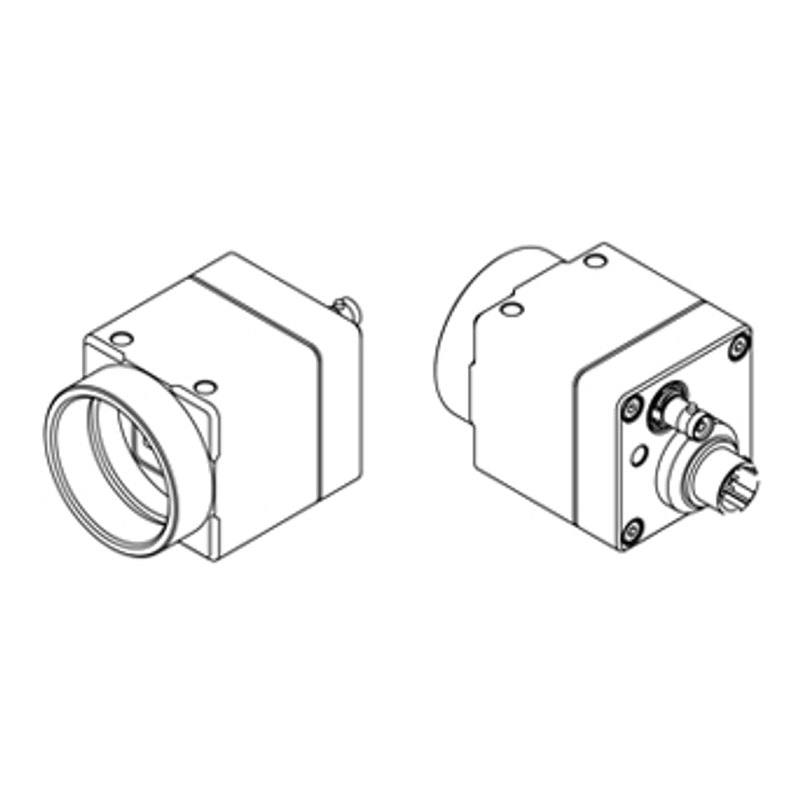
Omron / Sentech Sentech STC-MBS512CXP121 / STC-MCS512CXP121 5MP CXP-12 Area Scan Camera
STC-MBS512CXP121
The STC-MBS512CXP121 (monochrome) and STC-MCS512CXP121 (color) are compact CXP-12 area scan cameras featuring the Sony IMX537 back-illuminated global shutter CMOS sensor at 5MP (2448×2048) resolution. They achieve 198.5 fps full-frame over a single CXP-12 lane, making them among the fastest 5MP CoaXPress cameras in the Sentech lineup. The 29×29×40 mm housing weighs approximately 54 g and uses a C-mount lens interface with a Micro BNC connector. Power is supplied either via PoCXP or an external 18.5–26 Vdc source, with total consumption under 3.8 W.
Brand
Omron / Sentech
Camera type
Area Scan
Interface
CoaXPress CXP-12 (1 lane)
Resolution
5 MP
Horizontal resolution
2448 px
Mono / color
Mono (STC-MBS512CXP121) / Color (STC-MCS512CXP121)
The STC-MBS512CXP121 (monochrome) and STC-MCS512CXP121 (color) are built around the Sony IMX537 back-illuminated Pregius S global shutter CMOS, delivering a 2448 × 2048 pixel (5 MP) image at 198.5 fps over a single CXP-12 lane. The back-illuminated architecture of the IMX537 maximises photon collection at each 2.74 × 2.74 µm pixel, which is especially significant when working with high-speed strobed illumination: shorter exposure windows remain viable because more light reaches the photodiode per unit time. The global shutter eliminates the spatial distortion that a rolling shutter would introduce on fast-moving parts or robot-mounted setups, making every pixel in a frame geometrically consistent — a prerequisite for dimensional measurement and robot guidance. At 198.5 fps full-frame, the camera can track objects moving at several metres per second without motion blur provided the strobe or integration time is set accordingly, placing it firmly in the high-speed inspection tier for a 5 MP sensor.
The single-lane CXP-12 interface transfers data at 12.5 Gbit/s, which is sufficient to sustain the full 198.5 fps throughput without requiring multi-lane cabling or frame decimation. CoaXPress uses thin 75-Ω coax, an advantage over GigE or USB3 Vision in factory environments where long cable runs and electrical noise are common. Power over CoaXPress (PoCXP) is supported, so a single cable carries both data and power; an external 18.5–26 Vdc feed is also available for installations where the frame grabber does not supply PoCXP. Total consumption is under 3.8 W, keeping thermal load low inside tight enclosures. The camera speaks CoaXPress Standard v2.0 and GenICam, so any compliant frame grabber and HALCON, VisionPro, or custom GenICam-based software stack can control it without vendor-specific drivers. The 1/1.8-inch optical format is served by a C-mount, a widely available standard with a large ecosystem of machine-vision lenses from sub-8 mm wide-angle to long-working-distance telecentric designs.
The 29 × 29 × 40 mm housing weighs 54 g and uses a Micro BNC connector, keeping the footprint small enough for multi-camera gantry arrays, conveyor-side bracket mounts, or robot wrist installations where mass and protrusion matter. The 0–45 °C operating range suits typical factory floors and climate-controlled cleanrooms alike. The dual model offering — monochrome (STC-MBS512CXP121) and colour (STC-MCS512CXP121) — lets integrators standardise on one mechanical and electrical platform: monochrome for maximum sensitivity and contrast on single-wavelength illumination in defect or dimensional tasks, colour where hue differentiation between components, labels, or surface coatings is required for packaging or traceability applications.
Best for
High-speed surface and defect inspection on fast production lines — 198.5 fps at 5 MP resolves fine features on parts moving at several metres per second when paired with a short-pulse strobe, eliminating motion blur without sacrificing spatial resolution.
Dimensional measurement and gauging of machined or pressed components where global shutter geometric integrity is non-negotiable and sub-pixel accuracy depends on consistent pixel positioning across the full 2448 × 2048 frame.
Robot guidance and bin-picking in automotive and electronics assembly, where the compact 54 g body and single-coax CXP-12 cable simplify wrist mounting and cable management while the global shutter removes pose-estimation errors from part motion during acquisition.
Semiconductor and electronics PCB or wafer inspection using the monochrome variant with narrowband LED illumination, leveraging the back-illuminated IMX537's sensitivity to extract contrast from subtle surface anomalies at high throughput.
Packaging and pharma traceability — OCR/OCV, 1D/2D code reading, and label verification — where the colour variant distinguishes label background from print and the high frame rate keeps up with modern filling and labelling lines.
Selection notes
A CXP-12 frame grabber is mandatory — this camera does not enumerate on GigE, USB3, or Camera Link hosts. Confirm the grabber supports CoaXPress v2.0 single-lane at CXP-12 speed and supplies PoCXP if you want to avoid running a separate power cable.
The 1/1.8-inch sensor format constrains lens selection: C-mount lenses must cover the 1/1.8-inch image circle at full resolution. Many legacy C-mount lenses are rated for 1/2-inch or smaller formats and will vignette; verify the lens datasheet image circle rating before ordering.
At 2.74 µm pixel pitch, the lens resolution must resolve better than 5.48 µm at the sensor plane (two pixels per line pair by Nyquist) to realise the sensor's full spatial resolution. Choose lenses with MTF specifications at the spatial frequency corresponding to 182 lp/mm at the image plane, particularly at field angles covering the 1/1.8-inch corner.
Operating temperature tops out at 45 °C. In enclosed machine enclosures with multiple heat sources, ensure the camera body stays within this range; the under-3.8 W dissipation is low but ambient temperature management and airflow around the housing remain the integrator's responsibility.
The Micro BNC connector is non-standard relative to the full-size BNC used on many CXP cables and patch panels. Source Micro BNC to BNC adapters or Micro BNC-terminated coax assemblies before installation; substituting a push-fit or wrong-impedance connector will degrade signal integrity at CXP-12 speeds.
Specifications: General
Brand
Omron / Sentech
Camera type
Area Scan
Specifications: Sensor
Resolution
5 MP
Horizontal resolution
2448 px
Mono / color
Mono (STC-MBS512CXP121) / Color (STC-MCS512CXP121)
Sensor manufacturer
Sony Pregius S
Sensor model
Sony IMX537
Shutter
Global Shutter
Sensor size
1/1.8 inch
Pixel size
2.74 × 2.74 µm
Specifications: Performance
FPS
198.5 fps
Specifications: Interface
Interface
CoaXPress CXP-12 (1 lane)
Protocols
CoaXPress Standard v2.0, GenICam
Specifications: Optics
Mount
C Mount
Specifications: Electrical
Power
PoCXP or External +18.5 to +26 Vdc
Power consumption
3.8 W
Specifications: Environment
Operating temperature
0 to +45 °C
Specifications: Mechanical
Dimensions
29 × 29 × 40 mm
Weight
54 g
Applications this camera is commonly selected for. Open one to see the full recommended hardware and approach.
These steps take an Omron Sentech (STC) camera from the box to a stable first image and on to your own application. They apply across the GigE Vision, USB3 Vision and CoaXPress STC families; the interface only changes how you cable and power the camera.
Download and install the Sentech SDK on the host PC. The package provides StViewer, the viewing and configuration software you use to bring the camera up, and StApi, the programming SDK you integrate later. Because the cameras are GenICam/GenTL-compliant, StApi also registers a GenTL producer, so any GenICam-compliant third-party vision software can discover and drive the camera as an alternative front end.
2. Cable, power and connect the camera
Connect according to the interface. GigE Vision: link to a Gigabit NIC (use PoE or the separate power input) and put the camera and host on the same subnet; for USB3 Vision use a USB 3.x port and a certified cable; for CoaXPress (STC) connect to a CoaXPress frame grabber, which also supplies Power-over-Coax. Then open StViewer and let it enumerate the camera. If a GigE camera does not appear, check the IP configuration and firewall, and on USB3 confirm the host bandwidth and driver.
3. Configure exposure, gain and white balance
Open the device in StViewer and start a live stream. Set exposure and gain for a well-exposed, low-noise image: raise exposure first and only add gain when more light or a faster shutter is not an option, keeping exposure short enough to freeze motion on global-shutter models. On colour cameras, run white balance under your actual production lighting. Adjust the lens aperture and focus on a representative target before tuning anything else.
4. Set the trigger and grab a first image
Start in free-run (continuous) acquisition to confirm a clean, stable image. For inline inspection switch to hardware or software triggering: select the trigger source, set the active edge and any delay, and wire the strobe or illumination to the camera's I/O so lighting fires with each exposure. Acquire and save a frame in StViewer; this saved image is your reference for the SDK stage and for downstream inspection.
5. Move to the StApi SDK (or any GenICam software)
Once the image is stable, reproduce the same settings in code. Use StApi to open the device, apply the GenICam features you validated in StViewer (exposure, gain, trigger, pixel format) and grab frames into your application via the bundled C++, C, C#/.NET or Python interfaces; the included samples are the fastest starting point. Prefer a different stack? The same GenICam/GenTL camera works with third-party vision libraries. With a reliable feed, you can route it into a deep-learning inspection such as Rosepetal for AI-based defect detection.
Frequently asked questions
The camera delivers 198.5 fps at its full 2448 × 2048 (5 MP) resolution over a single CXP-12 lane. No resolution reduction or lane aggregation is needed to reach this rate.
Both options are supported. The camera accepts Power over CoaXPress (PoCXP) from a compliant frame grabber, allowing a single coax cable to carry data and power. Alternatively, an external DC supply between 18.5 and 26 Vdc can be connected. Total consumption is under 3.8 W in either case.
Yes. The Sony IMX537 uses a global shutter, meaning all pixels are exposed simultaneously. This eliminates the geometric skew that a rolling shutter would introduce on parts moving relative to the camera during exposure — a requirement for dimensional measurement and robot guidance.
The camera uses a standard C-mount. The Sony IMX537 is a 1/1.8-inch format sensor, so the chosen lens must cover at least the 1/1.8-inch image circle at full aperture to avoid vignetting at the corners of the 2448 × 2048 frame.
Both variants share the same mechanical and electrical platform. The STC-MBS512CXP121 is the monochrome model and the STC-MCS512CXP121 is the colour (Bayer) model. Monochrome is preferable for maximum sensitivity and single-wavelength illumination tasks; colour is required when hue information is needed for label, coating, or component differentiation.