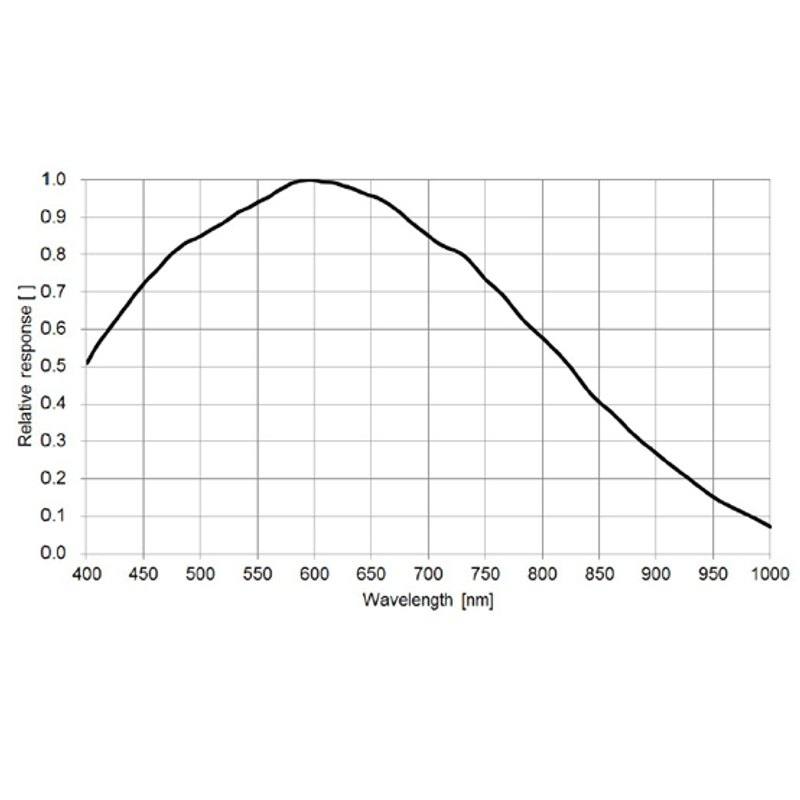
The STC-SPB43PCL (monochrome) and STC-SPC43PCL (color) are compact Camera Link Base area-scan cameras built around the Sony IMX287 1/2.9" global shutter CMOS sensor with 720×540 effective pixels at 6.9 µm pitch. Both models deliver up to 523.5 fps at full resolution and support Camera Link 2.1 protocol via a single SDR connector. Power can be supplied via PoCL (Power over Camera Link) or an external +12 V DC supply, with consumption of 1.7 W or less. The 28×28×40 mm cased body weighs approximately 40 g and accepts C-mount lenses, making it suitable for high-speed machine vision tasks in space-constrained environments.
The STC-SPB43PCL and STC-SPC43PCL are built around Sony's IMX287 Pregius global shutter CMOS sensor, a 1/2.9" format device delivering 720 × 540 effective pixels at a 6.9 µm pitch. Global shutter is the defining capability here: every pixel integrates simultaneously, so even the fastest-moving parts, conveyor belts, or strobe-illuminated targets produce images completely free of rolling-shutter skew. At 523.5 fps full-resolution, the pair can capture motion at speeds that are impractical for most area-scan cameras — a 100 mm/s line speed with a 10 µs strobe, for instance, introduces under 1 µm of motion blur. For machine vision tasks that involve high-cycle-rate pick-and-place, rapidly indexed trays, or continuous-motion print inspection, this frame rate headroom allows genuine temporal oversampling: multiple frames per part pass, providing redundancy against a single blurred acquisition.
The Camera Link Base interface (Camera Link 2.1, single SDR connector, GenICam compliant) connects to any standard frame-grabber that supports CL Base mode. Camera Link remains the preferred interface in deterministic, low-latency production lines where GigE or USB3 jitter is unacceptable — triggering is synchronised at hardware level, and pixel delivery is synchronous with the line clock. Power over Camera Link (PoCL) eliminates a separate power cable run to the camera head, simplifying cable management in multi-camera gantries. An external +12 V DC input is available when PoCL is not supported by the frame-grabber. At 1.7 W total consumption the camera generates minimal heat, which matters in enclosed housings and thermally sensitive semiconductor or pharma environments. The 28 × 28 × 40 mm, 40 g body fits in space-constrained multi-camera fixtures without mechanical redesign.
Lens mounting is C-mount, which gives access to a very broad selection of industrial fixed-focal and telecentric lenses designed for the 1/2.9" image circle. The sensor measures 5 mm × 3.7 mm (approximately 6.2 mm diagonal), so any lens rated for 1/3" or larger format will fully illuminate the chip without vignetting. The 6.9 µm pixel pitch means that even a modest 2 line-pairs/pixel MTF criterion requires the lens to resolve roughly 72 lp/mm at image space — a specification comfortably met by mid-grade machine-vision C-mount optics. For the color (SPC) variant, Bayer-pattern demosaicking reduces effective chroma resolution to approximately 360 × 270 per channel, so lighting wavelength selection and white-balance calibration are design-in considerations. Operating temperature of 0 to +45 °C covers standard factory and cleanroom environments without additional thermal conditioning.
Best for
High-speed component inspection on fast-moving conveyors where 500+ fps combined with global shutter eliminates both motion blur and image skew, allowing reliable defect calls on parts moving at speeds impractical for standard 60–200 fps cameras.
Compact multi-camera arrays in confined spaces — the 28 × 28 × 40 mm, 40 g body and single SDR PoCL cable make it straightforward to mount four or more cameras on a small gantry or rotary indexer without exceeding payload or clearance limits.
Semiconductor and electronics wafer/PCB inspection where deterministic Camera Link triggering, low jitter frame delivery, and a clean global-shutter image are required by process SPC systems that cannot tolerate variable-latency GigE acquisition.
Colour mark registration and print-quality verification (SPC variant) on high-cycle packaging lines, where the Bayer sensor captures colour deviation in a single acquisition without a filter wheel, and the 523.5 fps rate allows every single label or carton to be imaged.
Robot guidance and part-present detection in pick-and-place cells where a lightweight, low-power camera head can be mounted directly on the robot arm, triggered synchronously by the robot controller via Camera Link hardware trigger, with PoCL simplifying arm-mounted cabling.
Selection notes
Frame-grabber compatibility is a hard requirement: Camera Link Base (CL 2.1, SDR connector) support and PoCL capability must be confirmed on the host board before ordering. Not all CL grabbers implement PoCL; if PoCL is unavailable, a separate +12 V DC supply line must be routed to the camera.
Lens format must cover at least 1/2.9" (5 mm × 3.7 mm, approximately 6.2 mm diagonal). Lenses marked for 1/3" image circles will cover this format; 1/4" lenses will not. For dimensional measurement applications requiring low distortion, specify a telecentric C-mount lens rated for 1/3" or larger, as telecentricity is not inherent in the camera itself.
The 0 to +45 °C operating window excludes installation near furnaces, ovens, or outdoor enclosures without supplemental cooling. In sealed enclosures, the 1.7 W self-heating is modest but should still be accounted for in thermal calculations alongside frame-grabber and lighting heat loads.
For the color (SPC) variant, illumination color temperature and spectral consistency directly affect demosaicking accuracy. Narrow-band or broadband LED sources with stable CCT, combined with in-system white-balance calibration, are required to achieve repeatable color measurements. The monochrome (SPB) variant avoids this dependency and offers higher effective spatial resolution for the same pixel array.
At 523.5 fps, sustained data throughput over Camera Link Base reaches its interface ceiling. If the application needs to run at maximum frame rate continuously rather than in burst, the frame-grabber's DMA buffer depth and host CPU/PCIe bandwidth must be sized to avoid frame drops. Partial-scan ROI modes can reduce bandwidth if full-rate continuous streaming is required at sub-full-resolution.
Specifications: General
Brand
Omron / Sentech
Camera type
Area Scan
Specifications: Sensor
Resolution
0.4 MP
Horizontal resolution
720 × 540 px
Mono / color
Mono (SPB) / Color (SPC)
Sensor manufacturer
Sony Pregius
Sensor model
Sony IMX287
Shutter
Global Shutter
Sensor size
1/2.9" (5 mm × 3.7 mm)
Pixel size
6.9 × 6.9 µm
Specifications: Performance
FPS
523.5 fps (max, full resolution)
Specifications: Interface
Interface
Camera Link Base (Camera Link 2.1, SDR x1, PoCL)
Protocols
Camera Link 2.1 / GenICam
Specifications: Optics
Mount
C-Mount
Specifications: Electrical
Power
PoCL or External +12 V DC
Power consumption
1.7 W
Supply voltage
+12 V DC (external) or PoCL
Specifications: Environment
Operating temperature
0 to +45 °C
Specifications: Mechanical
Dimensions
28 × 28 × 40 mm
Weight
40 g
Applications this camera is commonly selected for. Open one to see the full recommended hardware and approach.
Matched automatically by: lens mount fits the camera mount · lens image circle covers the camera sensor — this camera: C-Mount · 1/2.9" (5 mm × 3.7 mm) sensor.
By category
All 244C-mount lenses 179Telecentric lenses 62F-mount / large-format lenses 3
By brand
All 244Omron / Sentech 81iRAYPLE 66Basler 65Datalogic / Datasensing 32
These steps take an Omron Sentech (STC) camera from the box to a stable first image and on to your own application. They apply across the GigE Vision, USB3 Vision and CoaXPress STC families; the interface only changes how you cable and power the camera.
Download and install the Sentech SDK on the host PC. The package provides StViewer, the viewing and configuration software you use to bring the camera up, and StApi, the programming SDK you integrate later. Because the cameras are GenICam/GenTL-compliant, StApi also registers a GenTL producer, so any GenICam-compliant third-party vision software can discover and drive the camera as an alternative front end.
2. Cable, power and connect the camera
Connect according to the interface. GigE Vision: link to a Gigabit NIC (use PoE or the separate power input) and put the camera and host on the same subnet; for USB3 Vision use a USB 3.x port and a certified cable; for CoaXPress (STC) connect to a CoaXPress frame grabber, which also supplies Power-over-Coax. Then open StViewer and let it enumerate the camera. If a GigE camera does not appear, check the IP configuration and firewall, and on USB3 confirm the host bandwidth and driver.
3. Configure exposure, gain and white balance
Open the device in StViewer and start a live stream. Set exposure and gain for a well-exposed, low-noise image: raise exposure first and only add gain when more light or a faster shutter is not an option, keeping exposure short enough to freeze motion on global-shutter models. On colour cameras, run white balance under your actual production lighting. Adjust the lens aperture and focus on a representative target before tuning anything else.
4. Set the trigger and grab a first image
Start in free-run (continuous) acquisition to confirm a clean, stable image. For inline inspection switch to hardware or software triggering: select the trigger source, set the active edge and any delay, and wire the strobe or illumination to the camera's I/O so lighting fires with each exposure. Acquire and save a frame in StViewer; this saved image is your reference for the SDK stage and for downstream inspection.
5. Move to the StApi SDK (or any GenICam software)
Once the image is stable, reproduce the same settings in code. Use StApi to open the device, apply the GenICam features you validated in StViewer (exposure, gain, trigger, pixel format) and grab frames into your application via the bundled C++, C, C#/.NET or Python interfaces; the included samples are the fastest starting point. Prefer a different stack? The same GenICam/GenTL camera works with third-party vision libraries. With a reliable feed, you can route it into a deep-learning inspection such as Rosepetal for AI-based defect detection.
Frequently asked questions
523.5 fps is the published maximum at full 720 × 540 resolution. No resolution reduction is needed to reach this rate, though ROI sub-scanning can push rates further if the application requires it and the frame-grabber supports partial-scan readout.
Yes. The camera supports Power over Camera Link (PoCL), so a PoCL-capable frame-grabber can supply the required power through the single SDR Camera Link cable. An external +12 V DC input is also available for grabbers that do not implement PoCL. Total consumption is 1.7 W or less.
Yes, and it is well matched to strobe use. Because all pixels integrate simultaneously in global shutter mode, a strobe pulse of any duration shorter than the exposure window produces a uniformly lit frame with no banding or partial-frame exposure artifacts. This makes it straightforward to freeze fast motion with a short, high-intensity strobe pulse.
The camera uses a standard C-mount. The sensor is 1/2.9" format (5 mm × 3.7 mm, approximately 6.2 mm diagonal). Any C-mount lens rated for a 1/3" or larger image circle will fully cover the sensor without vignetting. Lenses rated only for 1/4" format are too small for this sensor.
SPB designates the monochrome variant and SPC the color variant. Both use the same Sony IMX287 sensor, dimensions, interface, and frame-rate specification. The color (SPC) model has a Bayer color filter array over the pixel array, enabling single-shot color capture at the cost of reduced effective chroma resolution and the need for demosaicking in the image-processing pipeline.