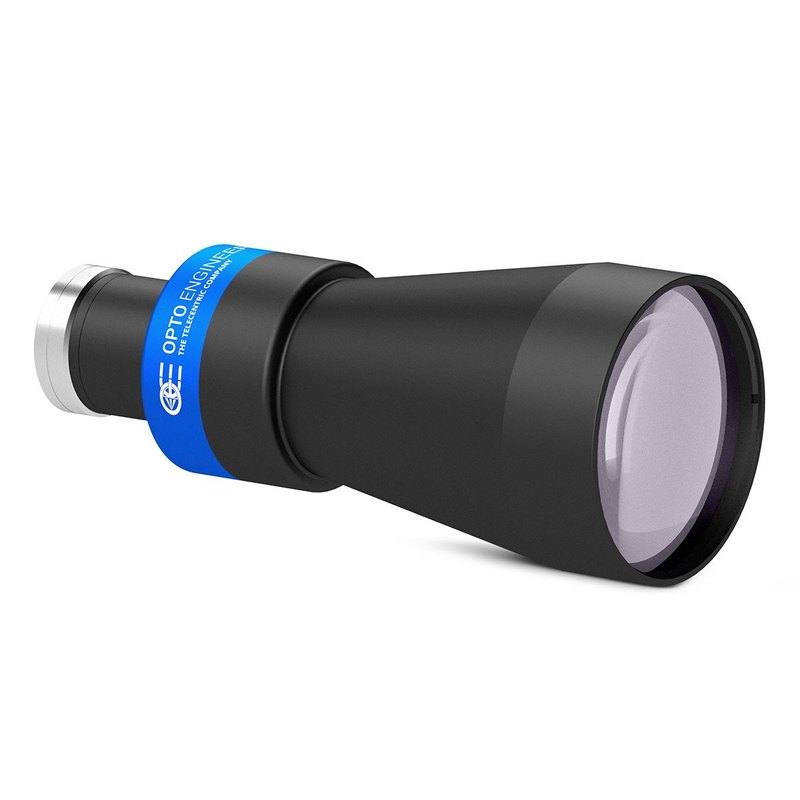
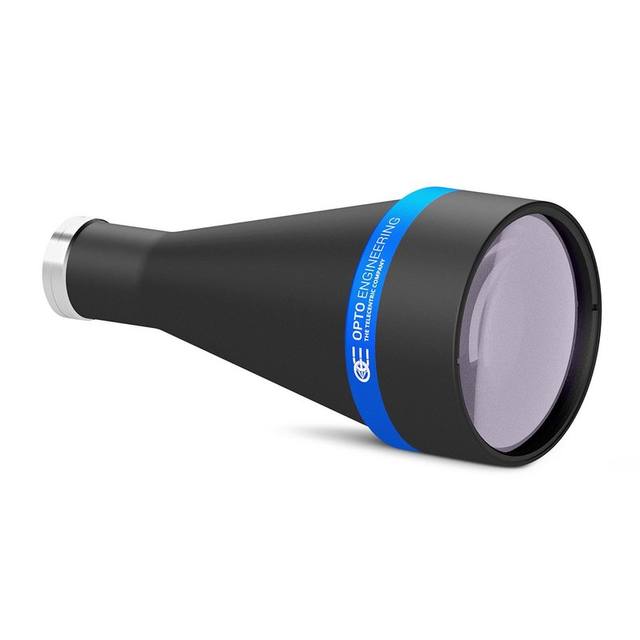
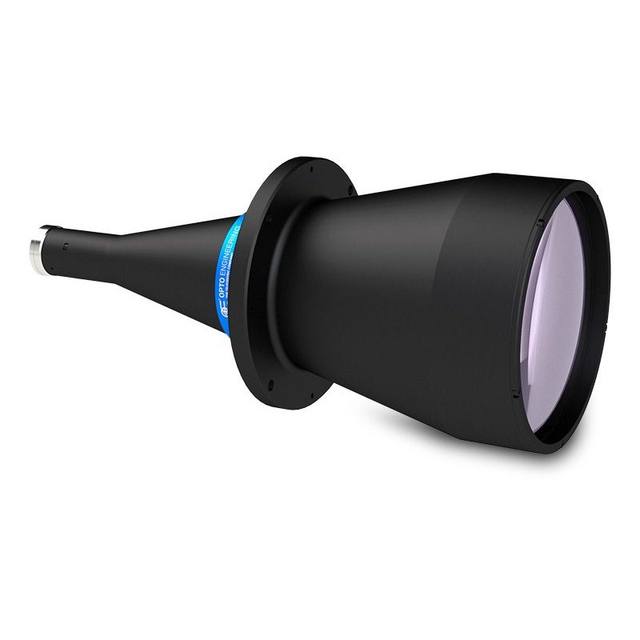
The Opto Engineering TC13056 is a bi-telecentric lens for 1/3″ sensors with 0.084× magnification, a working distance of 157.5 mm and a C-mount. Its image circle is listed as Ø 6.0 mm for a maximum 1/3″ sensor. The 157.5 mm working distance keeps the lens at a generous distance from the part, which suits installations with guarding or handling equipment in front of the object.
As a bi-telecentric design, the lens keeps its image scale steady across the depth of field and through small shifts of the image plane. Distortion is below 0.04% typical (0.08% maximum), and telecentricity is below 0.04° typical (0.08° maximum). These low optical figures keep the contribution to dimensional measurement error small, which matters when edge positions are being gauged.
The working f-number is wF/# 8. It gives depth of field but needs adequate light at the sensor, so illumination and exposure should be planned for this aperture. Keep the sensor within the 1/3″ format and the Ø 6.0 mm image circle, and plan the light for the 0.084× magnification at 157.5 mm.
Best for
Gauging with 1/3″ C-mount cameras where telecentricity below 0.04° typical is needed
Inspection setups requiring 157.5 mm of clearance between the lens and the part
Measurement of parts with depth where image scale must stay steady
Installations with guarding or handling equipment in front of the lens
Selection notes
Match the sensor to the 1/3″ format within the Ø 6.0 mm image circle.
Confirm the C-mount on the camera before ordering.
Set the stand and guarding around the 157.5 mm working distance, and check that the lighting reaches the field at that range.
The wF/# 8 aperture needs enough light, so set illumination and exposure for it.
Include the listed distortion (below 0.04% typical, 0.08% maximum) and telecentricity (below 0.04° typical, 0.08° maximum) in the measurement uncertainty budget.
Specifications: General
Brand
Opto Engineering
Specifications: Optical
Lens mount
C-mount
Image circle / max sensor
Ø 6.0 mm (max sensor 1/3″)
Magnification
0.084×
Working distance
157.5 mm
Telecentric
Yes
Applications this product is commonly selected for. Open one to see the full recommended hardware and approach.
Matched automatically by: camera mount fits the lens mount · camera sensor is covered by the lens image circle — this lens: C-mount · Ø 6.0 mm (max sensor 1/3″) image circle.