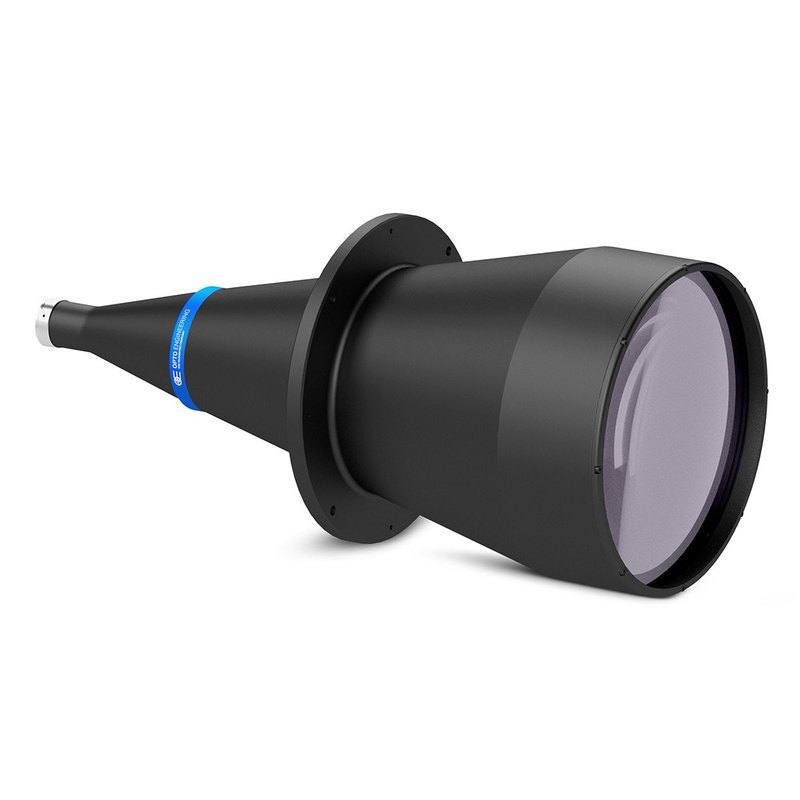
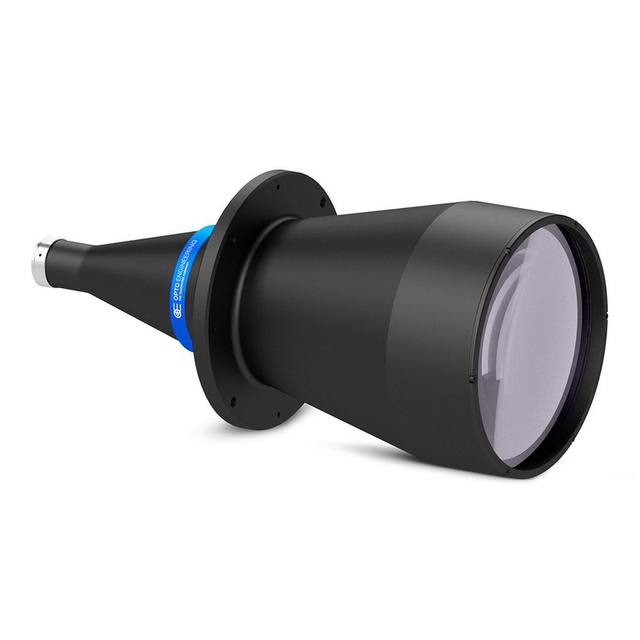
The Opto Engineering TC13192 is a bi-telecentric C-mount lens with a 0.025× magnification and a working distance of 527.6 mm, designed for 1/3″ sensors. Its Ø 6.0 mm image circle matches the 1/3″ maximum sensor size, and the working f-number is wF/# 8. At 0.025× the 1/3″ sensor covers a large object field, and the 527.6 mm working distance sets a long camera-to-object separation. That geometry suits setups where the camera has to stand well clear of the part.
The telecentric design is central to this lens. With telecentricity below 0.06° typical (0.08° maximum), the image scale stays close to constant as the object moves in depth. Distortion is below 0.04 % typical (0.10 % maximum). Over a long working distance, a conventional lens would change apparent size more with small shifts in distance, so telecentric behavior helps keep wide-field measurements repeatable. For accuracy budgets, the maximum values are the conservative inputs.
Use a C-mount camera with a 1/3″ or smaller sensor. Focus is set at 527.6 mm, so the fixture or mounting frame must hold the object at that distance and remain rigid across the long span. Lighting must be sized for the wF/# 8 aperture and for the large field, and backlighting is a common choice for outline measurement with telecentric optics.
Best for
Wide-field dimensional inspection at 0.025× magnification with the camera set back from the part.
Setups that need a 527.6 mm working distance between the camera and the object.
Silhouette and edge measurement with a backlight across a broad 1/3″ field.
Installations that need long camera-to-object clearance for access, guarding or handling.
Selection notes
Confirm the sensor is 1/3″ or smaller and that the camera uses a C-mount.
Hold the object at 527.6 mm and build a rigid frame, since long working distances make mechanical drift more significant.
Plan illumination for the wF/# 8 aperture and the large field produced by 0.025× magnification.
Use the maximum values, 0.10 % distortion and 0.08° telecentricity, as worst-case inputs for accuracy.
Specifications: General
Brand
Opto Engineering
Specifications: Optical
Lens mount
C-mount
Image circle / max sensor
Ø 6.0 mm (max sensor 1/3″)
Magnification
0.025×
Working distance
527.6 mm
Telecentric
Yes
Applications this product is commonly selected for. Open one to see the full recommended hardware and approach.
Matched automatically by: camera mount fits the lens mount · camera sensor is covered by the lens image circle — this lens: C-mount · Ø 6.0 mm (max sensor 1/3″) image circle.