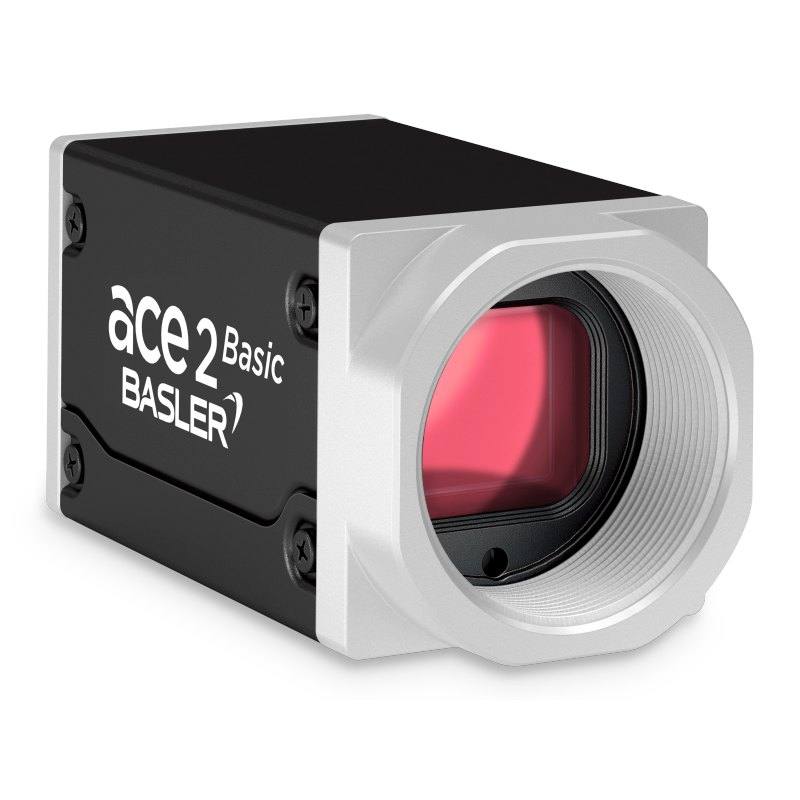
The Basler a2A2840-14gc is an ace 2 R series GigE area scan camera featuring the Sony IMX546-AAQJ-C progressive scan CMOS global shutter sensor in a 2/3" format. It resolves 8.1 MP at 2840×2840 pixels with a 2.74 µm pixel pitch, delivering up to 14.5 fps via Gigabit Ethernet (GigE Vision 2.0 / GenICam compliant). The compact 55.5×29×29 mm housing supports C-mount lenses, PoE (IEEE 802.3af) or 12–24 VDC power, and includes one opto-coupled input plus two GPIO lines for flexible triggering and I/O integration.
The Basler a2A2840-14gc is built around Sony's IMX546-AAQJ-C Pregius S progressive scan CMOS sensor that delivers 8.1 MP at a square 2840 × 2840-pixel array with a 2.74 µm pixel pitch. The 2/3" optical format (7.78 × 7.78 mm active area, 11 mm diagonal) gives installers a generous field of view relative to the compact C-mount body, and the 2.74 µm pitch strikes a practical balance: small enough to pack high spatial density into the sensor die, yet large enough to maintain acceptable signal-to-noise for moderate-contrast surface and packaging features in factory lighting. Global shutter capture eliminates the motion-induced skew and rolling-shutter artifacts that would corrupt images of fast-moving parts on conveyors or during robot pick cycles — every pixel is exposed simultaneously regardless of line speed.
At 14.5 fps full-resolution over GigE Vision 2.0 / GenICam, the camera transfers color pixel data across a single Gigabit Ethernet link. GigE Vision's built-in packetisation and resend mechanisms tolerate the modest latency variations of managed-switch infrastructure, making multi-camera layouts straightforward without specialist cabling. Power-over-Ethernet (IEEE 802.3af) or 12–24 VDC means only one cable reaches the camera in PoE installations — a concrete benefit when mounting inside enclosures or on robot arms where wiring bulk matters. At 2.9 W and 100 g in a 55.5 × 29 × 29 mm housing, thermal and mechanical integration is low-burden. IP30 protection covers solid objects larger than 2.5 mm, appropriate for panel-mount or enclosure use in clean to lightly dusty industrial environments.
The I/O complement — one opto-coupled input plus two GPIO lines — covers the most common trigger-and-flash architectures: the opto-isolated input accepts a PLC or encoder line-pulse to fire the shutter without ground-loop risk, while the GPIO lines can drive a strobe controller or signal acquisition complete back to a PLC. C-mount compatibility opens the lens catalog fully: standard 2/3" and larger image-circle C-mount lenses are the natural match, and installers should verify the lens image circle covers the full 11 mm diagonal to avoid corner shading. For the square sensor geometry, a lens with roughly equal horizontal and vertical MTF performance gives consistent sharpness edge-to-edge. Color output from the IMX546-AAQJ-C suits label verification, cosmetic grading, and solder-paste color differentiation without the add-on cost of a separate color sensor or lighting channel.
Best for
High-resolution surface and cosmetic inspection on continuous packaging or electronics lines where motion demands a true global shutter — the 2840 × 2840 array resolves fine defects across a wide field without requiring the camera to stop the line.
Color label and print inspection on pharmaceutical or FMCG packaging, where the IMX546's color output distinguishes misprint hues, verifies label placement, and reads 1D/2D codes in a single acquisition.
Robot guidance and bin-picking cells that need 8 MP spatial precision to locate part features reliably from a fixed overhead mount, with PoE simplifying cable management on a robot end-effector bracket.
Dimensional measurement of flat or near-flat parts (PCBs, stamped metal, blister packs) where the square sensor maximises coverage of square or circular gauging zones and the global shutter removes part-vibration error.
Logistics sortation and parcel induction where a GigE camera can be added to an existing managed-switch network, PoE eliminates a separate power drop to the scan tunnel, and 14.5 fps captures packages at moderate belt speeds.
Selection notes
Lens image circle must cover the full 11 mm diagonal of the 2/3" sensor. Many C-mount lenses are rated for 2/3" sensors but check the corner illumination spec explicitly; under-sized image circles produce visible vignetting at the corners of the 7.78 × 7.78 mm active area.
At 14.5 fps full-resolution over Gigabit Ethernet, the camera consumes the majority of a 1 Gbps link's bandwidth. If multiple cameras share a switch uplink, account for aggregated bandwidth and enable jumbo frames (up to 9000-byte MTU) and packet delay settings in Basler's pylon software to prevent packet loss at sustained frame rates.
The opto-coupled input is the correct trigger path from PLC or encoder outputs — it prevents ground-loop noise from corrupting trigger timing. The two GPIO lines are not opto-isolated; use appropriate signal conditioning or a dedicated I/O module if they must interface with high-voltage industrial signals.
IP30 is a protection rating against solid objects larger than 2.5 mm but offers no rated protection against dust ingress or liquid. Installations in environments with coolant mist, metal chips, or wash-down cycles require an enclosure or a camera with a higher IP rating. For clean-room or inspection-booth use, IP30 is typically sufficient.
The IMX546-AAQJ-C is a color-only sensor. If the application is purely monochrome — OCR in single wavelength, high-contrast code reading under red illumination, or tasks prioritising peak quantum efficiency — a monochrome sibling camera on the same Sony Pregius S platform will deliver higher per-pixel sensitivity and eliminate the Bayer interpolation step.
Specifications: General
Brand
Basler
Camera type
Area Scan
Specifications: Sensor
Resolution
8.1
Horizontal resolution
2840 px
Mono / color
Color
Sensor manufacturer
Sony Pregius S
Sensor model
Sony IMX546-AAQJ-C
Shutter
Global Shutter
Sensor size
2/3" (11 mm diagonal)
Pixel size
2.74 µm
Specifications: Performance
FPS
14
Specifications: Interface
Interface
GigE (100/1000 Mbit/s)
Protocols
GigE Vision 2.0, GenICam
Specifications: Optics
Mount
C-Mount
Specifications: Electrical
Power
PoE (IEEE 802.3af) or 12–24 VDC
Power consumption
2.9 W
Specifications: Environment
IP rating
IP30
Operating temperature
-10 to 60 °C
Specifications: Mechanical
Dimensions
7.78 × 7.78 mm
Weight
100 g
Applications this camera is commonly selected for. Open one to see the full recommended hardware and approach.
Matched automatically by: lens mount fits the camera mount · lens image circle covers the camera sensor — this camera: C-Mount · 2/3" (11 mm diagonal) sensor.
By category
All 198C-mount lenses 135Telecentric lenses 60F-mount / large-format lenses 3
By brand
All 198Omron / Sentech 66Basler 59iRAYPLE 48Datalogic / Datasensing 25
Get a first image quickly with the pylon Viewer, then move into the pylon SDK for your application. These cameras are GenICam/GenTL-compliant, so any compliant vision software can drive them as well.
Download and install the pylon Camera Software Suite for your OS from Basler. This provides the pylon Viewer, the GenTL transport-layer producers and the pylon SDK (C/C++/.NET/Python). On Windows the installer adds the needed drivers; on Linux follow the included setup notes for USB and network permissions.
2. Connect the camera and check the link
Cable the camera to its matching interface: GigE Vision to a GigE port (use a quality cable and, ideally, a dedicated NIC with jumbo frames enabled), USB3 Vision to a USB 3.x port with the supplied cable, or CoaXPress to the frame grabber. Provide power where required (PoE, USB bus power, or PoCXP). Open the pylon Viewer and confirm the camera appears in the device list; for GigE, make sure the camera and NIC are on the same subnet.
3. Grab a first image and set exposure, gain and pixel format
Select the camera in the pylon Viewer and start a continuous grab. Adjust exposure time and gain until the image is well exposed (avoid clipped highlights), set the pixel format (e.g. Mono8 or a Bayer/RGB format), and focus the lens. Use a test pattern if the lens or scene is not ready yet.
4. Configure triggering and acquisition
Decide between free-run and triggered acquisition. For synchronized capture, set the trigger source (software or a hardware line on the I/O connector), trigger mode and any debounce or exposure mode, then verify timing. Note the parameter names you change in the Viewer feature tree, as you will reuse them in code.
5. Move to the SDK or a GenICam-compliant library
Recreate your settings in code with the pylon SDK (C, C++, .NET or Python) to open the device, apply the same features and pull frames into your pipeline; pylon vTools and pylon AI can add processing blocks. Because the cameras are GenICam/GenTL standard, third-party vision libraries work too. Once the image stream is stable, you can route frames to a deep-learning inspection such as Rosepetal for automated defect detection.
Frequently asked questions
The specified maximum frame rate is 14.5 fps at the full 2840 × 2840 pixel resolution over GigE. The GenICam interface supports region-of-interest (ROI) windowing, which reduces the data volume per frame and can allow higher frame rates — but the exact ROI-vs-fps curve depends on the pylon driver and host NIC configuration. The 14.5 fps figure is the guaranteed full-frame rate documented in the spec.
Yes. The camera supports Power over Ethernet (IEEE 802.3af), so a PoE-capable managed switch or PoE injector on the GigE cable provides both data and power in a single run. Total power consumption is 2.9 W, within the 802.3af budget. Alternatively, 12–24 VDC via a separate connector is supported if a PoE infrastructure is not available.
Yes. The Sony IMX546's global shutter exposes all pixels simultaneously, so there is no rolling-shutter skew or banding when imaging moving objects. The practical limit is the exposure time relative to part velocity — a short strobe-synchronized exposure freezes motion at high belt speeds. The opto-coupled trigger input allows precise synchronisation to an encoder pulse so the shutter fires at the correct part position.
The camera uses a C-mount. When selecting a lens, specify a 2/3" image circle (minimum) to cover the 7.78 × 7.78 mm / 11 mm diagonal active area of the IMX546 sensor. The pixel pitch is 2.74 µm, so the lens optical resolution (limiting resolution in lp/mm) should be specified to at least 1 / (2 × 0.00274 mm) ≈ 182 lp/mm at the sensor plane to avoid the lens becoming the resolving bottleneck.
The camera is rated IP30, which provides protection against solid objects larger than 2.5 mm but offers no rated protection against dust ingress or liquid. It is not suitable for wash-down, coolant-spray, or outdoor environments without an appropriate enclosure. For food-processing or harsh-environment applications, the camera should be housed in a sealed IP65/IP67 enclosure or a purpose-built vision housing.