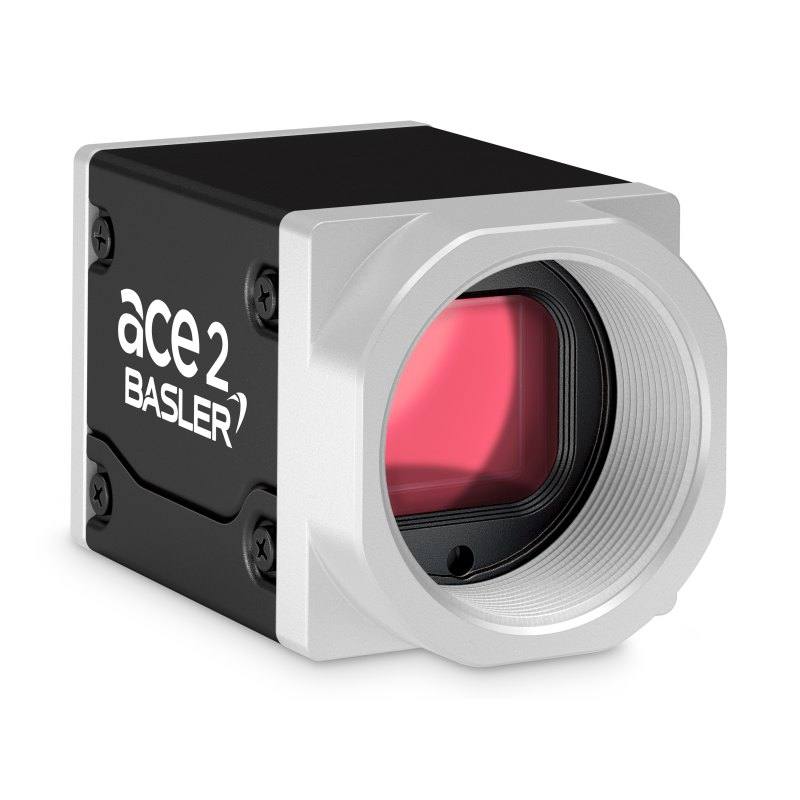
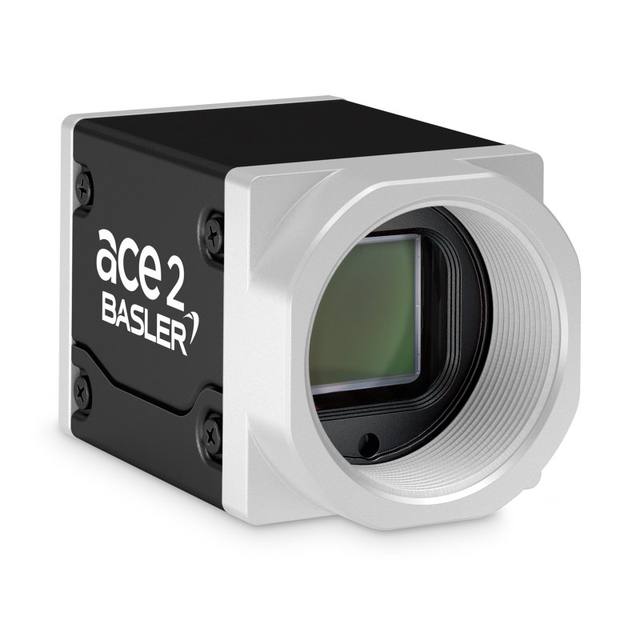
The Basler ace 2 V a2A2840-86cc is an 8.1 MP color area scan camera using the Sony IMX546 CMOS sensor with a 2840 × 2840 pixel resolution and 2.74 µm pixel size on a 2/3" format. It uses a CoaXPress 2.0 (CXP-12) interface with up to 12.5 Gbps data transfer and Power over CoaXPress, achieving 86 fps at full resolution. The camera features a global shutter, C-mount lens interface, IP30-rated compact 29 × 29 mm housing weighing 76 g, and is GenICam compliant. Bit depth options of 8, 10, and 12 bits are supported, with flexible triggering via free-run, hardware, or software modes.
The Basler ace 2 V a2A2840-86cc pairs the Sony IMX546 Pregius S CMOS sensor with an 8.1 MP, 2840 x 2840 square-array resolution on a 2/3" optical format. The 2.74 µm pixel pitch is fine enough to resolve subtle surface features or small markings without demagnifying the field of view excessively, and the sensor's global shutter captures all pixels simultaneously — critical when parts move at speed past the camera or when a strobe flash is used, since there is no image skew or rolling-shutter distortion to correct. At full 8.1 MP the camera sustains 86 fps, which means a conveyor running at several hundred millimetres per second can be imaged with only a few millimetres of inter-frame gap before a hardware trigger event; in triggered mode that figure effectively becomes the maximum trigger rate if illumination allows. The combination of high pixel count and high frame rate places this model squarely in the high-resolution, high-speed segment and makes it suitable for continuous on-the-fly inspection without sacrificing spatial detail.
The CoaXPress 2.0 (CXP-12) interface delivers up to 12.5 Gbps on a single coaxial cable and provides Power over CoaXPress (PoCXP), so the camera draws its 3.7 W supply directly from the frame-grabber connection rather than requiring a separate power run. A single coax cable therefore carries data, trigger signals, and power — reducing cabling complexity on a gantry or machine frame significantly. The camera is GenICam compliant and supports 8-, 10-, and 12-bit pixel depth, giving integrators the flexibility to run at 8-bit for maximum throughput or 12-bit for radiometric accuracy when discriminating subtle grey-level differences in colour or luminance is important for a defect classifier or a dimensional measurement workflow.
The housing measures 29 x 29 mm and weighs only 76 g, meaning it can be mounted in tight multi-camera arrays or on small robotic end-effectors without adding significant mass. The C-mount lens interface gives access to the widest range of industrial-grade optics; for the 2/3" sensor format, designers should confirm that candidate lenses cover at least a 2/3" image circle to avoid corner vignetting. IP30 protection is appropriate for controlled factory environments and clean-room areas, though it implies the camera is not intended for wash-down or heavy-dust exposure without additional enclosure work. Operating temperature spans -10 to 50 °C, comfortably covering most indoor inspection stations. Free-run, hardware-trigger, and software-trigger modes are all supported, giving installers the flexibility to synchronise acquisition to encoder signals, photoelectric sensors, or PLC outputs without additional timing hardware.
Best for
High-resolution surface defect inspection on electronics PCBs, semiconductor wafers, and battery electrodes, where 8.1 MP at 86 fps allows large panels to be covered quickly while resolving fine scratch or particle features at 2.74 µm pixel pitch.
Dimensional measurement of precision parts in automotive and semiconductor lines, particularly profiles or features that require both wide field coverage and sub-pixel accuracy — the square 2840 x 2840 array avoids anisotropic sampling artefacts when measuring in both axes.
Pharmaceutical blister-pack and label inspection at line speed, where the global shutter eliminates motion blur on fast-moving packaging and the colour output supports colour-code verification and print quality checks simultaneously.
Industrial OCR, OCV, and 2-D code reading (Data Matrix, QR) on traceability lines, where 8.1 MP provides sufficient resolution to decode small codes on large labels in a single frame without stitching.
Multi-camera robotic or gantry scanning installations where the CXP-12 single-cable architecture and 76 g compact body simplify integration and reduce cabling mass on moving axes.
Selection notes
CXP-12 requires a compatible frame-grabber card in the host PC — verify that your frame-grabber supports CoaXPress 2.0 at 12.5 Gbps and exposes PoCXP to eliminate the separate power supply; not all CXP cards support the full CXP-12 lane speed.
Lens selection must cover the 2/3" sensor format. Lenses rated for only 1/1.8" or 1/2" will vignette the corners of the 2840 x 2840 array and degrade measurement accuracy at the field edges; confirm the image-circle diameter in the lens datasheet before committing to a mount.
The 2.74 µm pixel pitch is demanding on lens resolution — choose optics with MTF performance rated at or above the Nyquist frequency of ~182 lp/mm at the sensor plane, especially for high-accuracy gauging tasks where contrast roll-off near pixel pitch will add measurement uncertainty.
IP30 protection means the camera should be housed in an additional sealed enclosure if the installation environment involves coolant mist, metal swarf, or regular wash-down cycles; in clean semiconductor or pharmaceutical environments it is typically sufficient as-is.
At 86 fps full-resolution and 12-bit depth the raw data rate approaches the CXP-12 ceiling — if ROI windowing is used to achieve higher frame rates for a specific task, confirm that the frame-grabber and host PC storage or processing pipeline can sustain the burst throughput.
Specifications: General
Brand
Basler
Camera type
Area Scan
Specifications: Sensor
Resolution
8.1 MP
Horizontal resolution
2840 px
Mono / color
Color
Sensor manufacturer
Sony Pregius S
Sensor model
Sony IMX546
Shutter
Global Shutter
Sensor size
2/3"
Pixel size
2.74 µm
Specifications: Performance
FPS
86 fps
Specifications: Interface
Interface
CoaXPress CXP-12
Protocols
GenICam, CoaXPress 2.0
Specifications: Optics
Mount
C-Mount
Specifications: Electrical
Power
pocxp
Power consumption
3.7 W
Specifications: Environment
IP rating
IP30
Operating temperature
-10 to 50 °C
Specifications: Mechanical
Dimensions
29 × 29 mm
Weight
76 g
Applications this camera is commonly selected for. Open one to see the full recommended hardware and approach.
Get a first image quickly with the pylon Viewer, then move into the pylon SDK for your application. These cameras are GenICam/GenTL-compliant, so any compliant vision software can drive them as well.
Download and install the pylon Camera Software Suite for your OS from Basler. This provides the pylon Viewer, the GenTL transport-layer producers and the pylon SDK (C/C++/.NET/Python). On Windows the installer adds the needed drivers; on Linux follow the included setup notes for USB and network permissions.
2. Connect the camera and check the link
Cable the camera to its matching interface: GigE Vision to a GigE port (use a quality cable and, ideally, a dedicated NIC with jumbo frames enabled), USB3 Vision to a USB 3.x port with the supplied cable, or CoaXPress to the frame grabber. Provide power where required (PoE, USB bus power, or PoCXP). Open the pylon Viewer and confirm the camera appears in the device list; for GigE, make sure the camera and NIC are on the same subnet.
3. Grab a first image and set exposure, gain and pixel format
Select the camera in the pylon Viewer and start a continuous grab. Adjust exposure time and gain until the image is well exposed (avoid clipped highlights), set the pixel format (e.g. Mono8 or a Bayer/RGB format), and focus the lens. Use a test pattern if the lens or scene is not ready yet.
4. Configure triggering and acquisition
Decide between free-run and triggered acquisition. For synchronized capture, set the trigger source (software or a hardware line on the I/O connector), trigger mode and any debounce or exposure mode, then verify timing. Note the parameter names you change in the Viewer feature tree, as you will reuse them in code.
5. Move to the SDK or a GenICam-compliant library
Recreate your settings in code with the pylon SDK (C, C++, .NET or Python) to open the device, apply the same features and pull frames into your pipeline; pylon vTools and pylon AI can add processing blocks. Because the cameras are GenICam/GenTL standard, third-party vision libraries work too. Once the image stream is stable, you can route frames to a deep-learning inspection such as Rosepetal for automated defect detection.
Frequently asked questions
Power over CoaXPress (PoCXP) is built into the CXP-12 connection, so a single coaxial cable carries data, trigger, and power to the camera. The camera draws 3.7 W from the frame-grabber's PoCXP output; no separate power cable is needed provided the frame-grabber supports PoCXP.
At full 8.1 MP (2840 x 2840) resolution the camera runs at 86 fps. Reducing the active ROI vertically increases the frame rate proportionally because fewer lines need to be read out per frame, subject to the maximum CXP-12 bandwidth limit of 12.5 Gbps.
Yes. Global shutter captures all pixels at the same instant, so moving parts produce no geometric distortion or skew in the image — unlike a rolling shutter, which exposes rows sequentially and bends straight edges on fast-moving objects. For any application where parts are in motion during exposure, or where a strobe flash is synchronised to the trigger, global shutter is the correct choice.
The camera uses a C-mount. The sensor is 2/3" format, so any C-mount lens with an image circle that covers 2/3" will illuminate the full sensor. Lenses marketed for smaller formats such as 1/1.8" will vignette the corners.
The camera supports 8-, 10-, and 12-bit output. Use 8-bit when maximising throughput is the priority and the inspection task relies on binary or coarse grey-level discrimination. Use 10- or 12-bit when fine radiometric gradations matter — for example, detecting subtle shading differences in a colour defect classifier, performing photometric stereo, or making measurements that depend on precise intensity values rather than edges.